3-3-3 Rule for Anxiety-The 60 Second Trick That Actually Works | QuickDawa
Imagine this for a second.
You are sitting at your desk or maybe standing in a grocery store line.
Suddenly your chest feels tight.
Your hands get sweaty.
Your mind starts racing with a hundred thoughts at once.
You feel like something bad is about to happen but you don’t even know what.
Sound familiar?
If yes, you are not alone.
Millions of people feel this way every single day.
Anxiety can hit you out of nowhere and make you feel completely out of control.
But what if I told you there is a dead simple trick that can calm your mind in about 60 seconds?
No pills, no therapy session, no special equipment needed.
It is called the 3-3-3 rule for anxiety.
And honestly, it is one of the easiest and most powerful grounding techniques out there.
I first came across this method while researching anxiety relief tips for our readers.
And I was genuinely surprised by how something so simple could work so well.
At QuickDawa, we are all about making health information easy to understand.
So let me break down exactly what the 3-3-3 rule is, how it works, and why it might just become your new best friend during anxious moments.
💡 What Is the 3-3-3 Rule for Anxiety?
The 3-3-3 rule for anxiety is a simple grounding technique.
It helps pull your mind out of anxious thoughts and brings your focus back to the present moment.
It uses your senses and your body to “reset” your brain.
There is no medicine involved.
No complicated steps.
Just three easy actions you can do anywhere, anytime.
Think of it like pressing a pause button on your racing mind.
🧠 How Does the 3-3-3 Rule Work? (Step by Step)
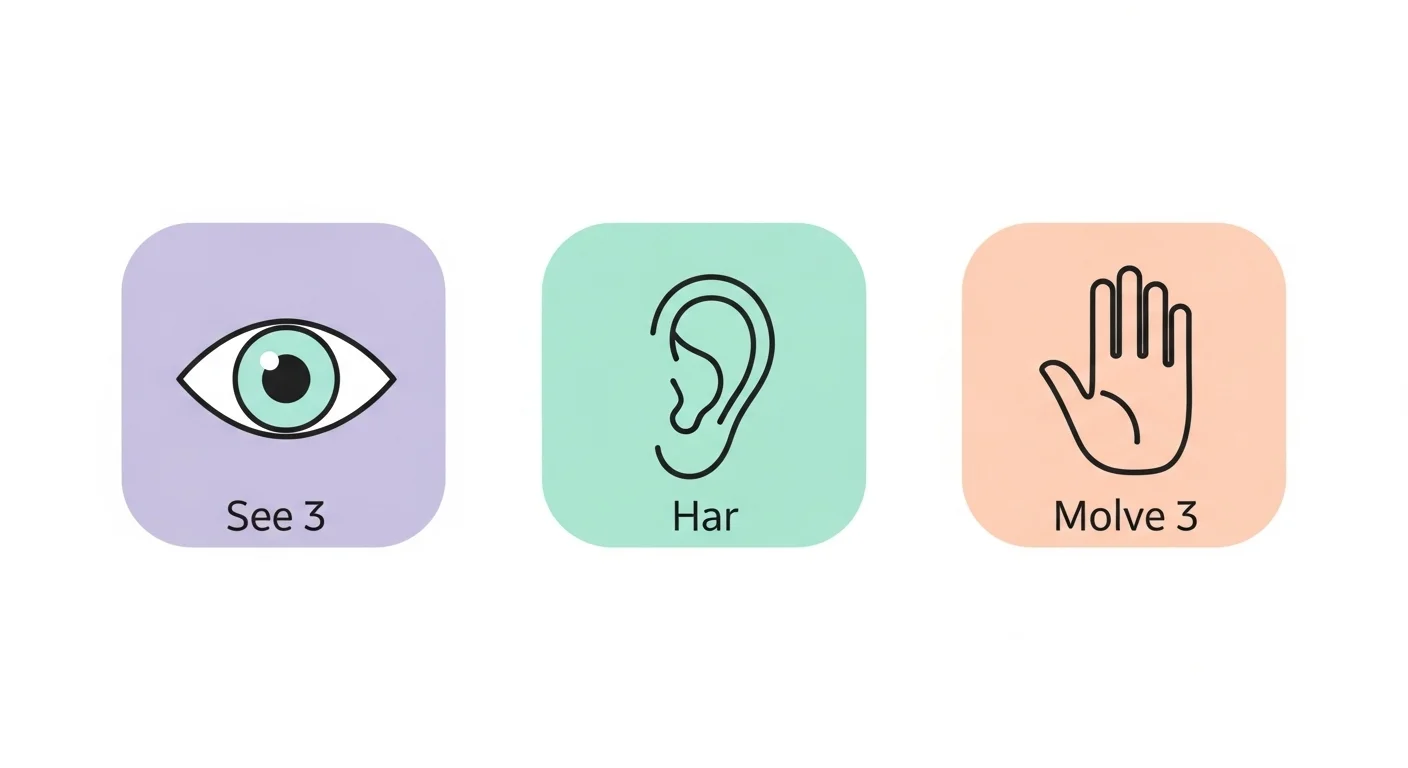
Here is exactly what you do when anxiety starts creeping in.
Step 1: Name 3 Things You Can SEE 👀
Stop whatever you are doing and look around.
Pick out three things you can see right now.
It could be anything.
- A blue pen on your desk.
- A crack on the wall.
- A bird outside the window.
Say them out loud or in your head.
This forces your brain to stop spiraling and start observing.
Step 2: Name 3 Things You Can HEAR 👂
Now close your eyes if you want and just listen.
What sounds can you hear around you?
- The hum of a fan.
- A car passing outside.
- Someone talking in the other room.
Again, name three sounds.
This shifts your focus from internal panic to external reality.
Step 3: Move 3 Parts of Your BODY 🤸
Now physically move three body parts.
- Wiggle your fingers.
- Roll your shoulders.
- Tap your feet on the floor.
This step reconnects your mind with your body.
It tells your nervous system, “Hey, you are safe. You are here. You are okay.”
That is it.
Three things you see, three things you hear, three body parts you move.
Simple, right?
But do not let the simplicity fool you.
This grounding technique for anxiety is backed by real psychology.
🔬 Why Does the 3-3-3 Rule Actually Work?
You might be wondering, how can something this basic actually help?
Great question.
Here is the science behind it in plain language.
When anxiety hits, your brain goes into “fight or flight” mode.
Your body thinks there is danger even when there is none.
Your amygdala, the fear center of your brain, takes over.
And your logical thinking brain kind of shuts down.
The 3-3-3 rule for anxiety works because it activates your thinking brain again.
When you start naming things you see and hear, your brain has to process new information.
This pulls energy away from the fear center.
It is like tricking your brain out of panic mode.
Moving your body also helps release physical tension and sends signals to your nervous system that you are not in actual danger.
Mental health experts call this a grounding technique.
It literally “grounds” you back to the present moment instead of letting your mind fly off into worst case scenarios.
🕐 When Should You Use the 3-3-3 Rule?
You can use this technique in so many situations.
Here are some common ones.
- Before a big meeting or exam when nerves kick in.
- During a panic attack to regain control.
- At night when your mind won’t stop racing.
- In social situations when you feel overwhelmed.
- At work when stress starts building up.
- In public places like malls or crowded spaces.
The beauty of this method is that nobody even has to know you are doing it.
You can practice it silently in your head while standing in line at a coffee shop.
✅ Benefits of the 3-3-3 Rule for Anxiety

Let me list out why this technique is so popular among therapists and mental health coaches.
- It is free. No cost at all.
- It takes less than a minute. You can do it in 30 to 60 seconds.
- It works anywhere. Office, home, car, school, literally anywhere.
- No side effects. Unlike medication, there is zero risk.
- Anyone can do it. Kids, adults, elderly, everyone.
- It is backed by psychology. Grounding techniques are widely recommended by therapists.
- It breaks the anxiety loop. It stops the cycle of anxious thoughts feeding more anxious thoughts.
At QuickDawa, we always encourage safe and simple solutions alongside proper medical guidance.
And this is one technique we genuinely believe everyone should know about.
🚫 What the 3-3-3 Rule Cannot Do
Let me be real with you for a moment.
The 3-3-3 rule is amazing for mild to moderate anxiety episodes.
But it is not a replacement for professional help.
If you experience any of the following, please see a doctor or mental health professional.
- Anxiety that lasts for weeks without improvement.
- Panic attacks that happen frequently.
- Trouble sleeping, eating, or functioning because of anxiety.
- Thoughts of harming yourself.
- Physical symptoms like chest pain or difficulty breathing that do not go away.
This rule is a coping tool, not a cure.
Think of it like a fire extinguisher.
It helps in the moment, but if the fire keeps coming back, you need to find the source and fix it.
🩺 When to Call a Doctor
Please reach out to a healthcare professional if anxiety is affecting your daily life.
You should call a doctor if:
- Your anxiety feels uncontrollable most days.
- You avoid normal activities because of fear or worry.
- You have physical symptoms like constant headaches, stomach issues, or heart racing.
- You are using alcohol or other substances to cope.
- You have been feeling hopeless or worthless.
There is absolutely no shame in asking for help.
Getting support from a therapist, counselor, or doctor is one of the bravest things you can do.
🙋 Frequently Asked Questions (FAQs)
Q: Is the 3-3-3 rule for anxiety safe for children?
A: Yes, it is completely safe for children. In fact, many school counselors teach it to kids because it is so easy. Learn more about anxiety in children at MedlinePlus.
Q: How long does the 3-3-3 rule take to calm anxiety?
A: Most people feel calmer within 30 to 60 seconds. It may take a few minutes if the anxiety is more intense. The key is to focus slowly and breathe while doing it.
Q: Can you use the 3-3-3 rule for panic attacks?
A: Yes, many therapists recommend grounding techniques like this during panic attacks. It helps bring your mind back to the present. However, if panic attacks are frequent, please consult a doctor. WebMD has a helpful guide on panic attacks.
Q: 3-3-3 rule vs 5-4-3-2-1 grounding technique: which is better?
A: Both are effective grounding techniques. The 5-4-3-2-1 method uses all five senses and has more steps. The 3-3-3 rule is quicker and easier to remember. You can try both and see which works better for you. Learn about grounding techniques at Cleveland Clinic.
Q: Can the 3-3-3 rule for anxiety replace medication?
A: No, it is not a replacement for prescribed medication. It is a helpful coping tool you can use alongside treatment. Always follow your doctor’s advice regarding anxiety medication. Read more about anxiety treatment at NIMH.
Q: Is the 3-3-3 rule effective for social anxiety?
A: Yes, it can be very helpful during social situations. You can quietly do it in your head without anyone noticing. It helps reduce that overwhelming “spotlight” feeling.
🏁 Final Thoughts: A Small Trick That Makes a Big Difference
Let me wrap this up with something important.
Anxiety is real, it is tough, and it can make you feel completely helpless.
But you are not helpless.
The 3-3-3 rule for anxiety is proof that sometimes the simplest tools are the most powerful ones.
Three things you see.
Three things you hear.
Three body parts you move.
That is all it takes to pull yourself back from the edge.
Will it cure anxiety forever? No.
But will it give you a moment of peace when you desperately need one? Absolutely.
Keep this technique in your back pocket like a trusted friend.
Use it whenever you need it.
And if anxiety keeps showing up uninvited, please talk to a professional who can help you find lasting solutions.
At QuickDawa, we believe that understanding your health is just as important as treating it. Knowledge is the first step toward better well being. If you found this guide helpful, share it with someone who needs it. And explore more health guides on QuickDawa.com for trusted, easy to understand information.
💬 Got a question or want to share your experience with this technique? Drop a comment below or reach out to us through our contact page. We love hearing from you!
⚠️ Medical Disclaimer
The information provided in this article is intended for educational and informational purposes only. It is not a substitute for professional medical advice, diagnosis, or treatment. Always seek the guidance of your qualified doctor, pharmacist, or healthcare provider with any questions you may have regarding a medical condition, medication, or treatment plan.
Never disregard professional medical advice or delay seeking it because of something you read on QuickDawa or any other website. If you think you may have a medical emergency, call your doctor, go to the nearest emergency room, or call emergency services immediately.
Drug information, dosages, and interactions described in this post are provided for general awareness only and may not apply to your individual health situation. Medications affect people differently based on age, weight, health conditions, and other factors.
QuickDawa and its authors do not assume any liability for any consequences arising from the use or misuse of information presented on this website.