Children’s Ibuprofen Dosage Chart – Safe Doses by Weight & Age (2026 Guide)
It’s the middle of the night.
Your child is burning up with a fever.
They’re cranky, uncomfortable, and clinging to you.
You grab the bottle of children’s ibuprofen from the medicine cabinet.
And then you freeze.
“How much do I give them? Is this the right one? Did they outgrow this dose?”
Sound familiar?
You’re not alone.
This exact moment happens in millions of homes every single week.
Getting the right dose of ibuprofen for your child isn’t just important — it’s critical.
Too little won’t help bring down the fever.
Too much can be dangerous.
And to make things even more confusing, there are different concentrations of children’s ibuprofen.
Infant drops are NOT the same strength as children’s suspension.
Mixing them up is a real risk.
That’s exactly why I put together this complete children’s ibuprofen dosage chart — so you can feel confident and calm the next time your child needs relief.
At QuickDawa, we’re all about making medicine easy to understand — so let’s break down everything you need to know about children’s ibuprofen in simple, clear language.
💊 What Is Children’s Ibuprofen?

Ibuprofen is a nonsteroidal anti-inflammatory drug — or NSAID for short.
Don’t let that long name scare you.
It simply means it reduces pain, fever, and swelling without using steroids.
You probably know it by its brand names — Advil and Motrin.
Both brands make versions specifically designed for babies and children.
Children’s ibuprofen comes in liquid form so little ones can swallow it easily.
It’s one of the most commonly used over-the-counter medicines for kids.
Doctors recommend it for fevers, teething pain, earaches, sore throats, and minor injuries.
It’s been used safely in children for decades — when dosed correctly.
And that’s the key part — getting the dose right.
🚨 Infant Drops vs. Children’s Suspension — The Critical Difference
This is the single most important thing in this entire article.
Please read this section carefully.
There are two types of liquid ibuprofen for kids:
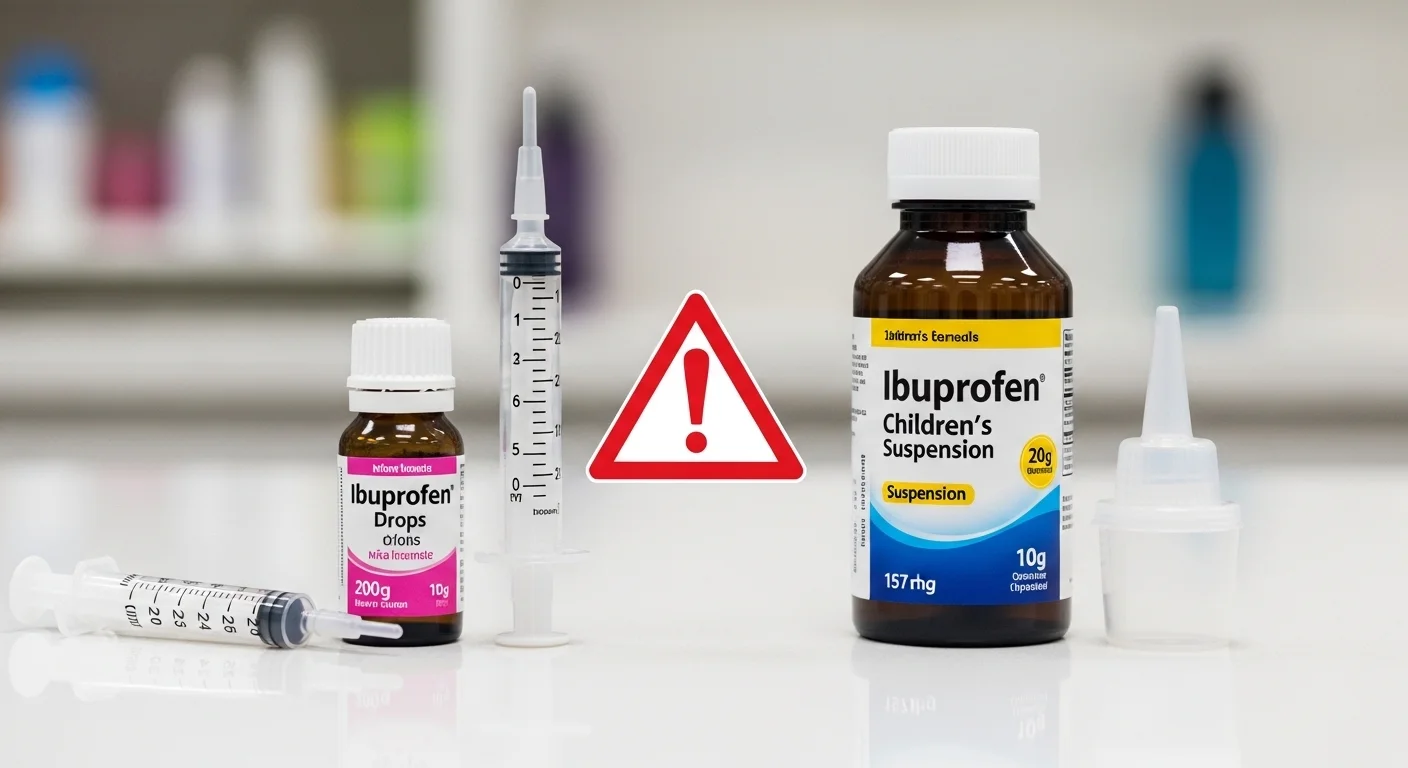
1. Infant Concentrated Drops (50 mg per 1.25 mL)
These are designed for babies aged 6 to 23 months.
They come with a small syringe or dropper.
The liquid is more concentrated — meaning there’s more medicine packed into a smaller amount.
This makes sense because babies can only swallow tiny amounts.
2. Children’s Suspension / Liquid (100 mg per 5 mL)
This is for kids aged 2 to 11 years.
It comes with a dosing cup or oral syringe.
The liquid is less concentrated — meaning you need to give a larger volume for the same dose.
⚠️ Why This Matters So Much
Here’s where the danger lies.
If you accidentally use the infant drops dosing with the children’s suspension bottle — your child gets LESS medicine than they need.
If you accidentally use the children’s suspension dosing with the infant drops bottle — your child gets WAY MORE medicine than they should.
This can lead to a serious overdose.
Always — and I mean ALWAYS — check which product you’re using before measuring a dose.
Look at the label.
Read the concentration.
Use the measuring device that came with that specific bottle.
Never swap droppers or cups between products.
💡 Quick Tip: In 2019, most manufacturers in the U.S. standardized infant ibuprofen drops to match the children’s concentration (100 mg per 5 mL). But some older or generic products may still use the old concentrated formula. Always check your specific bottle.
📊 Children’s Ibuprofen Dosage Chart by Weight (Primary Chart)
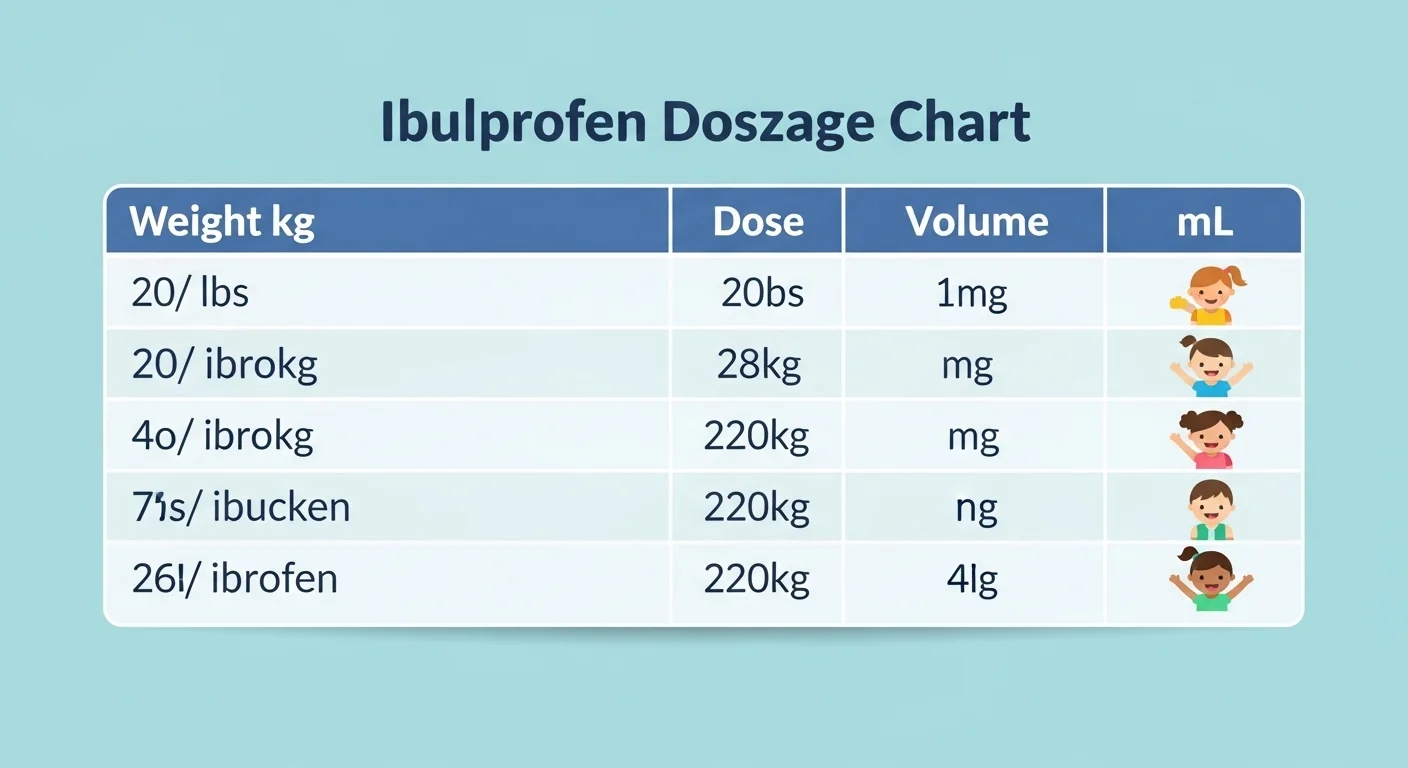
Weight is the most accurate way to dose ibuprofen for children.
Age is a backup — but weight comes first.
If you know your child’s weight, use this chart.
The standard dose is 5–10 mg per kg of body weight, given every 6 to 8 hours.
Most doctors recommend 10 mg/kg for fever and moderate pain.
📋 Dosage Chart — Children’s Ibuprofen Suspension (100 mg per 5 mL)
- 12–17 lbs (5.5–7.7 kg)
- Single Dose: 50 mg
- Volume to Give: 2.5 mL
- Frequency: Every 6–8 hours (max 4 doses per day)
- 18–23 lbs (8.2–10.4 kg)
- Single Dose: 75 mg
- Volume to Give: 3.75 mL
- Frequency: Every 6–8 hours (max 4 doses per day)
- 24–35 lbs (10.9–15.9 kg)
- Single Dose: 100 mg
- Volume to Give: 5 mL
- Frequency: Every 6–8 hours (max 4 doses per day)
- 36–47 lbs (16.4–21.4 kg)
- Single Dose: 150 mg
- Volume to Give: 7.5 mL
- Frequency: Every 6–8 hours (max 4 doses per day)
- 48–59 lbs (21.8–26.8 kg)
- Single Dose: 200 mg
- Volume to Give: 10 mL
- Frequency: Every 6–8 hours (max 4 doses per day)
- 60–71 lbs (27.3–32.3 kg)
- Single Dose: 250 mg
- Volume to Give: 12.5 mL
- Frequency: Every 6–8 hours (max 4 doses per day)
- 72–95 lbs (32.7–43.2 kg)
- Single Dose: 300 mg
- Volume to Give: 15 mL
- Frequency: Every 6–8 hours (max 4 doses per day)
⚠️ Remember: Always use the measuring syringe or cup that came with the bottle. Never use a kitchen spoon. And weight-based dosing is always more accurate than age-based dosing.
📋 Dosage Chart — Infant Ibuprofen Drops (50 mg per 1.25 mL) — If Using Old Concentrated Formula
- 12–17 lbs (5.5–7.7 kg)
- Single Dose: 50 mg
- Volume to Give: 1.25 mL
- Frequency: Every 6–8 hours (max 4 doses per day)
- 18–23 lbs (8.2–10.4 kg)
- Single Dose: 75 mg
- Volume to Give: 1.875 mL
- Frequency: Every 6–8 hours (max 4 doses per day)
⚠️ Important: If your infant drops bottle says 100 mg per 5 mL (the newer standardized version), use the Children’s Suspension chart above instead — just give a smaller volume as listed.
⚠️ This dosage information is for general awareness only. Always follow your doctor’s prescription or the instructions on your medicine packaging.
📅 Age-Based Dosing Guidelines (6 Months and Up)
Sometimes you might not know your child’s exact weight.
In that case, you can use age as a rough guide.
But remember — weight-based dosing is always more accurate.
📋 Children’s Ibuprofen Suspension (100 mg per 5 mL) — By Age
- 6–11 months
- Typical Weight: 12–17 lbs (5.5–7.7 kg)
- Suggested Dose: 50 mg
- Volume to Give: 2.5 mL
- 12–23 months
- Typical Weight: 18–23 lbs (8.2–10.4 kg)
- Suggested Dose: 75 mg
- Volume to Give: 3.75 mL
- 2–3 years
- Typical Weight: 24–35 lbs (10.9–15.9 kg)
- Suggested Dose: 100 mg
- Volume to Give: 5 mL
- 4–5 years
- Typical Weight: 36–47 lbs (16.4–21.4 kg)
- Suggested Dose: 150 mg
- Volume to Give: 7.5 mL
- 6–8 years
- Typical Weight: 48–59 lbs (21.8–26.8 kg)
- Suggested Dose: 200 mg
- Volume to Give: 10 mL
- 9–10 years
- Typical Weight: 60–71 lbs (27.3–32.3 kg)
- Suggested Dose: 250 mg
- Volume to Give: 12.5 mL
- 11 years
- Typical Weight: 72–95 lbs (32.7–43.2 kg)
- Suggested Dose: 300 mg
- Volume to Give: 15 mL
⚠️ Remember: Age-based dosing is only a rough guide. Weight-based dosing is always more accurate and safer. If you know your child’s weight, always use the weight-based chart instead.
Key Rules to Remember:
- Never give ibuprofen to babies under 6 months old.
- Wait at least 6 hours between doses.
- Don’t give more than 4 doses in 24 hours.
- Don’t use for more than 10 days without talking to your doctor.
- For fever specifically, don’t use for more than 3 days unless your doctor says so.
✅ Uses of Children’s Ibuprofen
So what exactly can children’s ibuprofen help with?
Quite a lot, actually.
Fever Reduction
This is the #1 reason parents reach for children’s ibuprofen.
When your child’s body is fighting an infection, their temperature goes up.
Ibuprofen brings it down by working on the part of the brain that controls body temperature.
It usually starts working within 30 to 60 minutes.
And the fever relief lasts about 6 to 8 hours — longer than acetaminophen (Tylenol).
Pain Relief
Kids feel pain too — even though they can’t always explain it well.
Ibuprofen works great for:
- Teething pain (for babies 6 months and older)
- Earaches
- Sore throats
- Headaches
- Toothaches
- Minor injuries (bumps, bruises, sprains)
- Post-vaccination soreness
Reducing Inflammation
Here’s where ibuprofen has a superpower that acetaminophen doesn’t.
It actually reduces swelling and inflammation.
Think of it like this — if your child falls and their ankle swells up, ibuprofen doesn’t just block the pain signal.
It also tells the body to calm down the swelling itself.
That’s why doctors often prefer it for sports injuries, sprains, and anything involving inflammation.
How It Works in the Body
Ibuprofen blocks certain chemicals in the body called prostaglandins.
These chemicals cause pain, fever, and inflammation.
By blocking them, ibuprofen tackles all three problems at once.
Think of prostaglandins as little alarm bells ringing in the body.
Ibuprofen turns those alarms down so your child feels better.
⚠️ Side Effects of Children’s Ibuprofen
Like all medicines, ibuprofen can cause side effects.
But here’s the truth — most kids tolerate it very well.
Especially when it’s given at the right dose and with food.
Common Side Effects (May happen occasionally):
- Upset stomach or tummy ache — the most common one
- Nausea — your child might feel a bit queasy
- Vomiting — rare but possible, especially on an empty stomach
- Diarrhea — mild and usually goes away
- Dizziness — uncommon but can happen
Less Common Side Effects:
- Mild headache
- Rash or skin irritation
- Constipation
- Gas or bloating
Rare but Serious Side Effects (Seek Medical Help Immediately):
- Bloody or black stools — could signal stomach bleeding
- Vomiting blood or vomit that looks like coffee grounds
- Severe allergic reaction — hives, facial swelling, difficulty breathing
- Signs of kidney problems — decreased urination, swelling in legs
- Severe stomach pain that doesn’t go away
- Unusual bruising or bleeding
💙 Side effects don’t happen to everyone. Many children use ibuprofen with no issues at all. But it’s important to be aware so you know what to watch for.
Pro tip: Always give ibuprofen with food or milk to reduce the chance of stomach upset.
🚨 Warnings & Precautions

This section is super important.
Please take a minute to read through it — especially if your child has any health conditions.
Who Should NOT Take Children’s Ibuprofen:
- Babies under 6 months of age
- Children who have had an allergic reaction to ibuprofen, aspirin, or any other NSAID
- Children with active stomach ulcers or gastrointestinal bleeding
- Children with severe kidney or liver disease
- Children who are dehydrated — this is a big one that many parents don’t know about
⚠️ Dehydration Warning — VERY IMPORTANT
Never give ibuprofen to a child who is dehydrated.
If your child has been vomiting a lot, has diarrhea, or hasn’t been drinking fluids — skip the ibuprofen.
Here’s why: Ibuprofen can affect blood flow to the kidneys.
When a child is dehydrated, their kidneys are already under stress.
Adding ibuprofen on top of that can cause kidney damage.
In this situation, acetaminophen (Tylenol) is the safer choice for fever.
Or better yet — call your doctor first.
Pregnancy & Breastfeeding:
This is a children’s medicine guide, but just in case — ibuprofen should be avoided in the third trimester of pregnancy. It can cause serious heart problems in the developing baby. Breastfeeding mothers should consult their doctor before use.
Chickenpox Warning:
Some doctors recommend avoiding ibuprofen during chickenpox because it may increase the risk of a serious skin infection. Use acetaminophen instead, or ask your pediatrician.
Asthma Caution:
Some children with asthma may be sensitive to ibuprofen.
It can trigger wheezing or breathing problems in a small number of asthma patients.
If your child has asthma, talk to your doctor before giving ibuprofen.
Allergic Reactions:
If your child has ever had hives, facial swelling, or breathing problems after taking aspirin or any pain reliever — do NOT give ibuprofen.
This is called NSAID hypersensitivity and it can be life-threatening.
⚫ FDA Warning:
NSAIDs like ibuprofen can increase the risk of serious cardiovascular events and gastrointestinal bleeding. This risk is generally lower in children with short-term use at recommended doses, but it’s still important to use the lowest effective dose for the shortest time needed.
🔴 Why You Should NEVER Give Ibuprofen to Babies Under 6 Months
This is non-negotiable.
Do not give ibuprofen to any baby younger than 6 months old.
Here’s why:
1. Their Kidneys Aren’t Ready
A baby’s kidneys are still developing in the first 6 months of life.
Ibuprofen is processed through the kidneys.
Immature kidneys can’t handle it safely.
This can lead to kidney damage or even kidney failure in very young infants.
2. Limited Safety Data
There simply isn’t enough research proving ibuprofen is safe for babies under 6 months.
The FDA has not approved it for this age group.
And no responsible doctor would recommend it.
3. Higher Risk of Side Effects
Young babies are more vulnerable to side effects like stomach bleeding and kidney problems.
Their tiny bodies process medicines differently than older children.
What to Use Instead?
For babies under 6 months, infant acetaminophen (Tylenol) is the recommended option for fever and pain.
It can be used in babies as young as 2 months old (or even younger under direct doctor guidance).
But honestly?
If your newborn or very young baby has a fever — call your pediatrician right away.
A fever in a baby under 3 months old is always considered serious and needs medical evaluation.
💡 Tips for Giving Liquid Medicine to Kids
Let’s be real — giving medicine to kids can be a battle.
Some kids spit it out.
Others clamp their mouths shut.
And a few will scream like you’re asking them to eat broccoli-flavored ice cream.
Here are some tried-and-true tips that actually work:
1. Always Use the Measuring Device That Comes With the Medicine
Kitchen spoons are NOT accurate.
A regular teaspoon from your kitchen drawer could be off by 50% or more.
Use the oral syringe, dosing cup, or dropper that came in the box.
If you lost it, ask your pharmacist for a replacement.
2. Aim for the Inside Cheek
Don’t squirt the medicine straight to the back of the throat.
That causes gagging.
Instead, place the syringe tip inside the cheek and slowly push the medicine in.
Give small amounts at a time so they can swallow comfortably.
3. Give It With Food or Milk
Ibuprofen works best when given with a little food or milk.
It reduces stomach upset AND makes it easier to get down.
A few crackers, a piece of toast, or a small cup of milk works perfectly.
4. Don’t Mix It Into a Full Bottle or Cup
If you mix medicine into a whole bottle of milk or juice and your child doesn’t finish it — they didn’t get the full dose.
If you must mix it, use a very small amount of liquid (like 1–2 oz) so they drink all of it.
5. Try Chilling It
Cold liquid can mask the taste.
Try storing the bottle in the refrigerator (check the label first to make sure this is okay).
6. Praise and Reward
After they take it, give them lots of praise.
A sticker, a hug, or even just a cheerful “Great job!” can make the next time easier.
7. Never Call Medicine “Candy”
I know it’s tempting — but this is dangerous.
If your child thinks medicine is candy, they might try to drink the whole bottle when you’re not looking.
Always explain that it’s medicine that helps them feel better, and that they should only take it when a grown-up gives it to them.
🔄 Drug Interactions
Ibuprofen can interact with other medicines your child might be taking.
Here are the most important ones to know about:
- Aspirin
- Type: Major Interaction
- What Happens: Increases risk of stomach bleeding. Ibuprofen may also reduce aspirin’s heart-protective effects.
- Other NSAIDs (naproxen, etc.)
- Type: Major Interaction
- What Happens: Using two NSAIDs together doubles the risk of stomach ulcers and bleeding.
- Acetaminophen (Tylenol)
- Type: Generally Safe
- What Happens: Can be alternated with ibuprofen for fever — but don’t give both at the exact same time without doctor guidance.
- Blood Thinners (warfarin)
- Type: Major Interaction
- What Happens: Significantly increases bleeding risk.
- Steroids (prednisone)
- Type: Moderate Interaction
- What Happens: Higher chance of stomach ulcers when combined.
- Certain Blood Pressure Medicines
- Type: Moderate Interaction
- What Happens: Ibuprofen may reduce the effectiveness of blood pressure medications.
- Lithium
- Type: Moderate Interaction
- What Happens: Ibuprofen can increase lithium levels in the blood to toxic ranges.
- Methotrexate
- Type: Major Interaction
- What Happens: Ibuprofen can increase methotrexate levels, leading to serious toxicity.
💊 Always tell your doctor or pharmacist about every medicine, supplement, or herbal product your child is currently taking before starting ibuprofen.
Can You Alternate Ibuprofen and Tylenol?
Yes — many pediatricians recommend alternating ibuprofen and acetaminophen for stubborn fevers.
For example: give ibuprofen, then 3 hours later give acetaminophen, then 3 hours later give ibuprofen again.
But — only do this if your doctor specifically recommends it.
It’s easy to accidentally overdose when juggling two medicines.
Write down the time and dose of each medicine you give to keep track.
💊 Always tell your doctor or pharmacist about every medicine, supplement, or herbal product your child is currently taking before starting ibuprofen.
💉 Overdose / Missed Dose
Overdose — What to Watch For
An ibuprofen overdose in a child is a medical emergency.
Signs and symptoms include:
- Nausea and vomiting
- Severe stomach pain
- Drowsiness or lethargy
- Headache
- Blurred vision
- Seizures (in severe cases)
- Difficulty breathing
- Blood in vomit or stool
What to Do If You Suspect an Overdose:
- Stay calm — panicking doesn’t help your child.
- Call Poison Control immediately: 1-800-222-1222 (in the U.S.)
- Or call 911 / your local emergency number.
- Tell them your child’s age, weight, how much ibuprofen they took, and when.
- Do NOT make your child vomit unless Poison Control tells you to.
- Do NOT wait for symptoms to appear — call right away.
Keep the medicine bottle handy so you can read the label to the medical team.
Missed Dose
If you forget a dose, here’s what to do:
- Give it as soon as you remember — unless it’s almost time for the next dose.
- If it’s close to the next scheduled dose, skip the missed one.
- Never double up to make up for a missed dose.
- Continue the regular dosing schedule.
Since ibuprofen is usually given “as needed” for pain or fever (not on a strict schedule), missed doses are less of a concern.
If the fever is gone and your child feels fine, you don’t need to keep giving it on a schedule.
📊 General Dosage Overview
Here’s a quick summary of ibuprofen dosing:
- Children (6 months – 12 years): 5–10 mg/kg per dose, every 6–8 hours. Maximum 40 mg/kg/day.
- Children over 12 / Adults: 200–400 mg per dose, every 4–6 hours. Maximum 1,200 mg/day (OTC) or 3,200 mg/day (prescription).
- Elderly: Lower doses recommended due to increased risk of side effects.
- Maximum daily dose for children: Do not exceed 4 doses in 24 hours.
Available Forms:
- Infant drops (liquid with dropper/syringe)
- Children’s suspension (liquid with dosing cup)
- Chewable tablets (for older kids who can chew)
- Junior strength tablets (for kids 6–11 years old — typically 100 mg each)
- Regular tablets/capsules (for teens and adults — 200 mg)
⚠️ This dosage information is for general awareness only. Always follow your doctor’s prescription or the instructions on your medicine packaging.
At QuickDawa, we always recommend double-checking the label and using weight-based dosing whenever possible.
🩺 When to Call the Doctor
Ibuprofen is great for common fevers and minor pain.
But sometimes your child needs more than over-the-counter medicine.
Call your pediatrician or go to the ER if:
- Your baby is under 3 months old and has ANY fever (100.4°F / 38°C or higher)
- Your child’s fever is 104°F (40°C) or higher
- The fever lasts more than 3 days despite treatment
- Your child seems unusually drowsy, confused, or unresponsive
- They have a stiff neck or a rash that doesn’t fade when pressed
- Your child is not drinking fluids and shows signs of dehydration
- They have difficulty breathing
- You see blood in their stool or vomit after taking ibuprofen
- Your child develops a rash or swelling after taking ibuprofen
- The pain is severe and not improving with ibuprofen
- You gave ibuprofen but the fever keeps coming back quickly
- Your child had a febrile seizure (convulsion caused by fever)
Trust your gut.
You know your child better than anyone.
If something feels off — even if you can’t quite explain it — call the doctor.
It’s always better to be safe.
🙋 FAQs – Children’s Ibuprofen Dosage Chart
Q: Can you give children’s ibuprofen and Tylenol together?
A: You can alternate them (not give both at the exact same time) — but only if your pediatrician recommends it. Alternating every 3 hours is a common approach for stubborn fevers.
Q: How long does children’s ibuprofen take to work?
A: It usually starts reducing fever and pain within 30 to 60 minutes. Full effects are typically felt within 1–2 hours, and relief lasts 6–8 hours.
Q: Is children’s ibuprofen safe for a 6-month-old baby?
A: Yes, ibuprofen is approved for babies 6 months and older. Always dose by weight, not just age. Never give it to babies younger than 6 months.
Q: Children’s Advil vs. children’s Motrin — is there a difference?
A: No real difference. Both contain the same active ingredient — ibuprofen — at the same concentration. They’re made by different manufacturers, but they work exactly the same way. Choose whichever is available or affordable.
Q: Can I give children’s ibuprofen for a toothache?
A: Yes! Ibuprofen is actually one of the best over-the-counter options for toothache pain in children because it reduces both pain and swelling around the tooth. Give the appropriate dose based on your child’s weight and see a dentist as soon as possible.
🌐 Sources & External References
- FDA Drug Label — Ibuprofen — Official FDA Information
- MedlinePlus — Ibuprofen — U.S. National Library of Medicine
- Drugs.com — Ibuprofen Dosage Guide — Complete Dosing Information
- WebMD — Children’s Ibuprofen Oral — Overview and Side Effects
- Mayo Clinic — Ibuprofen (Oral Route) — Proper Use & Precautions
- HealthyChildren.org — Ibuprofen Dosage Table — American Academy of Pediatrics
🏁 Conclusion — You’ve Got This, Parent

Giving your child the right dose of ibuprofen doesn’t have to be stressful.
Now you know the key facts:
- Always dose by weight first — it’s the most accurate method.
- Know which product you’re using — infant drops and children’s suspension may have different concentrations.
- Never give ibuprofen to babies under 6 months.
- Give it with food to protect their tummy.
- Don’t exceed 4 doses in 24 hours.
- When in doubt, call your pediatrician.
You’re already an amazing parent for taking the time to look this up.
The fact that you want to get it right shows how much you care.
Keep this children’s ibuprofen dosage chart bookmarked for those middle-of-the-night moments.
At QuickDawa, we believe that understanding your medicine is just as important as taking it. Knowledge is the first step toward better health. If you found this guide helpful, share it with someone who needs it — and explore more medicine guides on QuickDawa.com for trusted, easy-to-understand health information.
💬 Have a question? Drop it in the comments below, or reach out through our contact page. We’d love to hear from you!
⚠️ Medical Disclaimer
The information provided in this article is intended for educational and informational purposes only. It is not a substitute for professional medical advice, diagnosis, or treatment. Always seek the guidance of your qualified doctor, pharmacist, or healthcare provider with any questions you may have regarding a medical condition, medication, or treatment plan.
Never disregard professional medical advice or delay seeking it because of something you read on QuickDawa.com or any other website. If you think you may have a medical emergency, call your doctor, go to the nearest emergency room, or call emergency services immediately.
Drug information, dosages, and interactions described in this post are provided for general awareness only and may not apply to your individual health situation. Medications affect people differently based on age, weight, health conditions, and other factors.
QuickDawa.com and its authors do not assume any liability for any consequences arising from the use or misuse of information presented on this website.