Prescription Ibuprofen 800 mg – Why Doctors Prescribe This Instead of OTC | QuickDawa
We have all been there.
You twist your back lifting something heavy.
Or maybe your arthritis flares up and your joints feel like they are on fire.
You reach for a regular ibuprofen tablet from the drugstore.
You take two. Maybe three. Maybe even four at once.
And you wonder if that is even safe.
Here is the truth. Prescription ibuprofen 800 mg exists for exactly these situations.
When regular over-the-counter ibuprofen just does not cut it, doctors step in with the big guns.
But wait. Is taking four 200 mg OTC tablets the same as one 800 mg prescription tablet?
Is the prescription version actually different?
And why do you even need a doctor’s note for ibuprofen in the first place?
These are all great questions.
And honestly, most people get confused about this stuff.
You are not alone.
At QuickDawa, we are all about making medicine easy to understand.
So let’s break down everything you need to know about prescription ibuprofen 800 mg in simple, clear language.
No medical school required. Just honest answers.
💊 What Is Prescription Ibuprofen 800 mg?
Prescription ibuprofen 800 mg is a high-dose non-steroidal anti-inflammatory drug (NSAID).
It belongs to the same drug family as over-the-counter Advil and Motrin.
But this version is stronger and requires a doctor’s prescription.
It is manufactured by several companies, and common brand names include Motrin (prescription strength) and various generic versions.
Doctors prescribe it for moderate to severe pain, arthritis, menstrual cramps, dental pain, and inflammatory conditions.
Think of it as the stronger, supervised version of the ibuprofen you already know.
🔍 Prescription Ibuprofen 800 mg vs OTC Ibuprofen: What Is the Real Difference?
This is the question everybody asks.
And it is a really important one.
Let me break it down simply.
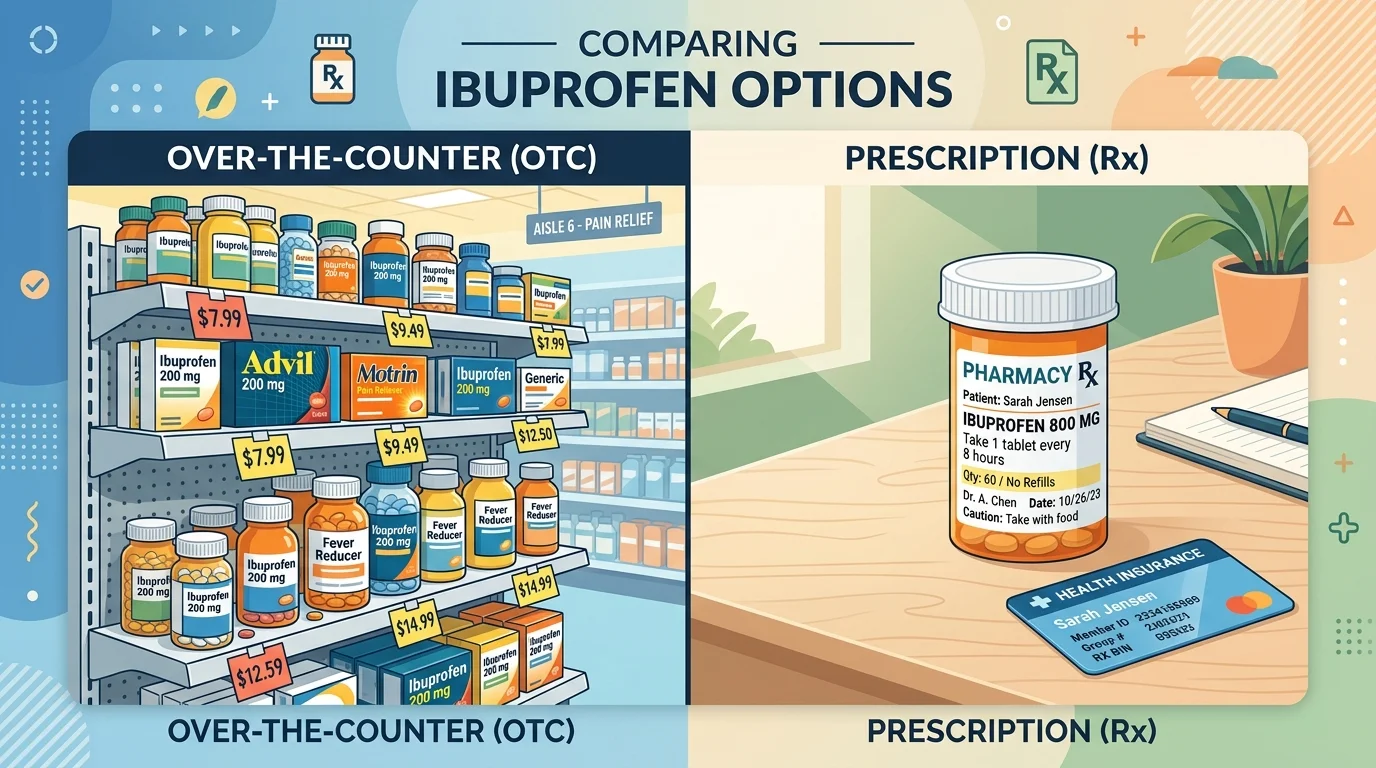
Over-the-counter (OTC) ibuprofen comes in 200 mg tablets.
You can buy it at any pharmacy without a prescription.
The maximum recommended OTC dose is usually 400 mg per dose (two tablets) and 1,200 mg per day for self-treatment.
Prescription ibuprofen 800 mg is a single tablet with four times the strength of one OTC tablet.
Your doctor may prescribe up to 800 mg three times daily, which totals 2,400 mg per day.
That is double the recommended daily OTC limit.
Here is a quick comparison:
- OTC Ibuprofen: 200 mg per tablet, max 1,200 mg/day for self-care
- Prescription Ibuprofen 800 mg: 800 mg per tablet, max 3,200 mg/day under doctor supervision
- Active Ingredient: Exactly the same in both versions
- Doctor Supervision: Not required for OTC, absolutely required for prescription strength
- Insurance Coverage: OTC is paid out of pocket, prescription may be covered by insurance
So yes, the active ingredient is identical.
But the dosage is much higher with the prescription version.
And that higher dose needs doctor supervision for a very good reason.
💰 The Cost Difference: Is Prescription Ibuprofen 800 mg Cheaper?
Here is something most people do not realize.
Prescription ibuprofen 800 mg can actually be cheaper than buying OTC ibuprofen.
Wait, what? Let me explain.
If you have health insurance, your prescription ibuprofen might be covered under your plan.
Your copay could be as low as $1 to $10 for a month’s supply.
Now compare that to buying bottles of OTC ibuprofen every week.
Those 200 mg tablets add up fast when you are taking 4 of them multiple times a day.
Over a month, you could easily spend $15 to $30 or more on OTC tablets.
So here is the surprise.
With insurance, the prescription version is often cheaper than the OTC version.
Even without insurance, generic prescription ibuprofen 800 mg is very affordable.
Most pharmacies charge around $4 to $15 for a generic prescription.
Talk to your doctor about this if cost is a concern for you.
It might save you real money.
⚠️ Why You Need Doctor Supervision for Ibuprofen 800 mg
Let me be very clear about this.
High-dose ibuprofen is not something you should take on your own.
Here is why.
At 800 mg per dose, the risk of side effects goes up significantly.
Your stomach lining takes a bigger hit.
Your kidneys work harder to process the drug.
Your blood pressure can be affected.
And the risk of heart problems increases with long-term high-dose use.
That is exactly why doctor supervision for ibuprofen at this dose is not optional.
Your doctor needs to:
- Check if you have any conditions that make high-dose ibuprofen risky
- Monitor your kidney function with blood tests
- Watch for signs of stomach bleeding
- Make sure it does not interact with your other medications
- Set a safe duration for treatment
This is not about being overly cautious.
This is about keeping you safe while getting you the pain relief you need.
Never take 4 OTC ibuprofen tablets to match an 800 mg dose without talking to your doctor first.
Even though the math works out, the safety check does not.
📋 Common Uses of Prescription Ibuprofen 800 mg
Doctors prescribe this medication for a wide range of conditions.
Here are the most common ones:
- Osteoarthritis: Joint pain and stiffness from wear-and-tear arthritis
- Rheumatoid arthritis: Inflammatory arthritis that attacks your joints
- Severe menstrual cramps (dysmenorrhea): When regular painkillers are not enough
- Dental pain: After extractions or dental procedures
- Post-surgical pain: Mild to moderate pain after minor surgeries
- Muscle injuries: Sprains, strains, and sports injuries
- Back pain: Acute episodes of lower back pain
- Gout flare-ups: Painful swelling in joints caused by uric acid crystals
Your doctor will decide if ibuprofen 800 mg is the right choice based on your specific situation.
It is not meant for long-term daily use unless your doctor says otherwise.
💡 How to Take Prescription Ibuprofen 800 mg Safely
Taking this medication correctly makes a huge difference.
Here are the golden rules:
- Always take it with food or milk. This protects your stomach lining.
- Swallow the tablet whole. Do not crush, chew, or break it unless your doctor says so.
- Take it with a full glass of water. This helps it absorb properly.
- Do not lie down for at least 10 minutes after taking it.
- Stick to the exact dose your doctor prescribed. More is not better.
- Do not combine it with other NSAIDs like naproxen or aspirin without asking your doctor.
- Take it for the shortest time possible to get relief.
If you miss a dose, take it as soon as you remember.
But if it is almost time for your next dose, just skip the missed one.
Never double up.
🚨 Side Effects of Ibuprofen 800 mg You Should Know About

Every medication comes with potential side effects.
At higher doses like 800 mg, these risks go up.
Common side effects include:
- Stomach pain or upset
- Nausea or vomiting
- Dizziness or headache
- Bloating or gas
- Diarrhea or constipation
Serious side effects (call your doctor immediately):
- Black, tarry, or bloody stools
- Vomiting blood or material that looks like coffee grounds
- Sudden weight gain or swelling in your legs
- Chest pain or shortness of breath
- Severe stomach pain that does not go away
- Signs of kidney problems like changes in urine amount
- Skin rash, blisters, or peeling skin
- Yellowing of skin or eyes (jaundice)
These serious side effects are rare but real.
This is exactly why your doctor monitors you while you take this medication.
At QuickDawa, we always say the same thing.
Know your medicine. Know what to watch for. And never ignore warning signs.
🚫 Who Should NOT Take Prescription Ibuprofen 800 mg?
This medication is not safe for everyone.
You should avoid ibuprofen 800 mg if you:
- Have had a stomach ulcer or gastrointestinal bleeding
- Are allergic to ibuprofen, aspirin, or any other NSAID
- Have severe kidney or liver disease
- Are in the third trimester of pregnancy
- Have recently had or are about to have heart bypass surgery (CABG)
- Have a history of asthma attacks triggered by NSAIDs
People who need extra caution include:
- Older adults (higher risk of stomach bleeding)
- People with high blood pressure
- People with heart disease or stroke history
- Those taking blood thinners like warfarin
- People with diabetes
Always share your full medical history with your doctor before starting this medication.
🤔 Can You Just Take 4 OTC Ibuprofen Instead?
This is probably the most common question I get about this topic.
And the answer is… technically, the active ingredient is the same.
Four 200 mg OTC tablets give you 800 mg of ibuprofen.
But here is why that is a bad idea without your doctor’s approval.
First, OTC ibuprofen is labeled for short-term, self-care use at lower doses.
Taking 800 mg on your own goes against the label instructions.
Second, you are missing the safety net of doctor supervision.
Nobody is checking your kidneys. Nobody is monitoring your stomach.
Third, the fillers and coatings in OTC tablets may differ from prescription tablets.
Prescription versions are often formulated for higher-dose tolerability.
Fourth, if you need 800 mg regularly, that signals a pain level that deserves medical evaluation.
Your pain might need a different treatment entirely.
So the short answer? Do not self-prescribe 800 mg doses by stacking OTC tablets.
Get a prescription. Let your doctor guide you. That is the safe way.
🩺 When to Call Your Doctor
You should contact your doctor right away if you experience:
- Severe stomach pain, nausea, or vomiting while taking this medication
- Black or bloody stools
- Sudden chest pain or difficulty breathing
- Swelling in your face, lips, tongue, or throat
- Unusual bruising or bleeding
- Signs of an allergic reaction like hives or rash
- No improvement in your pain after several days
- Dizziness or fainting spells
If you suspect a medical emergency, call 911 or go to your nearest emergency room immediately.
Do not wait to see if it gets better on its own.
🙋 Frequently Asked Questions (FAQ)
Q: Can you take prescription ibuprofen 800 mg with acetaminophen (Tylenol)?
A: Yes, in most cases you can take ibuprofen and acetaminophen together because they work differently. However, always confirm with your doctor before combining any medications.
Q: How long does ibuprofen 800 mg take to work for pain?
A: Most people start feeling relief within 30 to 60 minutes after taking it. Full anti-inflammatory effects may take a few days of consistent use for conditions like arthritis.
Q: Is prescription ibuprofen 800 mg safe for elderly patients?
A: Older adults face a higher risk of stomach bleeding and kidney problems with high-dose ibuprofen. Doctors often prescribe the lowest effective dose for the shortest time in elderly patients.
Q: Prescription ibuprofen 800 mg vs naproxen for inflammation: which is better?
A: Both are NSAIDs and work similarly. Naproxen lasts longer (8 to 12 hours) while ibuprofen 800 mg is taken more frequently (every 6 to 8 hours). Your doctor will choose based on your condition and medical history.
Q: Can I take prescription ibuprofen 800 mg for toothache pain?
A: Yes, ibuprofen 800 mg is commonly prescribed for dental pain, especially after tooth extractions. It reduces both pain and swelling effectively. But you still need to see your dentist for the underlying issue.
🏁 Final Thoughts: Be Smart About Your Pain Relief
Let’s wrap this up.
Prescription ibuprofen 800 mg is a powerful and effective medication for moderate to severe pain and inflammation.
It contains the same active ingredient as OTC ibuprofen but at a much higher dose.
That higher dose means it works better for serious pain.
But it also means you need your doctor watching over you.
Do not try to match the dose by stacking OTC tablets on your own.
Get a proper prescription. Let your doctor check your health first.
Take it with food, follow the dosage instructions, and watch for side effects.
And remember, it might even be cheaper than buying OTC ibuprofen every week.
Your health matters. Your safety matters even more.
At QuickDawa, we believe that understanding your medicine is just as important as taking it. Knowledge is the first step toward better health. If you found this guide helpful, share it with someone who needs it and explore more medicine guides on QuickDawa.com for trusted, easy-to-understand health information.
Have a question about prescription ibuprofen 800 mg? Drop it in the comments below or reach out through our contact page. We love helping our readers find the answers they need!
⚠️ Medical Disclaimer
The information provided in this article is intended for educational and informational purposes only. It is not a substitute for professional medical advice, diagnosis, or treatment. Always seek the guidance of your qualified doctor, pharmacist, or healthcare provider with any questions you may have regarding a medical condition, medication, or treatment plan.
Never disregard professional medical advice or delay seeking it because of something you read on QuickDawa.com or any other website. If you think you may have a medical emergency, call your doctor, go to the nearest emergency room, or call emergency services immediately.
Drug information, dosages, and interactions described in this post are provided for general awareness only and may not apply to your individual health situation. Medications affect people differently based on age, weight, health conditions, and other factors.
QuickDawa.com and its authors do not assume any liability for any consequences arising from the use or misuse of information presented on this website.
🌐 Sources & External References
- FDA Drug Label Search — Official FDA information for Ibuprofen
- MedlinePlus — Ibuprofen — General drug information and safety
- Drugs.com — Ibuprofen Full Prescribing Information — Complete drug details
- WebMD — Ibuprofen 800 mg Oral — Uses, side effects, and interactions
- Mayo Clinic — Ibuprofen (Oral Route) — Dosage and precautions
- RxList — Motrin (Ibuprofen) — Prescription ibuprofen details