Difference Between Advil and Motrin – You’ve Been Fooled! | QuickDawa
You are standing in the pharmacy aisle with a throbbing headache.
You look at the shelf and see two boxes staring back at you.
One says Advil. The other says Motrin.
They look different. They have different names. They even have different prices sometimes.
So naturally, you wonder which one is better.
And honestly, you are not the only one confused about the difference between Advil and Motrin.
This question pops up every single day in pharmacies around the world.
People assume that because they have different names, they must be different medicines.
But is that actually true?
Here is the short answer. They are basically the same thing.
I know, surprising right?
But there is a little more to the story than just that one sentence.
There are some small details about coatings, formulations, and product lines that are worth knowing.
And that is exactly what we are going to cover today.
At QuickDawa, we are all about making medicine easy to understand. So let’s break down everything you need to know about Advil and Motrin in simple, clear language.
💊 What Are Advil and Motrin?
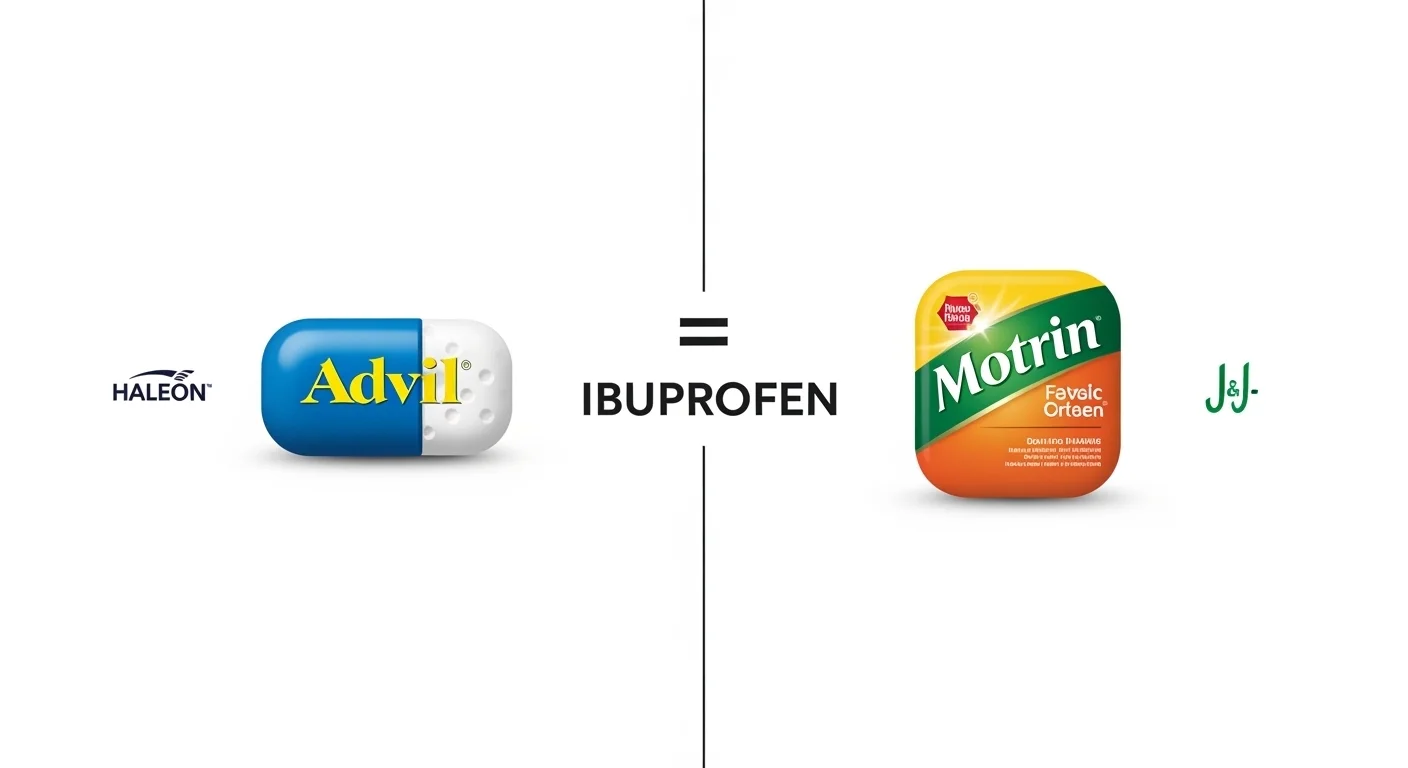
Both Advil and Motrin contain the exact same active ingredient.
That ingredient is called ibuprofen.
Ibuprofen belongs to a class of drugs known as NSAIDs (nonsteroidal anti-inflammatory drugs).
Advil is made by Haleon (formerly under Pfizer’s consumer health division).
Motrin is made by Johnson & Johnson’s McNeil Consumer Healthcare.
Both are used to treat the same conditions like headaches, fever, muscle pain, menstrual cramps, toothaches, and mild arthritis.
So yes, two different companies sell the same medicine under two different names.
🔍 The Real Difference Between Advil and Motrin
Let’s get straight to the point.
The difference between Advil and Motrin is mostly about branding and marketing.
Here is what they share in common:
- Same active ingredient: Ibuprofen
- Same drug class: NSAID
- Same mechanism: Both block pain and reduce inflammation the same way
- Same standard dosage: 200mg per tablet for adults (over the counter)
- Same uses: Pain relief, fever reduction, inflammation control
So if they are the same medicine inside, why do two versions exist?
Simple. Competition.
Different pharmaceutical companies are allowed to sell the same generic drug under their own brand name.
It is similar to how Coca-Cola and Pepsi are both cola drinks from different companies.
The recipe inside is almost identical. The label on the outside is what changes.
🧪 But Wait, Are There Any Small Differences?
Okay, so the active ingredient is the same.
But are there any differences at all?
Yes, there are a few minor ones worth mentioning.
📌 Inactive Ingredients and Coatings
Each brand uses slightly different inactive ingredients.
These are things like coatings, fillers, colorings, and flavoring agents.
They do not affect how the medicine works.
But they can affect things like:
- How quickly the tablet dissolves
- The taste (especially in liquid versions for kids)
- Whether a tablet has a smooth coating that is easier to swallow
For example, some Advil products use a sugar coating or a liqui-gel capsule.
Some Motrin products also come in liquid gels or caplets with different coatings.
These small differences might make one brand feel easier on your stomach or faster to kick in.
But the actual pain-relieving power is the same.
📌 Product Line Differences
Here is where things get a tiny bit interesting.
Both brands have expanded their product lines over the years.
Advil product examples:
- Advil Regular (200mg tablets)
- Advil Liqui-Gels
- Advil Dual Action (ibuprofen + acetaminophen)
- Advil PM (ibuprofen + sleep aid)
- Advil Migraine
Motrin product examples:
- Motrin IB (200mg tablets)
- Motrin Liquid Gels
- Children’s Motrin (liquid suspension)
- Infants’ Motrin
- Motrin PM (ibuprofen + sleep aid)
Notice how Motrin tends to have a stronger presence in the children’s and infant’s market.
Many pediatricians specifically mention Children’s Motrin when recommending ibuprofen for kids.
Meanwhile, Advil tends to be more popular among adults and is often the first name people think of for general pain relief.
But again, the core medicine inside is the same.
📌 Price Differences
This is a practical difference that actually matters to your wallet.
Advil and Motrin can sometimes differ in price depending on the store and location.
Sometimes Advil is cheaper. Sometimes Motrin is.
And here is a little secret.
Generic ibuprofen (the store brand version) is usually cheaper than both of them.
It contains the exact same 200mg of ibuprofen.
So if you are looking to save money, generic ibuprofen is a perfectly good option.
At QuickDawa, we always encourage smart health decisions. And sometimes that means knowing when a brand name is not worth the extra cost.
📋 Advil vs Motrin: Quick Comparison
Here is a simple side-by-side breakdown:
- Active Ingredient: Both contain ibuprofen
- Drug Class: Both are NSAIDs
- Manufacturer: Advil is by Haleon. Motrin is by Johnson & Johnson
- Standard OTC Dose: Both come in 200mg tablets
- Available Forms: Both come in tablets, caplets, liquid gels, and liquid for children
- Uses: Both treat pain, fever, headache, cramps, and inflammation
- Children’s Versions: Motrin is slightly more popular for kids. Advil also has children’s versions
- Combination Products: Advil has Dual Action (with acetaminophen). Motrin does not
- Price: Varies by store. Generic ibuprofen is usually the cheapest
⚡ How Do Advil and Motrin Work?
Since both contain ibuprofen, they work in exactly the same way.
Ibuprofen blocks certain enzymes in your body called COX-1 and COX-2.
These enzymes help produce chemicals called prostaglandins.
Prostaglandins cause pain, swelling, and fever.
By blocking them, ibuprofen reduces all three symptoms.
That is why both Advil and Motrin work for such a wide range of problems.
Whether it is a headache, sore muscles, period cramps, or a fever from the flu, the process is the same.
The medicine kicks in within about 20 to 30 minutes for most people.
And the effects usually last around 4 to 6 hours.
⚠️ Side Effects to Watch For
Since both drugs contain the same ingredient, they share the same side effects.
Common side effects include:
- Upset stomach or nausea
- Heartburn or indigestion
- Dizziness
- Mild headache
- Bloating or gas
More serious side effects (less common but important):
- Stomach bleeding or ulcers (especially with long-term use)
- Kidney problems
- Increased blood pressure
- Allergic reactions like skin rash or swelling
- Breathing issues in people with aspirin-sensitive asthma
Important warning: Taking ibuprofen (whether Advil or Motrin) for long periods or in high doses increases the risk of heart attack and stroke.
Always use the lowest dose that works for you.
And never take it longer than 10 days for pain or 3 days for fever without talking to your doctor.
🩺 When to Call Your Doctor
Even though Advil and Motrin are available without a prescription, they are not risk free.
Contact your doctor right away if you experience:
- Black or bloody stools
- Vomiting blood or material that looks like coffee grounds
- Severe stomach pain
- Sudden swelling of the face, lips, or throat
- Difficulty breathing after taking the medicine
- Chest pain or shortness of breath
- Skin rash, blisters, or peeling
- Symptoms that do not improve after a few days
Also, talk to your doctor before taking either brand if you:
- Have a history of stomach ulcers
- Take blood thinners like warfarin
- Have kidney or liver disease
- Are pregnant (especially in the third trimester)
- Have heart disease or high blood pressure
- Are already taking another NSAID
Your safety always comes first.
👶 Advil vs Motrin for Children

Parents often ask which one is better for their kids.
The honest answer? Both work the same.
Children’s Advil and Children’s Motrin both contain ibuprofen in liquid suspension form.
They are dosed based on the child’s weight, not just age.
The flavors and colors might differ slightly between the two brands.
Some kids prefer the taste of one over the other.
Motrin tends to be the brand pediatricians mention more often, but that is mostly because of marketing.
Important tips for parents:
- Always use the measuring device that comes in the box
- Never give ibuprofen to babies under 6 months old without a doctor’s approval
- Follow the weight-based dosing chart on the label carefully
- Do not give ibuprofen if your child has chickenpox or is dehydrated
When in doubt, call your pediatrician.
💡 So Which One Should You Buy?
Here is Hussain’s honest take.
If you already have Advil at home, use that. It is ibuprofen.
If you already have Motrin at home, use that. It is also ibuprofen.
If you are standing at the pharmacy and cannot decide, grab whichever one is cheaper or on sale.
Or better yet, grab the store brand generic ibuprofen and save yourself some money.
The medicine inside is exactly the same.
The only time brand choice really matters is if you need a specific product formulation.
For example:
- If you want ibuprofen combined with a sleep aid, Advil PM or Motrin PM are options
- If you want ibuprofen combined with acetaminophen in one pill, Advil Dual Action is the only one that offers that
- If you want a specific children’s flavor your kid actually likes, try both and see
Beyond that, do not stress about the brand name. Focus on using the medicine safely.
🙋 Frequently Asked Questions (FAQ)
Q: Can you take Advil and Motrin together?
A: No, you should not. Advil and Motrin both contain ibuprofen. Taking them together means you are double dosing, which increases the risk of serious side effects like stomach bleeding and kidney damage.
Q: How long does Advil or Motrin take to work?
A: Both typically start working within 20 to 30 minutes. Full pain relief is usually felt within an hour. The effects last about 4 to 6 hours depending on the person and the dose.
Q: Is Advil or Motrin safe during pregnancy?
A: Ibuprofen (in both Advil and Motrin) is generally not recommended during pregnancy, especially in the third trimester. It can cause complications for the baby. Always talk to your OB-GYN before taking any pain medication while pregnant.
Q: Advil vs Tylenol: which is better for a toothache?
A: Advil (ibuprofen) is often preferred for toothaches because it reduces both pain and inflammation. Tylenol (acetaminophen) only reduces pain but does not fight swelling. Some dentists recommend taking both together for severe tooth pain, but always check with your dentist first.
Q: Is Motrin the same as ibuprofen?
A: Yes, Motrin is simply a brand name for ibuprofen. It contains the exact same active ingredient as Advil and generic ibuprofen. The difference is only in the brand name, packaging, and sometimes the inactive ingredients used in the coating.
🏁 Conclusion
So let’s wrap this up.
The difference between Advil and Motrin is really just a difference in brand name and packaging.
Inside both boxes, you will find the same trusted medicine called ibuprofen.
They work the same way. They treat the same conditions. They have the same side effects.
The choice between the two comes down to personal preference, price, and which specific product line you need.
And generic ibuprofen works just as well as both of them for a fraction of the cost.
The most important thing is not which brand you pick. It is that you use the medicine safely and correctly.
At QuickDawa, we believe that understanding your medicine is just as important as taking it. Knowledge is the first step toward better health. If you found this guide helpful, share it with someone who needs it and explore more medicine guides on QuickDawa.com for trusted, easy-to-understand health information.
Got more questions about pain relievers or any other medicine? Drop a comment below or reach out through our contact page. We would love to hear from you!
⚠️ Medical Disclaimer
The information provided in this article is intended for educational and informational purposes only. It is not a substitute for professional medical advice, diagnosis, or treatment. Always seek the guidance of your qualified doctor, pharmacist, or healthcare provider with any questions you may have regarding a medical condition, medication, or treatment plan.
Never disregard professional medical advice or delay seeking it because of something you read on QuickDawa.com or any other website. If you think you may have a medical emergency, call your doctor, go to the nearest emergency room, or call emergency services immediately.
Drug information, dosages, and interactions described in this post are provided for general awareness only and may not apply to your individual health situation. Medications affect people differently based on age, weight, health conditions, and other factors.
QuickDawa.com and its authors do not assume any liability for any consequences arising from the use or misuse of information presented on this website.
🌐 Sources & External References
- FDA Drug Label: Ibuprofen
- MedlinePlus: Ibuprofen
- Drugs.com: Ibuprofen Information
- WebMD: Ibuprofen Oral
- Mayo Clinic: Ibuprofen (Oral Route)
- RxList: Motrin (Ibuprofen)