Stiffness – 3 Moves to Fix Stiff Joints, Balance & Sleep | QuickDawa
You know that feeling, right?
You open your eyes in the morning. Your alarm is screaming. And the second you try to get out of bed… your body says “nope.”
Your knees creak. Your back feels locked. Your neck barely turns.
Stiffness hits you like you aged 20 years overnight.
And honestly? You are not alone.
Millions of people deal with this every single day. Young or old. Active or not. It does not care.
The worst part? Stiffness does not just ruin your mornings. It messes with your balance throughout the day. It even steals your sleep at night because you cannot find a comfortable position.
You toss. You turn. You wake up even stiffer.
It becomes a painful cycle.
But here is the good news. You do not need expensive treatments or fancy gym equipment to fix this.
Sometimes, all it takes is 3 simple moves.
Yes, just three.
These moves can loosen your stiff joints, sharpen your balance, and actually help you sleep deeper.
Sounds too good to be true? Stick with me.
At QuickDawa, we are all about making health easy to understand. So let me break down everything about stiffness and these 3 game-changing moves in simple, clear language.
💊 What Exactly Is Stiffness?
Stiffness is that tight, restricted feeling in your joints or muscles.
It makes movement feel difficult or uncomfortable.
It can happen in your knees, hips, shoulders, neck, or back.
Sometimes it lasts a few minutes. Other times it sticks around for hours.
Common causes include inactivity, aging, poor sleep posture, arthritis, or even stress.
Your body is basically telling you, “Hey, I need to move more.”
🤔 Why Does Stiffness Affect Your Balance and Sleep?
Great question. Let me explain this simply.
Stiffness and Balance
When your joints are stiff, they cannot respond quickly.
Imagine walking on an uneven surface. Your ankle needs to adjust fast.
But if it is stiff? It reacts slowly. And that is when you stumble or lose balance.
Stiff joints equal slow reflexes. It is that straightforward.
Older adults especially face a higher fall risk because of this.
Even younger people notice they feel “clumsy” when their body is tight and locked up.
Stiffness and Sleep
Now here is something most people miss.
Stiffness ruins sleep quality.
When your muscles and joints are tight, your body cannot fully relax.
You keep shifting positions. Your hips ache. Your shoulders feel compressed.
Your brain never gets into that deep, restorative sleep stage.
So you wake up tired. And even stiffer. And the cycle repeats.
Breaking this cycle starts with the right movements before bed.
🏋️ The 3 Moves to Fix Stiff Joints, Balance & Sleep
Alright, here is what you came for.
These 3 moves are simple enough for anyone. You can do them at home. No equipment needed. And they take less than 10 minutes total.
I personally recommend doing them twice daily. Once in the morning. Once before bed.
Let me walk you through each one.
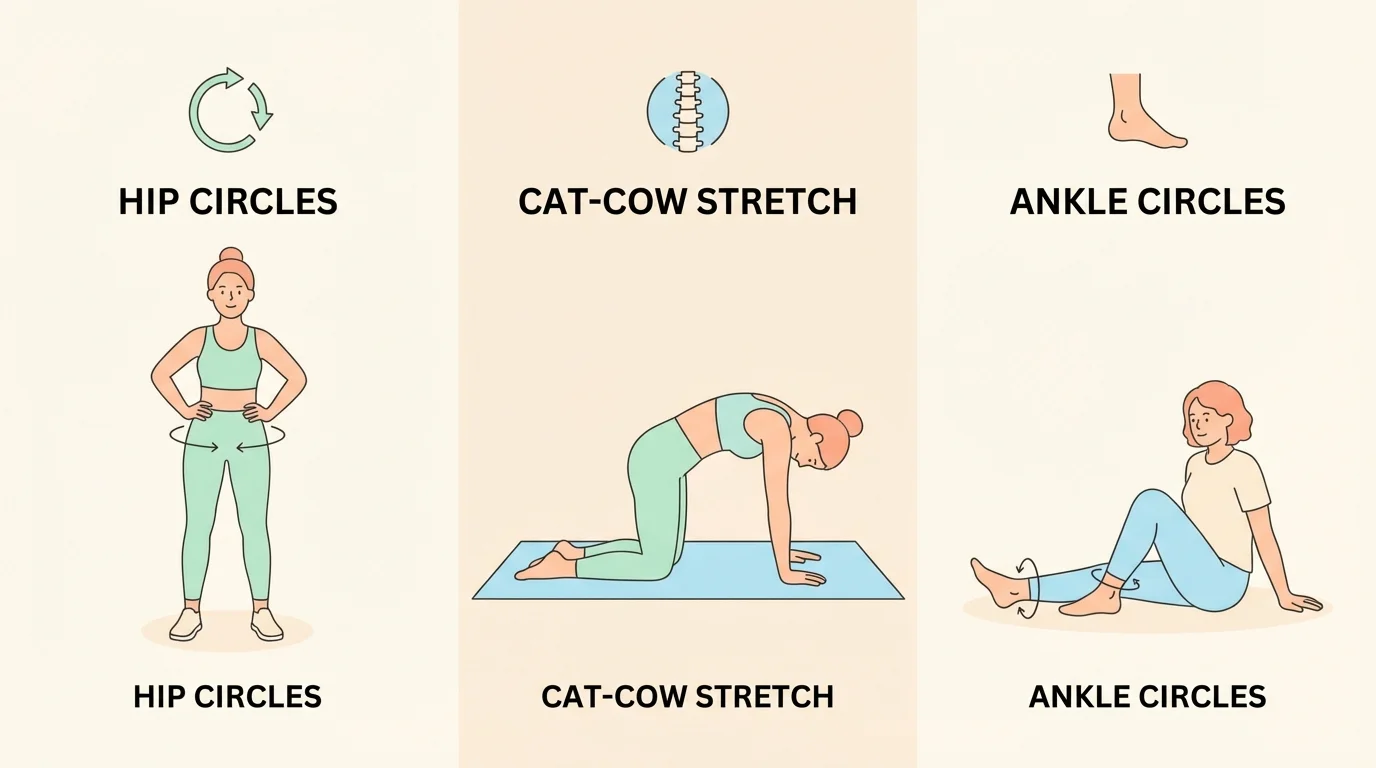
Move 1: The Standing Hip Circle 🔄
This one is a game changer for hip stiffness and balance.
How to do it:
- Stand tall with your feet shoulder-width apart.
- Place your hands on your hips.
- Slowly rotate your hips in a big circle. Like you are hula hooping.
- Do 10 circles clockwise.
- Then 10 circles counterclockwise.
- Keep your upper body still. Only your hips move.
Why it works:
Your hips are the foundation of your body’s movement.
When they get stiff, everything suffers. Your walking. Your balance. Even your lower back.
Hip circles gently warm up the joint fluid. They loosen tight muscles around the pelvis. And they improve your body’s stability over time.
Pro tip: If you feel wobbly, hold onto a chair or wall. No shame in that. Safety first.
Move 2: The Cat-Cow Stretch 🐱🐄
This is the best move for spinal stiffness. Hands down.
How to do it:
- Get on your hands and knees on a soft surface.
- Your hands should be under your shoulders. Knees under your hips.
- Cow position: Slowly drop your belly toward the floor. Lift your head and tailbone up. Breathe in deeply.
- Cat position: Round your back toward the ceiling. Tuck your chin to your chest. Breathe out fully.
- Flow between these two positions slowly.
- Do 10 rounds.
Why it works:
Your spine has dozens of small joints. They get compressed from sitting, sleeping, and daily stress.
The cat-cow stretch gently opens each segment of your spine. It brings fresh blood flow. It reduces morning stiffness dramatically.
Many people feel instant relief after just 5 rounds.
And here is the bonus. This move activates your parasympathetic nervous system. In simple words, it tells your body to calm down. That is why it is perfect before bed. It actually helps you fall asleep faster.
Move 3: The Ankle Alphabet ✍️🦶
This one sounds silly. But trust me, it is powerful.
How to do it:
- Sit on a chair or the edge of your bed.
- Lift one foot off the ground.
- Using your big toe as a pen, “write” the alphabet in the air. A, B, C, D… all the way to Z.
- Switch to the other foot and repeat.
Why it works:
Your ankles are one of the most neglected joints in your body.
But they are critical for balance.
Every step you take depends on ankle mobility. When ankles are stiff, your risk of tripping goes way up.
The ankle alphabet forces your foot to move in every possible direction. It strengthens the small stabilizer muscles. It improves flexibility. And it takes barely 2 minutes per foot.
People with morning stiffness in their feet love this move. It gets blood flowing and wakes up those sleepy joints fast.
📋 Quick Recap of the 3 Moves
- Move 1: Standing Hip Circle for hip stiffness and core balance
- Move 2: Cat-Cow Stretch for spinal stiffness and better sleep
- Move 3: Ankle Alphabet for ankle mobility and fall prevention
Do them daily. Be consistent. Results come within the first week for most people.
🛏️ Bonus Tips to Reduce Stiffness and Sleep Better
Since we are on the topic, here are a few extra tips from QuickDawa that really help.
- Stay hydrated. Dehydrated joints feel stiffer. Drink water throughout the day.
- Use a supportive pillow. A bad pillow causes neck stiffness every morning.
- Avoid sitting for too long. Get up and move every 30 to 45 minutes.
- Take a warm shower before bed. Heat relaxes tight muscles beautifully.
- Stretch gently before sleep. Even 5 minutes makes a huge difference.
- Consider magnesium. Low magnesium levels can cause muscle tightness and poor sleep. Ask your doctor about supplements.
🩺 When to Call Your Doctor
Most stiffness is harmless and gets better with movement.
But sometimes, it is a sign of something more serious.
See your doctor if:
- Your stiffness lasts more than 2 weeks without improvement.
- You have swelling, redness, or warmth around a joint.
- The stiffness comes with fever or unexplained weight loss.
- You feel numbness or tingling along with the tightness.
- Your joint locks up and you cannot move it at all.
- Morning stiffness lasts more than 30 minutes daily. This could be a sign of rheumatoid arthritis or another inflammatory condition.
Do not ignore these signs. Early treatment makes a world of difference.
🙋 Frequently Asked Questions (FAQ)
Q: How long does morning stiffness usually last?
A: For most people, morning stiffness lasts 10 to 30 minutes and improves with movement. If it lasts more than 30 minutes daily, it may signal an inflammatory condition like arthritis. Learn more on MedlinePlus.
Q: Is stiffness the same as arthritis?
A: Not always. Stiffness is a symptom, not a disease. Many things cause it, including inactivity, aging, or muscle tension. Arthritis is one possible cause, but your doctor needs to diagnose that properly. Read more on WebMD.
Q: Can you take ibuprofen for stiff joints?
A: Yes, over-the-counter anti-inflammatory medicines like ibuprofen can help with joint stiffness and pain temporarily. But they are not a long-term fix. Movement and stretching address the root cause better. Always check with your doctor before regular use. More info on Drugs.com.
Q: How long does it take for stretching to reduce stiffness?
A: Many people feel some relief immediately after stretching. But for lasting improvement, consistent daily stretching for 1 to 2 weeks is usually needed. The 3 moves shared above can show noticeable changes within 7 days.
Q: Is joint stiffness safe to ignore in young adults?
A: Occasional stiffness after sitting too long is usually nothing to worry about. But if a young adult experiences persistent stiffness, especially with swelling or fatigue, it is worth getting checked. Early-onset arthritis does exist. Check Mayo Clinic’s guide.
Q: Stiffness vs soreness, what is the difference?
A: Soreness usually comes from muscle overuse, like after exercise. Stiffness is more about restricted movement in a joint. Soreness feels achy. Stiffness feels tight and locked. Both can exist together, but they have different causes.
Q: Can stiffness cause poor balance and falls?
A: Absolutely. Stiff joints, especially in the hips and ankles, slow down your body’s ability to react. This increases fall risk significantly, particularly in older adults. Regular mobility exercises greatly reduce this risk. Read more on NIH.
🏁 Final Thoughts from QuickDawa
Let me be honest with you.
Stiffness is your body sending you a message. It is saying, “Please move me.”
And the beautiful thing is, the solution does not have to be complicated.
Three simple moves. Less than 10 minutes a day. That is all it takes to start feeling the difference.
Your joints get looser. Your balance gets sharper. Your sleep gets deeper.
It is a win on every level.
The key is consistency. Do not just try these once and forget about them. Make them part of your morning routine. Add them to your bedtime ritual.
Your future self will thank you.
At QuickDawa, we believe that understanding your body is just as important as treating it. Knowledge is the first step toward better health. If you found this guide helpful, share it with someone who needs it. And explore more wellness guides on QuickDawa.com for trusted, easy-to-understand health information.
Got questions? Drop them in the comments below! Or reach out to us through our contact page. We love hearing from our readers.
⚠️ Medical Disclaimer
The information provided in this article is intended for educational and informational purposes only. It is not a substitute for professional medical advice, diagnosis, or treatment. Always seek the guidance of your qualified doctor, pharmacist, or healthcare provider with any questions you may have regarding a medical condition, medication, or treatment plan.
Never disregard professional medical advice or delay seeking it because of something you read on QuickDawa or any other website. If you think you may have a medical emergency, call your doctor, go to the nearest emergency room, or call emergency services immediately.
The exercises and health tips described in this post are provided for general awareness only and may not apply to your individual health situation. Physical movements affect people differently based on age, fitness level, health conditions, and other factors.
QuickDawa and its authors do not assume any liability for any consequences arising from the use or misuse of information presented on this website.
🌐 Sources & External References
- MedlinePlus: Joint Stiffness
- Mayo Clinic: Arthritis Symptoms and Causes
- WebMD: Joint Stiffness Slideshow
- Drugs.com: Ibuprofen Information
- NIH National Institute on Aging: Falls Prevention
- Harvard Health: Stretching and Flexibility