How to Propagate Succulents (Step-by-Step Guide for Explosive Growth!)
Imagine turning one succulent into dozens—without spending a penny! Succulent propagation is nature’s gift to plant lovers, allowing you to multiply your collection, rescue leggy plants, and create endless gifts for friends and family.
Propagation simply means growing new plants from existing ones. With succulents, it’s remarkably easy because they store water and nutrients in their leaves and stems, making them survival experts.
In this complete guide, you’ll learn:
✓ 5 proven propagation methods (leaves, cuttings, offsets, water, seeds)
✓ Step-by-step instructions with timeline expectations
✓ Common mistakes and how to avoid them
✓ Expert tips for faster, successful propagation
Whether you’re working with Echeveria, Jade plants, Sedum, or other beaded succulents, this propagation guide will transform you into a succulent-growing pro!
What Is Succulent Propagation?
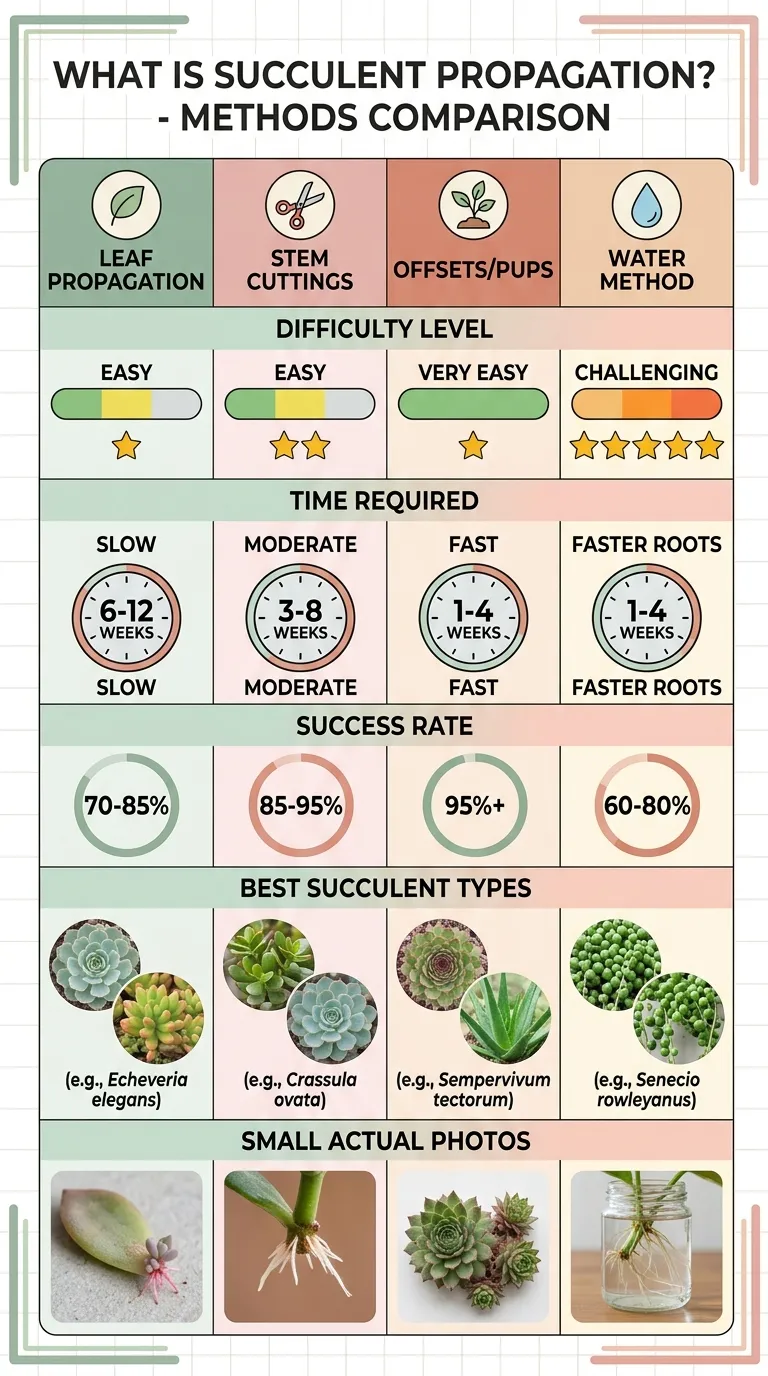
Succulent propagation is the process of creating new plants from leaves, stems, or baby offshoots. Unlike many plants, succulents have incredible regenerative abilities—a single healthy leaf can grow an entirely new plant!
Why Succulents Are Easy to Propagate
Succulents evolved in harsh environments, developing the ability to reproduce quickly from broken parts. This survival mechanism makes propagating succulents perfect for beginners.
Best Succulent Types for Beginners
Easy to propagate:
- Echeveria – Beautiful rosettes, high success rate
- Jade Plant (Crassula ovata) – Stems and leaves both work
- Sedum – Fast-growing ground covers
- Graptopetalum – Forgiving and prolific
- Crassula varieties – Reliable and rewarding
Harder to propagate:
- Lithops (Living Stones)
- Haworthia (slower process)
- Some cacti varieties
🌿 Succulent Propagation Methods Comparison
- Leaf Propagation
- Difficulty: Easy
- Time to Roots: 2–4 weeks
- Best For: Echeveria, Sedum, Graptopetalum
- Best Choice If: You want to grow multiple plants from a single leaf.
- Stem Cuttings
- Difficulty: Very Easy
- Time to Roots: 1–3 weeks
- Best For: Jade plants, leggy succulents
- Best Choice If: Your plant is stretched out and needs pruning.
- Offsets (Pups)
- Difficulty: Easiest
- Time to Roots: Immediate (already formed roots)
- Best For: Aloe, Sempervivum, Agave
- Best Choice If: You want the fastest and most reliable results.
- Water Propagation
- Difficulty: Medium
- Time to Roots: 1–2 weeks
- Best For: Gardeners who prefer watching roots grow
- Best Choice If: You enjoy experimental or visual propagation methods.
- Seeds
- Difficulty: Difficult
- Time to Growth: 3–6 months (or longer)
- Best For: Rare or hard-to-find varieties
- Best Choice If: You’re patient and want to grow unique succulents from scratch.
When Is the Best Time to Propagate Succulents?
The best time to propagate succulents is during their active growing season—spring and summer (March through September in most climates).
Seasonal Guidelines
Spring & Summer (Best):
- Warmer temperatures (65-80°F)
- Longer daylight hours
- Faster root development
- Higher success rates
Fall (Good):
- Still possible with indoor propagation
- Slower growth expected
Winter (Challenging):
- Can you propagate succulents in winter? Yes, but expect slower results
- Requires grow lights and warmth
- Lower success rates
Indoor vs Outdoor Propagation
Indoor propagation works year-round with:
- Bright indirect light or grow lights
- Controlled temperatures (65-75°F)
- Lower humidity (40-50%)
Outdoor propagation works best:
- In partial shade (morning sun only)
- Protected from rain
- During warm months
Tools & Materials You’ll Need
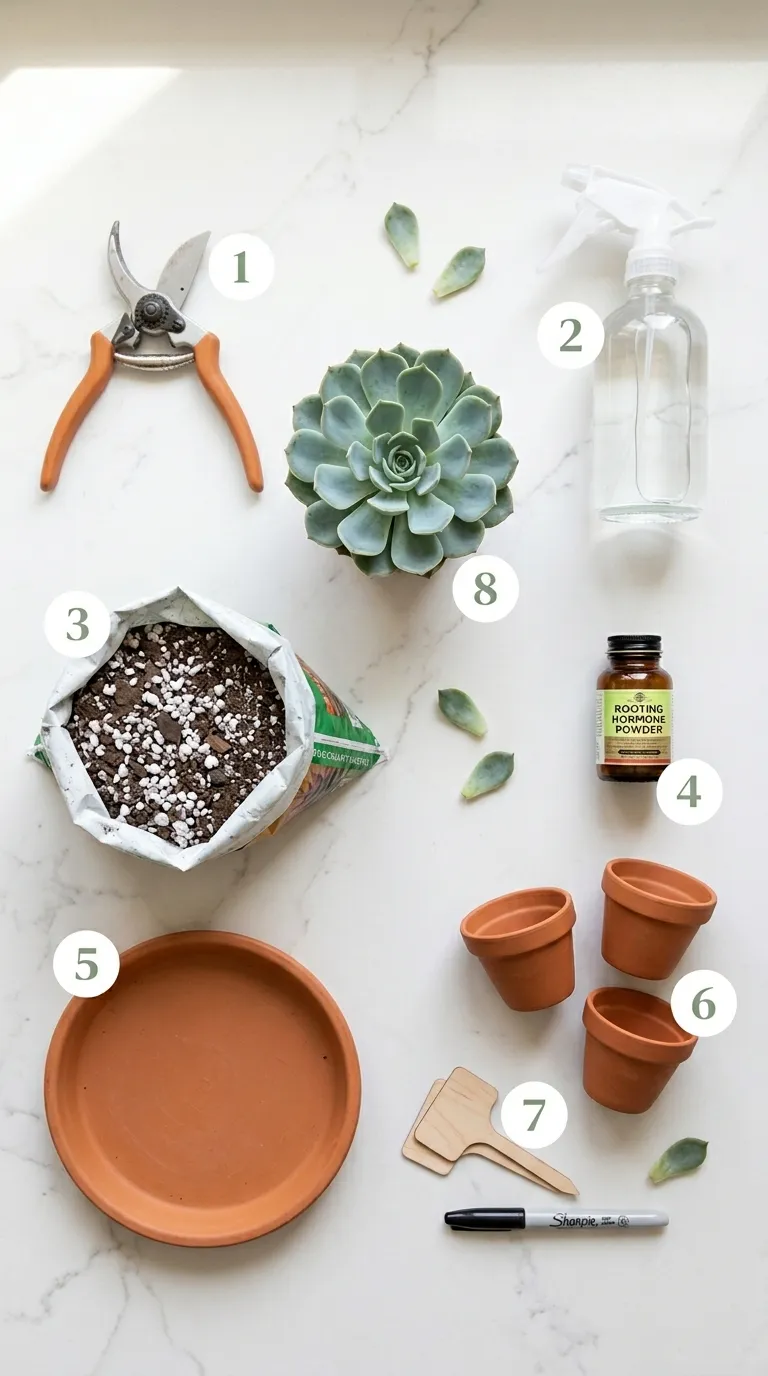
Gather these supplies before starting:
✓ Healthy mother plant (6+ months old)
✓ Sharp, sterilized scissors or pruning shears
✓ Succulent/cactus soil mix
✓ Shallow tray or propagation container
✓ Spray bottle for gentle misting
✓ Optional: Rooting hormone powder (speeds up process)
✓ Small pots for transplanting babies
Pro tip: Sterilize tools with rubbing alcohol between cuts to prevent disease spread.
Method 1: How to Propagate Succulents from Leaves (Most Popular)
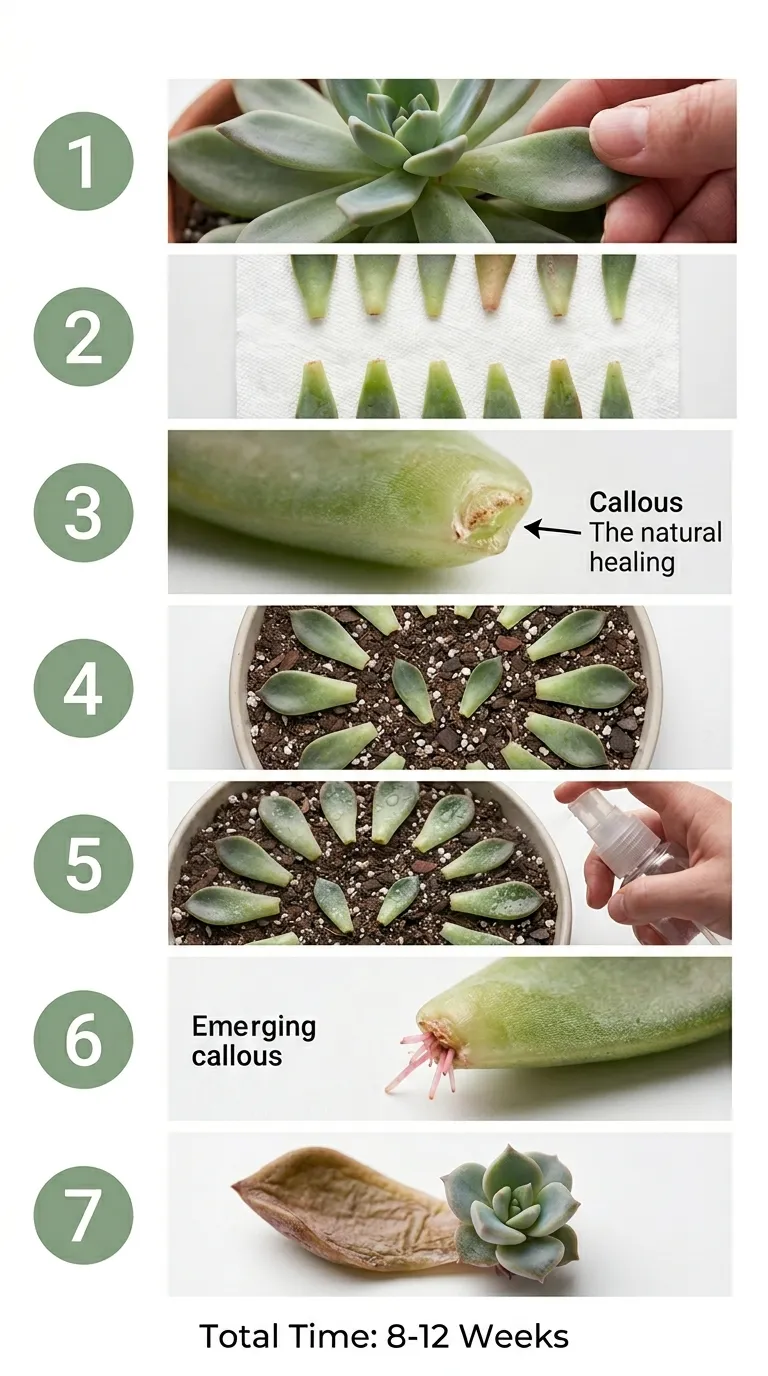
This is the most rewarding method for propagating succulents—watching tiny roots and baby plants emerge from a single leaf is magical!
Step 1 – Choose a Healthy Leaf
Select leaves from a mature, healthy succulent:
- ✓ Plump and full (not shriveled)
- ✓ No spots, discoloration, or damage
- ✓ From lower or middle rows (older leaves)
Avoid: Yellowing leaves, damaged leaves, or very young leaves
Step 2 – Remove the Leaf Properly
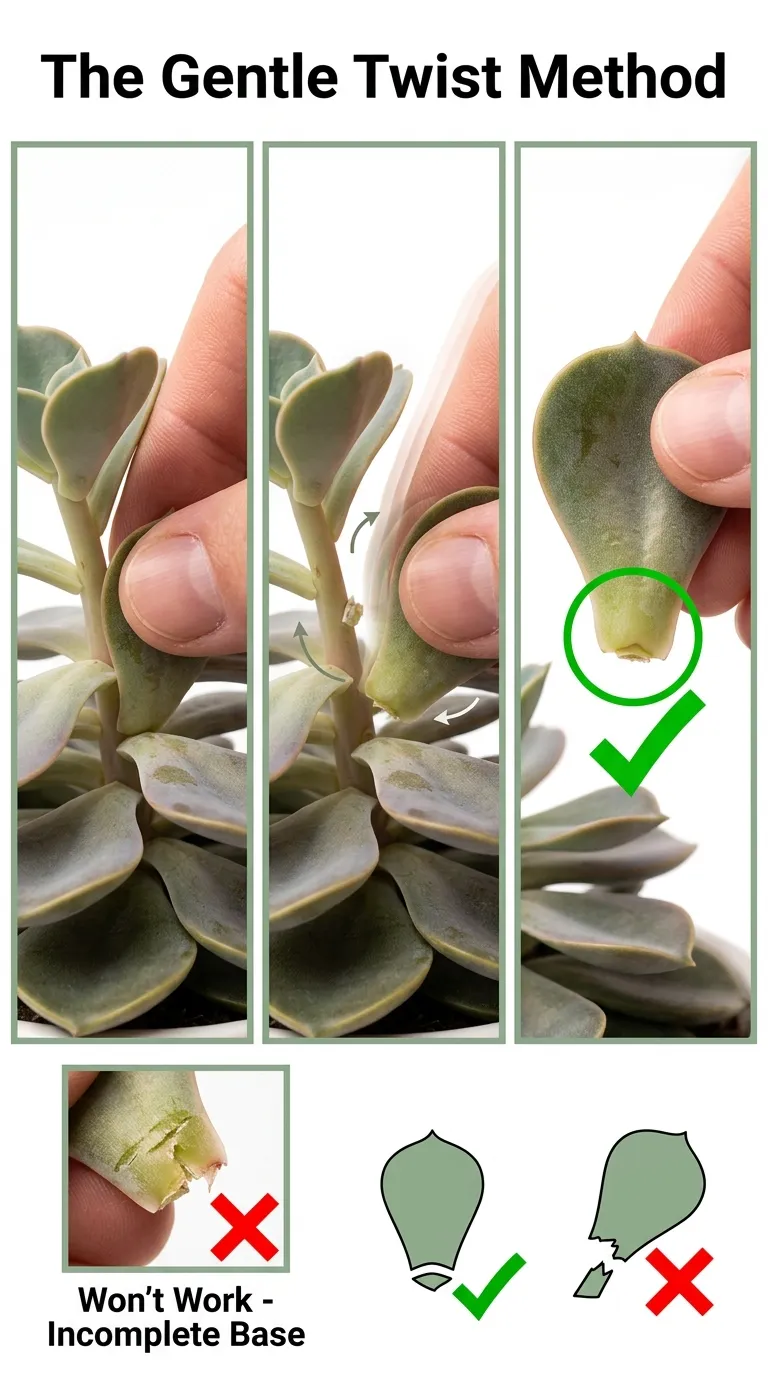
The twist method (best technique):
- Gently grasp the leaf near the base
- Wiggle side-to-side while pulling downward
- Ensure a clean break with no leaf tissue left on stem
Why torn leaves fail: If any part of the leaf remains on the stem (or tears), it won’t produce roots. The entire base must be intact.
Step 3 – Let the Leaf Callous
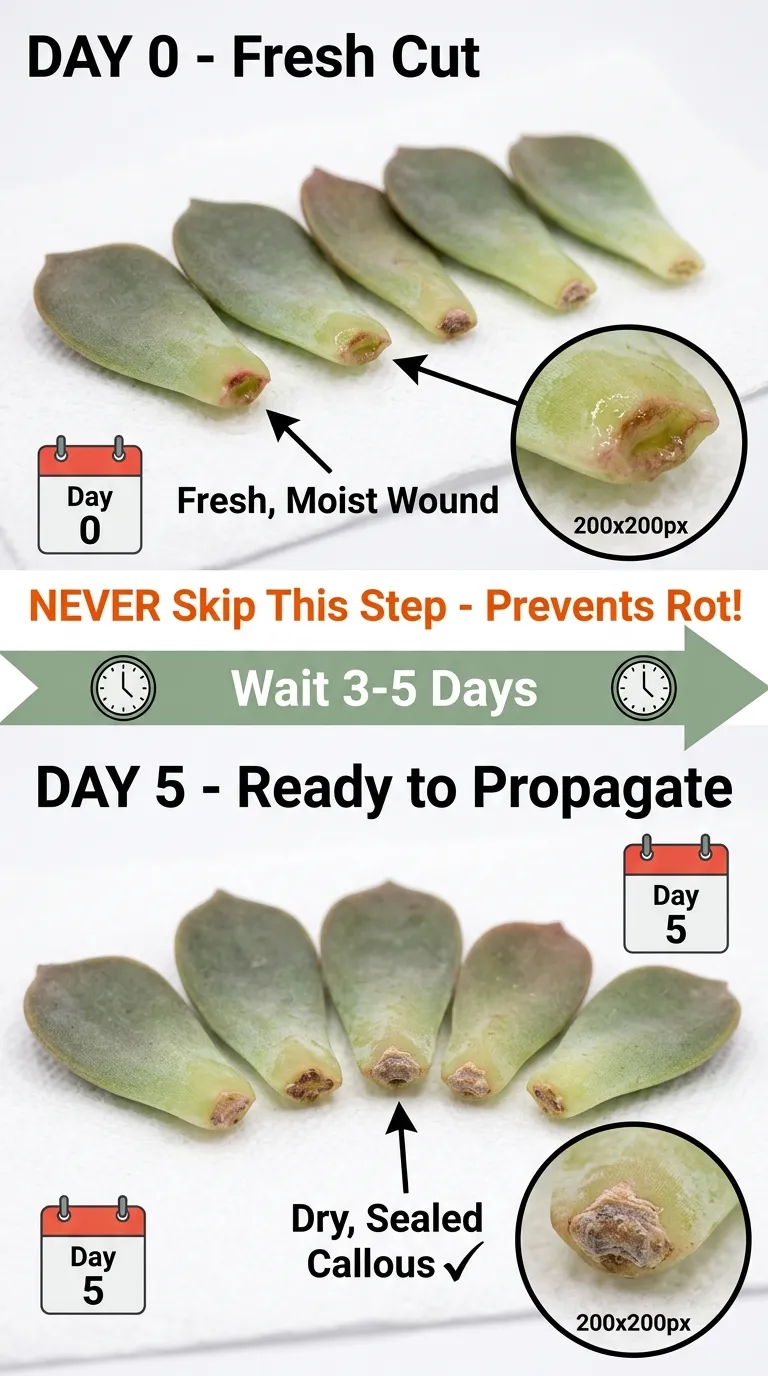
Critical step! Place leaves on a dry surface (paper towel, empty tray) in indirect light for:
- Thin leaves: 2-3 days
- Thick leaves: 3-5 days
Why callousing prevents rot: The exposed wound must seal over (callous) before touching soil. Skip this step, and your leaves will absorb too much moisture and rot.
Step 4 – Prepare the Soil
Fill a shallow tray with:
- Succulent/cactus soil mix (not regular potting soil)
- Lightly mist until just barely damp
- Soil should feel dry to the touch, not wet
Step 5 – Place Leaves on Top (Don’t Bury!)
Proper placement:
- Lay calloused leaves flat on soil surface
- Base (callous end) touching soil
- Don’t bury or push into soil
- Space leaves 1-2 inches apart
Light requirements:
- Bright, indirect light (near a window with sheer curtain)
- Avoid direct sunlight (will cook the leaves)
- 10-12 hours of light daily
Step 6 – Mist Lightly
Watering schedule:
- First 1-2 weeks: Don’t water (leaves use stored moisture)
- Weeks 2-6: Mist soil lightly every 2-3 days
- After roots appear: Mist every 3-4 days
How to mist properly:
- Spray the soil, not the leaves
- Just 2-3 sprays per leaf area
- Soil should dry completely between mistings
Step 7 – Roots & Pups Appear (2-10 Weeks)
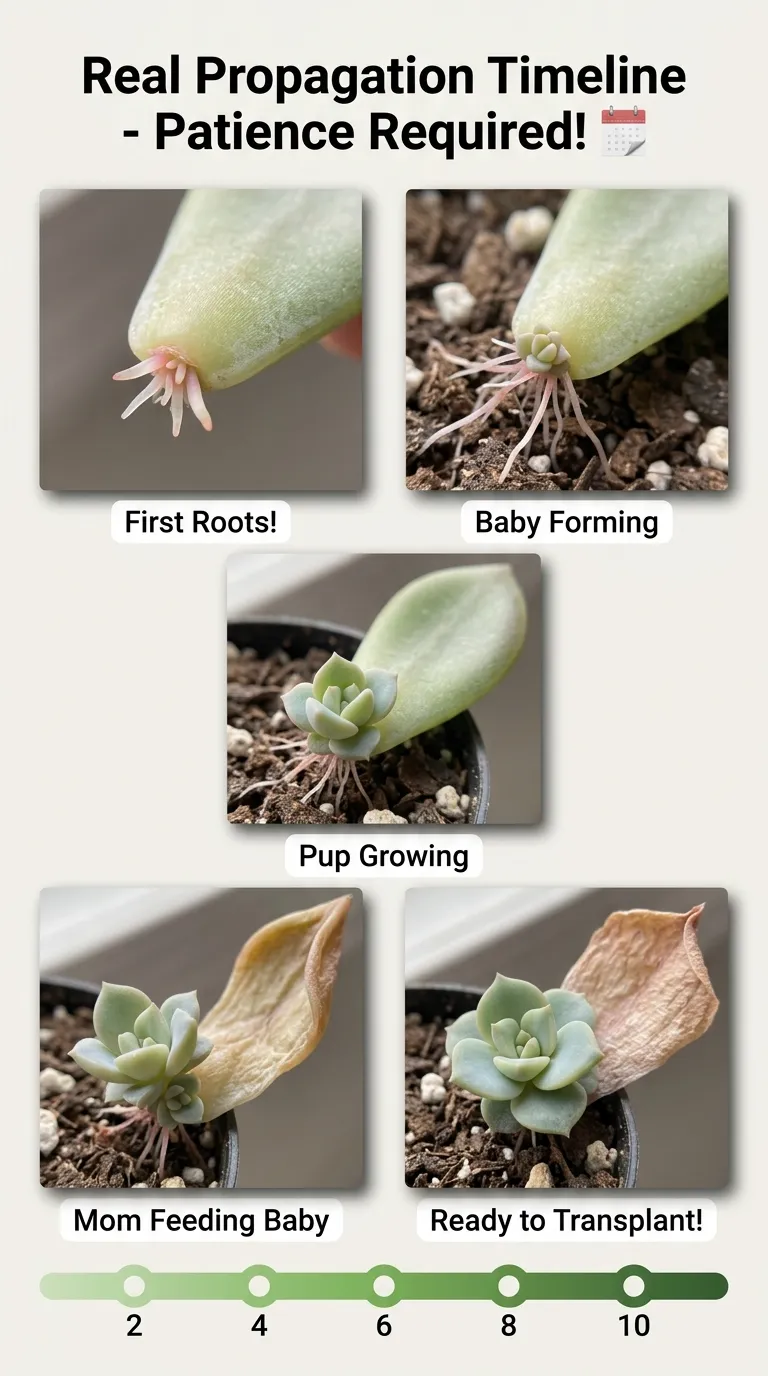
Timeline expectations:
Weeks 2-3: Pink or white roots emerge from base
Weeks 4-6: Tiny baby rosette (pup) forms
Weeks 6-10: Baby grows while mother leaf shrivels
Weeks 10-12: Ready to transplant
When to remove the mother leaf:
Wait until it’s completely dried and shriveled—it’s feeding the baby! Gently twist off when crispy.
Method 2: How to Propagate Succulents from Stem Cuttings
Perfect for:
- Leggy, stretched succulents
- Jade plants
- Sedum varieties
- Creating fuller succulent arrangements
Step-by-Step Stem Cutting Method
Step 1: Identify a healthy stem with several leaves
Step 2: Cut 2-4 inches below a node (leaf joint) using sterilized scissors
Step 3: Remove bottom leaves (leave 3-4 at top)
Step 4: Let stem dry and callous for 3-7 days (thicker stems need longer)
Step 5: Plant directly in dry succulent soil (bury 1/3 of stem)
Step 6: Wait 1 week, then water lightly
Step 7: Roots form in 2-3 weeks; new growth in 4-6 weeks
Success rate: 85-95% with proper callousing
Method 3: Propagating Succulent Offsets (Pups)
What are offsets? Baby plants that grow around the mother plant’s base. This is how succulents naturally reproduce!
How to Separate Offsets Safely
Step 1: Wait until pup is 1/3 the size of mother plant
Step 2: Gently brush away soil from base
Step 3: Identify where pup connects to mother
Step 4: Cut or twist pup away (some have their own roots)
Step 5: Let dry 1-2 days if cut (not needed if roots intact)
Step 6: Plant in fresh soil
Step 7: Water lightly after 3-4 days
Survival rate: 95%+ (easiest propagation method!)
Best for: Aloe, Sempervivum (Hen and Chicks), Echeveria, Agave
Can You Propagate Succulents in Water?
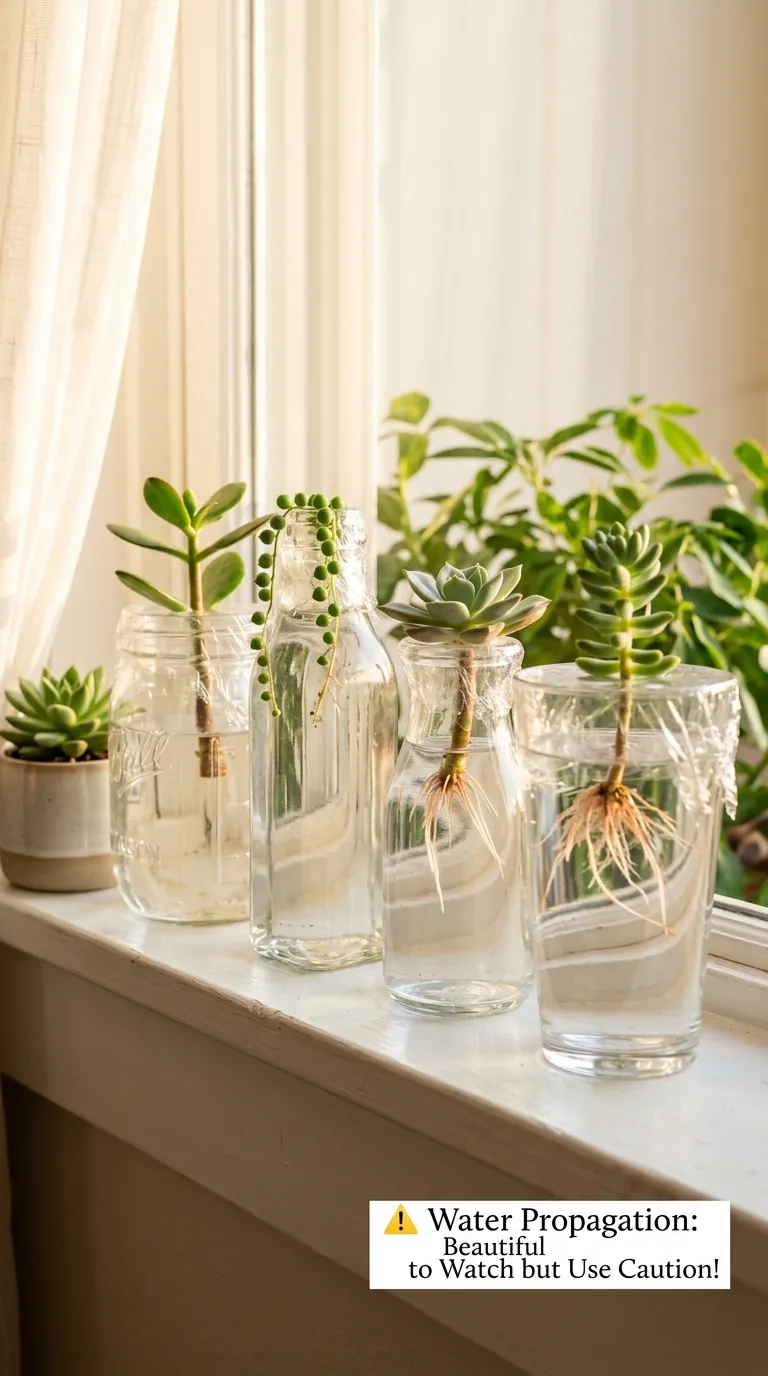
Yes! Water propagation works for some succulents, though it’s slightly riskier than soil propagation.
Step-by-Step Water Propagation Method
Step 1: Take a healthy stem cutting and callous 2-3 days
Step 2: Fill a clear glass with water
Step 3: Suspend cutting so stem base is just above water (not touching)
- Use plastic wrap with hole poked through
- Or rest on glass rim
Step 4: Place in bright, indirect light
Step 5: Change water every 5-7 days
Step 6: Roots appear in 1-3 weeks
Step 7: Transfer to soil once roots are 1-2 inches long
Pros and Cons
Pros:
✓ Watch root development (great for kids!)
✓ Faster initial root growth
✓ No soil mess
Cons:
✗ Water roots struggle adapting to soil
✗ Higher rot risk
✗ Not suitable for all succulents
Best candidates: Jade plant, String of Pearls, Sedum
Why soil propagation is safer: Soil-grown roots are stronger and adapt better to permanent planting.
Why Are My Succulent Leaves Not Growing?
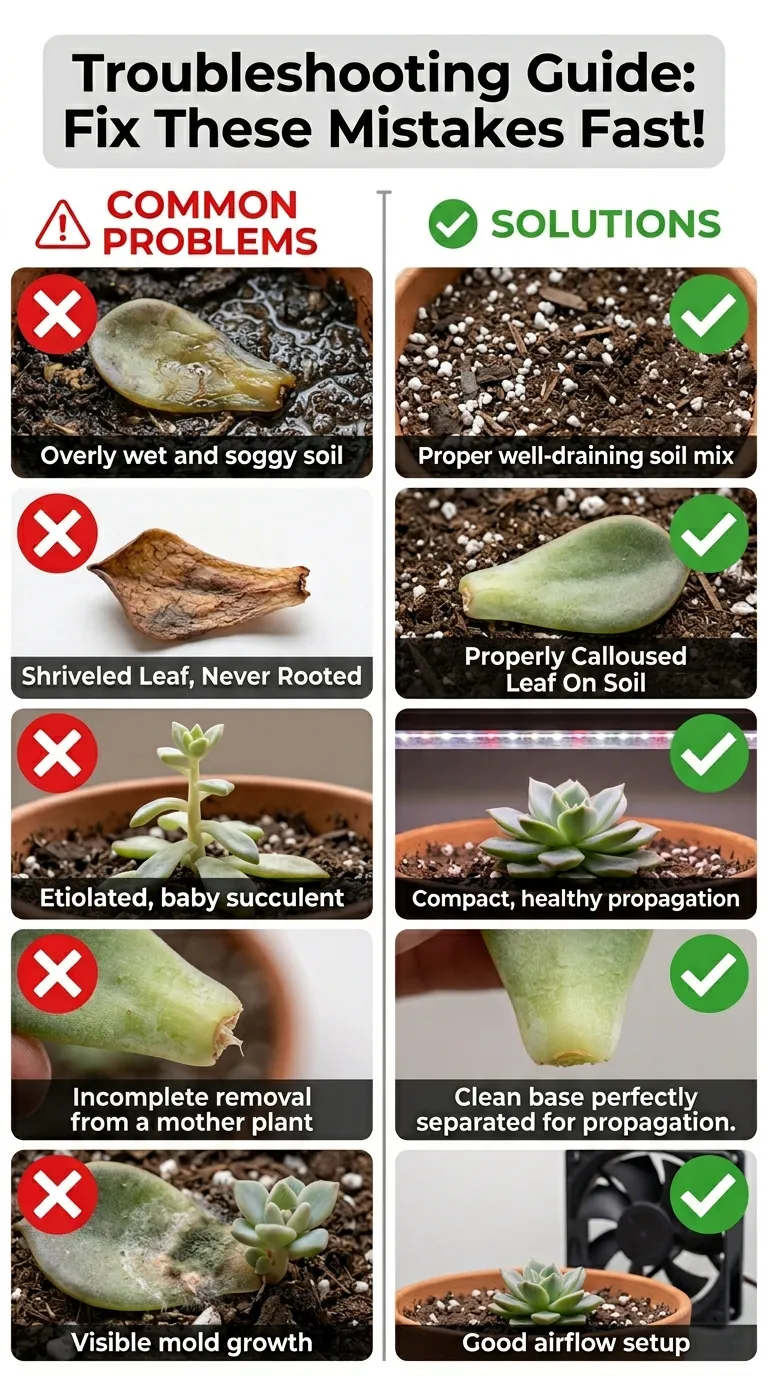
Common reasons propagation fails:
1. Leaf Wasn’t Calloused Properly
Solution: Ensure 3-5 days drying time; callous should feel firm and sealed
2. Too Much Water
Solution: Mist only 2-3 times per week; soil should dry completely between waterings
3. Not Enough Light
Solution: Provide 10-12 hours bright, indirect light or use grow lights
4. Damaged Leaf
Solution: Check that entire leaf base was removed cleanly; torn leaves won’t root
5. Wrong Season
Solution: Propagate during spring/summer for best results; winter propagation is much slower
6. Dead Leaf
Solution: Not all leaves will propagate; success rate is typically 60-80%
Why Are My Succulent Cuttings Rotting?
Rot is the #1 killer of succulent propagations.
Common Causes & Solutions
1. Overwatering
- Symptom: Mushy, translucent leaves
- Fix: Reduce watering to every 4-5 days; let soil dry completely
2. Poor Drainage
- Symptom: Soggy soil, moldy smell
- Fix: Use 50/50 mix of cactus soil and perlite
3. High Humidity
- Symptom: Condensation on leaves, mold growth
- Fix: Improve airflow; remove humidity domes
4. No Airflow
- Symptom: Stagnant air, fungus
- Fix: Use small fan nearby; don’t overcrowd propagations
5. Skipped Callousing
- Symptom: Rot starting at cut end
- Fix: Always allow 3-7 days drying time before soil contact
🌿 Complete Timeline: From Leaf to Baby Succulent
- Callousing (2–5 Days)
- The wound at the end of the leaf dries out.
- A protective layer forms over the cut area.
- This prevents rot when placed on soil.
- Keep the leaf in a dry, shaded spot during this stage.
- Root Emergence (2–4 Weeks)
- Small pink or white roots begin to grow from the calloused end.
- Roots may search for moisture and anchor into the soil.
- Light misting can encourage healthy root development.
- Pup Formation (4–6 Weeks)
- A tiny rosette (baby succulent) starts forming near the roots.
- The baby plant grows from the base of the leaf.
- This is the exciting stage where you visibly see success!
- Baby Growth (6–10 Weeks)
- The baby succulent becomes larger and more defined.
- The original (mother) leaf begins to shrivel and dry up.
- Nutrients transfer from the mother leaf to the baby plant.
- Transplant Ready (8–12 Weeks)
- The baby plant reaches about 1–2 inches in size.
- It develops stronger roots.
- The dried mother leaf usually falls off naturally.
- At this stage, it’s ready to be planted in its own small pot.
Factors affecting speed:
- Succulent variety (Sedum is fastest; Echeveria slower)
- Season (summer = faster)
- Light levels (more light = faster growth)
- Temperature (warmth speeds up process)
How to Transplant Baby Succulents
When to move propagated babies:
- Baby is 1-2 inches in diameter
- Has established root system
- Mother leaf has completely shriveled
Transplanting Steps
Step 1: Prepare small pot (2-3 inches) with drainage hole
Step 2: Fill with fresh succulent soil
Step 3: Gently lift baby from propagation tray (roots will be delicate)
Step 4: Make small hole in new soil
Step 5: Place baby and cover roots lightly
Step 6: Wait 3-4 days before first watering
Step 7: Water lightly, then follow normal succulent care
First Month Care
Watering: Every 7-10 days (when soil completely dry)
Light: Gradually increase to 6+ hours direct morning sun
Growth: Expect slow growth for 4-6 weeks as roots establish
Expert Tips for Faster & Successful Propagation
1. Use Shallow, Wide Trays
Better airflow and easier monitoring than deep pots
2. Avoid Humidity Domes
Succulents hate humidity—skip plastic covers
3. Rotate Tray Weekly
Ensures even light exposure on all sides
4. Use Grow Lights Indoors
LED grow lights 12-14 hours daily = year-round propagation success
5. Don’t Rush Watering
When in doubt, wait another day—underwatering is safer
6. Keep Mother Plant Healthy
Healthy parent = stronger propagation success rate
7. Label Everything
Mark date and variety to track what works best
8. Try Multiple Leaves
Aim for 60-80% success rate, so start with 10+ leaves
Common Mistakes to Avoid
❌ Mistake #1: Overwatering
Most common killer; remember—succulents store water!
❌ Mistake #2: Using Garden Soil
Too dense; holds moisture too long; use only cactus/succulent mix
❌ Mistake #3: Skipping Callousing
Leads to immediate rot; patience here saves weeks of work
❌ Mistake #4: Direct Sunlight Exposure
Tender propagations burn easily; bright indirect only
❌ Mistake #5: Handling Roots Too Early
Disturbing new roots damages them; let babies grow 2+ weeks
❌ Mistake #6: Burying Leaf Propagations
Leaves rot when buried; they need air circulation
❌ Mistake #7: Giving Up Too Soon
Some varieties take 12+ weeks; patience wins!
Frequently Asked Questions
Q: Can you propagate all succulents?
A: Most succulents can be propagated, but some (like Lithops) are very difficult. Echeveria, Sedum, Jade, and Crassula have the highest success rates.
Q: How often should I mist propagating succulents?
A: Every 3-4 days once roots appear. Before roots, wait 2 weeks, then start misting every 4-5 days.
Q: Do succulent leaves need sunlight to root?
A: Yes, but indirect light only. 10-12 hours of bright, filtered light is ideal. Direct sun will cook them.
Q: Why is my propagation leaf shriveling?
A: Normal! Mother leaves shrivel as they feed the baby. If shriveling before roots appear, it may be too dry—mist lightly.
Q: Can I propagate broken leaves?
A: Only if the break includes the entire base intact. Partial breaks won’t produce roots.
Q: Should I remove the mother leaf?
A: No! Let it shrivel naturally and fall off—it’s feeding the baby. Remove only when completely crispy.
Q: Can I propagate succulents in just water?
A: Yes, but soil propagation has higher long-term success. Water roots struggle transitioning to soil.
Q: What’s the success rate for succulent propagation?
A: Expect 60-80% for leaves, 85-95% for stem cuttings, and 95%+ for offsets.
Final Thoughts: Grow Unlimited Succulents for Free!
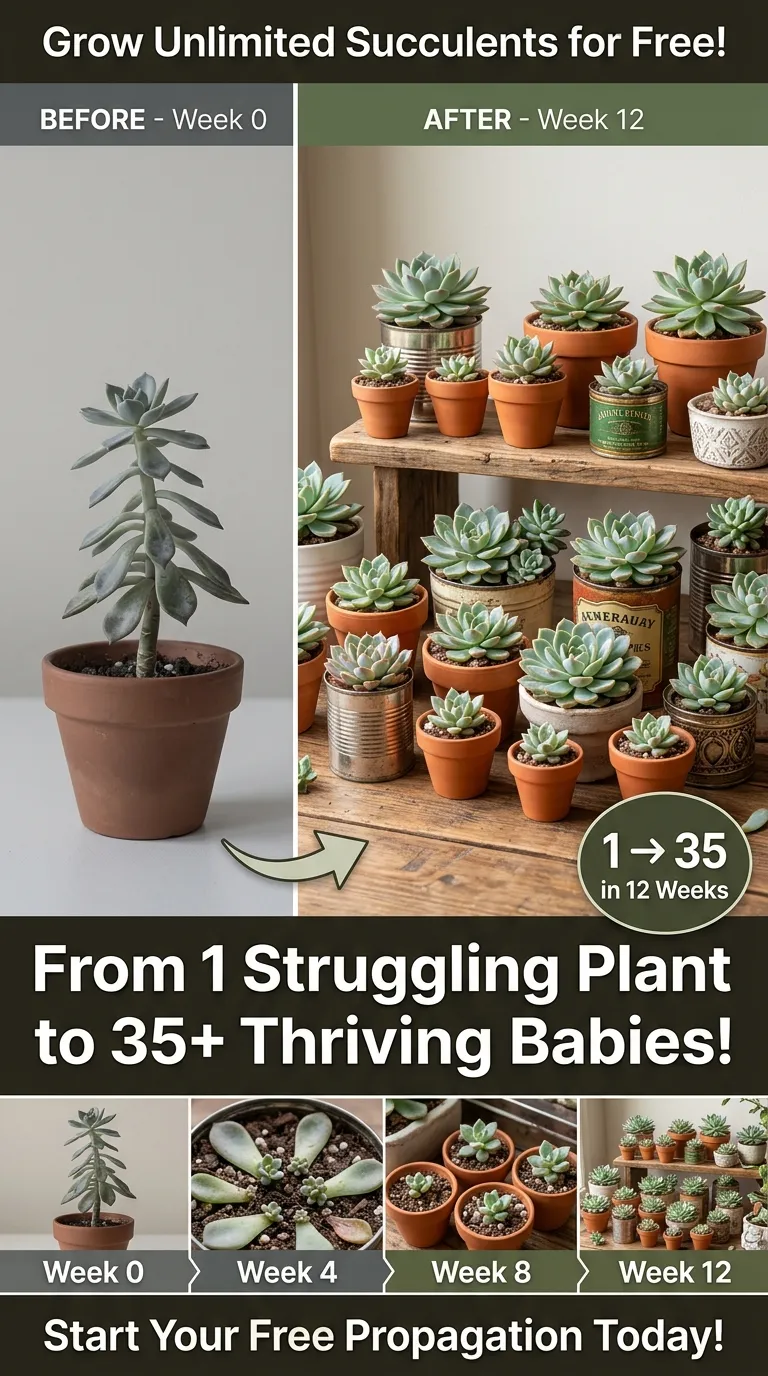
Propagating succulents is one of the most rewarding aspects of succulent gardening. With patience and these proven techniques, you’ll transform one plant into dozens—perfect for expanding your succulent garden, creating stunning succulent arrangements, filling succulent planters, or designing beautiful succulent centerpieces for gifts!
Key takeaways:
✓ Spring and summer offer best success rates
✓ Always callous before planting
✓ Less water is better than too much
✓ Patience pays off—propagation takes weeks, not days
✓ Experiment with different methods
Ready to multiply your collection? Start with 10 healthy leaves today and watch the magic happen!