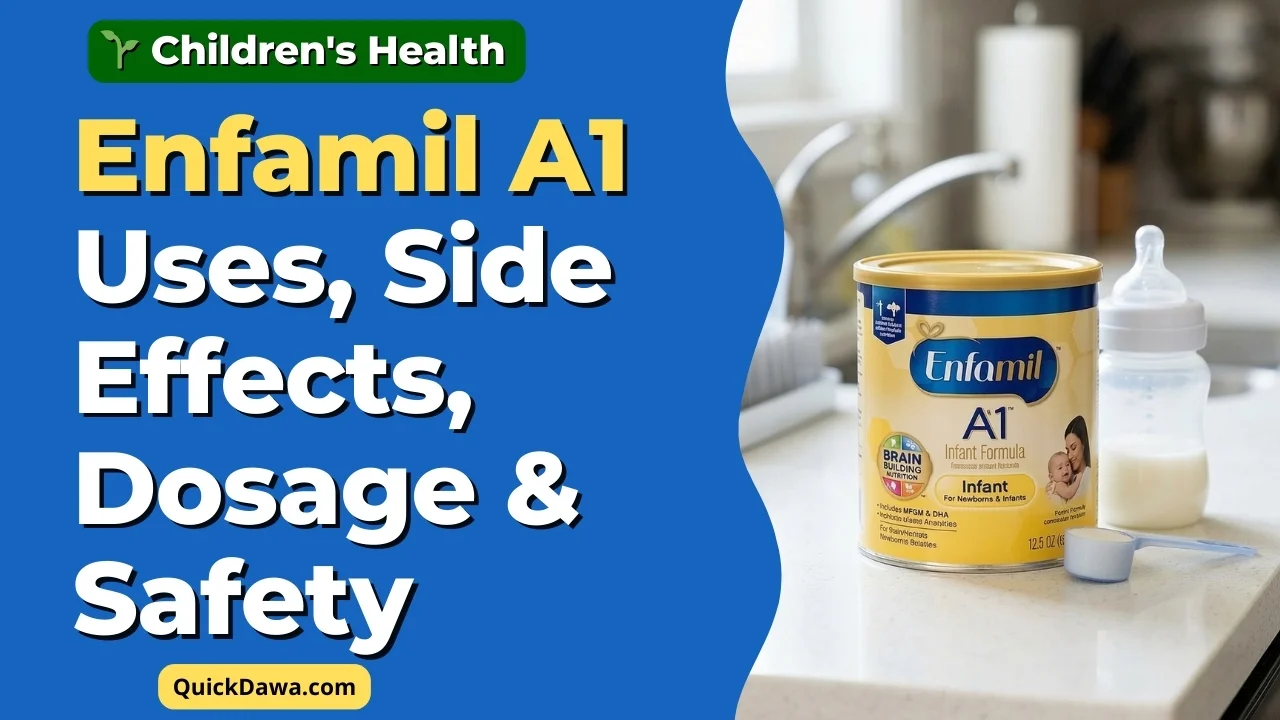
Enfamil A1 Uses, Side Effects, Dosage & Safety – Your Complete Parent’s Guide | Quick Dawa
Let’s be real for a moment.
Nothing worries a parent more than their baby’s nutrition.
Is my baby getting enough milk?
Is my baby growing properly?
What if I can’t breastfeed — what do I do?
These questions keep new parents up at night.
And if your doctor has recommended Enfamil A1 for your little one, you probably have a hundred questions running through your mind right now.
Is it safe?
What’s actually in it?
Will my baby have any side effects?
Take a deep breath.
You’re doing the right thing by researching before giving anything to your baby.
That’s what a good parent does.
And that’s exactly why we’re here.
At QuickDawa, we’re all about making health information easy to understand — so let’s break down everything you need to know about Enfamil A1 in simple, clear language that any parent can follow.
💊 What Is Enfamil A1?
Enfamil A1 (also known as Enfamil A+) is a milk-based infant formula designed for babies from birth up to 6 months old.
It is not a medicine.
It’s a specially formulated baby food that provides essential nutrition when breastfeeding is not possible, not sufficient, or not chosen.
It is manufactured by Mead Johnson Nutrition, which is now part of the Reckitt family of brands.
Enfamil A1 is one of the most widely trusted infant formula brands in the world.
It is enriched with DHA (docosahexaenoic acid) and ARA (arachidonic acid) — two important fatty acids that support your baby’s brain development and eye health.
Think of it as a carefully designed nutrition package for your baby when breast milk isn’t an option.
It comes in powder form and is mixed with water before feeding.
✅ Uses of Enfamil A1
So why do parents and doctors choose Enfamil A1?
Let’s go through all the reasons.
🍼 1. Primary Nutrition for Infants (0–6 Months)
This is the main purpose of Enfamil A1.
It is designed to be the sole source of nutrition for babies from birth to 6 months old.
When a mother cannot breastfeed — due to medical reasons, low milk supply, or personal choice — Enfamil A1 steps in as a reliable alternative.
It provides the calories, vitamins, minerals, and nutrients a newborn needs to grow healthy and strong.
🧠 2. Brain & Eye Development Support
This is where Enfamil A1 really shines.
It contains DHA and ARA — two fatty acids that are naturally found in breast milk.
DHA is a building block for your baby’s brain.
ARA supports healthy eye development.
Think of DHA and ARA like the construction workers building the foundation of your baby’s brain and vision during those critical first months.
Studies have shown that babies who get adequate DHA tend to have better cognitive development.
🦴 3. Bone & Teeth Development
Enfamil A1 contains calcium, phosphorus, and Vitamin D.
These are essential for building strong bones and healthy teeth in your growing baby.
Your baby’s skeleton is developing rapidly during the first 6 months.
This formula helps support that growth.
🛡️ 4. Immune System Support
The formula contains important nutrients like Vitamin C, Vitamin E, zinc, and iron.
These nutrients help support your baby’s developing immune system.
A strong immune system means your baby is better equipped to fight off common infections.
🥛 5. Supplementary Feeding
Some mothers produce breast milk but not enough to fully feed their baby.
In these cases, doctors often recommend Enfamil A1 as a supplement alongside breastfeeding.
This way, the baby gets the benefits of both breast milk AND formula nutrition.
💡 6. Feeding After Medical Conditions
Sometimes a mother may be taking medications that are not safe for breastfeeding.
Or the mother may have undergone surgery or is recovering from an illness.
In such situations, Enfamil A1 provides a safe and nutritious alternative for the baby.
🔬 How Does It Work?
Enfamil A1 is designed to mimic the nutritional profile of breast milk as closely as possible.
It contains a balanced blend of:
- Proteins — for muscle and tissue growth
- Carbohydrates (lactose) — for energy
- Fats (including DHA & ARA) — for brain and eye development
- Vitamins & Minerals — for overall health and immunity
When your baby drinks the formula, their tiny body absorbs these nutrients through the digestive system.
It’s like giving your baby a complete meal that covers all their nutritional needs in one bottle.
⚠️ Side Effects of Enfamil A1
Let’s address the elephant in the room.
Can Enfamil A1 cause side effects?
The short answer — most babies tolerate it very well.
But every baby is different.
Some babies may experience mild reactions, especially when they’re first introduced to formula.
Here’s what to watch for.
🟡 Common Side Effects (May Happen in Some Babies)
These are usually mild and temporary:
- Gas and bloating — Baby may seem fussy or uncomfortable after feeding. This is very common with formula and usually settles down as baby adjusts.
- Constipation — Some babies may have harder stools compared to breastfed babies. Formula-fed poop tends to be firmer, and that’s usually normal.
- Spit-up / Minor reflux — Some babies spit up small amounts after feeding. This is common in newborns and usually not a concern unless it’s excessive.
- Fussiness or colic-like behavior — Baby might be cranky or cry more after feeds, especially during the first few days of switching to formula.
- Mild diarrhea — Some babies may have loose stools initially as their digestive system adapts.
🟠 Less Common Side Effects
These happen less often but are worth knowing about:
- Rash or skin irritation — Could appear around the mouth, cheeks, or diaper area
- Excessive gas that doesn’t improve after a week or two
- Persistent vomiting (not just small spit-ups)
- Green-colored stools — Can sometimes occur and is usually harmless, but mention it to your doctor
🔴 Rare but Serious Side Effects (See a Doctor Immediately)
If you notice any of the following, stop the formula and contact your pediatrician right away:
- Signs of a milk allergy — hives, swelling (especially around face and lips), difficulty breathing, severe vomiting, or bloody stools
- Severe diarrhea that doesn’t stop
- Refusal to eat combined with unusual sleepiness or lethargy
- Wheezing or trouble breathing after feeding
- Signs of lactose intolerance — extreme bloating, watery diarrhea, severe stomach pain, and excessive crying after every feed
- Dehydration signs — dry mouth, no tears when crying, fewer wet diapers than usual, sunken soft spot on head
💚 Reassuring Note: Side effects don’t happen to every baby. The vast majority of infants do perfectly well on Enfamil A1. But as a parent, it’s important to know what to look for so you can act quickly if something doesn’t seem right. Trust your instincts — you know your baby best.
🚨 Warnings & Precautions
This section is very important for every parent to read.
🚫 Who Should NOT Use Enfamil A1?
Enfamil A1 should not be given to babies who:
- Have a confirmed cow’s milk protein allergy (CMPA) — This formula is milk-based and will trigger allergic reactions in these babies
- Have been diagnosed with galactosemia — a rare condition where the baby cannot process galactose (a sugar found in milk)
- Have severe lactose intolerance — the formula contains lactose as its primary carbohydrate
⚠️ If your baby has any known allergies or medical conditions, always consult your pediatrician before starting any formula.
🤱 Breast Milk Is Always the First Choice
This is something we want to be very clear about.
Breast milk is the gold standard for infant nutrition.
The World Health Organization (WHO) recommends exclusive breastfeeding for the first 6 months.
Enfamil A1 should be used only when breastfeeding is not possible, not sufficient, or not advised by a doctor.
It is a great alternative, but it does not completely replace the unique benefits of breast milk.
🧼 Hygiene Is Absolutely Critical
When preparing formula, cleanliness is everything.
- Always wash your hands thoroughly before preparing a bottle
- Sterilize all bottles, nipples, and utensils before every use
- Use clean, boiled, and cooled water for mixing
- Never reuse leftover formula — discard any formula your baby doesn’t finish within 1 hour
- Bacteria can grow rapidly in prepared formula, which can make your baby very sick
⏳ Prepared Formula Has a Shelf Life
Once you prepare a bottle:
- Use it within 1 hour if left at room temperature
- If refrigerated, use it within 24 hours
- Never microwave formula — it can create hot spots that burn your baby’s mouth
- Warm the bottle by placing it in warm water instead
🚰 Water Safety
Always use boiled and cooled water to prepare the formula.
Tap water may contain bacteria, minerals, or contaminants that are not safe for newborns.
Never use hot boiling water directly — let it cool to about 70°C (158°F) or as directed on the packaging.
📏 Follow the Exact Measurements
This is critical.
- Too much powder = concentrated formula = can strain your baby’s kidneys and cause dehydration
- Too little powder = diluted formula = your baby won’t get enough nutrition
Always use the scoop provided in the can and follow the instructions exactly.
More is NOT better when it comes to infant formula.
🍯 Never Add Anything Extra
Do not add sugar, honey, cereal, or any other substance to the formula.
Honey is especially dangerous for babies under 1 year old — it can cause infant botulism, a potentially life-threatening condition.
📦 Storage Tips
- Store unopened cans in a cool, dry place
- Once opened, use the powder within 4 weeks (or as directed on the label)
- Keep the lid tightly closed
- Do not store near strong-smelling products
- Always check the expiration date before use
🔄 Interactions to Be Aware Of
Enfamil A1 is a food product, not a medicine.
So it doesn’t have “drug interactions” in the traditional sense.
However, there are some important things to be aware of.
🔴 Important Interactions & Considerations
- Iron supplements — Enfamil A1 already contains iron. If your doctor has prescribed additional iron supplements, be aware that too much iron can cause constipation or stomach upset in your baby. Always let your doctor know that your baby is on iron-fortified formula.
- Vitamin D drops — Many pediatricians recommend Vitamin D drops for babies. Enfamil A1 contains Vitamin D, but the amount may not be sufficient depending on your region and baby’s needs. Talk to your doctor about whether your baby needs extra supplementation.
- Medications prescribed for baby — If your baby is on any prescribed medications (like reflux medicine or antibiotics), ask your doctor whether the formula affects the absorption or effectiveness of those medicines.
- Gripe water / Herbal remedies — Many parents give gripe water for colic or gas. While generally considered safe, always check with your pediatrician before combining any herbal remedies with formula feeding.
- Mixing with breast milk — Some parents mix formula powder directly into expressed breast milk. This is generally not recommended unless your doctor specifically advises it. Prepare formula with water first, then alternate between breast milk and formula bottles if needed.
📝 Important Reminder: Always tell your pediatrician about every supplement, vitamin drop, or remedy you’re giving your baby alongside Enfamil A1. Babies are tiny and their systems are sensitive — even small additions matter.
💉 Overfeeding / Missed Feeding
🆘 What If Your Baby Is Overfed? (Overfeeding)
Overfeeding can happen, especially with bottle-fed babies.
Here are signs your baby might be getting too much:
- Excessive spit-up or vomiting after most feeds
- Unusual fussiness and discomfort after eating
- Very rapid weight gain beyond normal growth curves
- Bloated or hard tummy
- Frequent loose stools
What to do:
- Don’t force your baby to finish the bottle — if baby turns away or stops sucking, they’re done
- Follow the recommended feeding amounts for your baby’s age and weight
- Talk to your pediatrician if you’re concerned about how much your baby is eating
- Feed on demand but watch for satiety cues — baby turning head away, closing mouth, pushing the bottle away
Remember: Babies are great at self-regulating their hunger.
Trust their cues.
⏰ What If You Miss a Feeding?
Babies need to eat regularly — typically every 2 to 4 hours for newborns.
If you miss or delay a feeding:
- Feed your baby as soon as possible
- Don’t try to make up for it by giving a larger amount at the next feed — this can cause overfeeding
- Get back on your regular feeding schedule
- Watch for signs of hunger — rooting, sucking on hands, fussiness, crying
If your baby seems unusually sleepy and skips feeds often, call your doctor.
Newborns should not go long stretches without eating.
📊 Dosage & Preparation Guide
Getting the preparation right is one of the most important things.
Here’s a general guide.
⚠️ This dosage information is for general awareness only. Always follow the instructions printed on your specific Enfamil A1 product packaging or your doctor’s recommendations.
📋 General Feeding Guide by Age
| Baby’s Age | Amount Per Feed | Number of Feeds Per Day |
|---|---|---|
| 0–1 week | 60–90 ml (2–3 oz) | 6–10 times |
| 1–2 weeks | 90–120 ml (3–4 oz) | 6–8 times |
| 2 weeks – 1 month | 120 ml (4 oz) | 6–8 times |
| 1–2 months | 120–150 ml (4–5 oz) | 5–7 times |
| 2–4 months | 150–180 ml (5–6 oz) | 5–6 times |
| 4–6 months | 180–240 ml (6–8 oz) | 4–5 times |
Note: Every baby is different. Some babies eat more, some eat less. Let your baby guide you.
🥄 How to Prepare Enfamil A1
Follow these steps carefully:
- Wash your hands thoroughly with soap and water
- Sterilize the bottle, nipple, cap, and measuring scoop
- Boil fresh drinking water for at least 1 minute
- Let the water cool down to about 70°C (158°F) or as directed on the label
- Pour the correct amount of cooled boiled water into the sterilized bottle
- Using the scoop provided, add the exact number of level scoops of powder (check the label for the correct ratio — usually 1 scoop per 60 ml of water)
- Cap the bottle and shake well until the powder is completely dissolved
- Check the temperature by dropping a little on the inside of your wrist — it should feel lukewarm, not hot
- Feed your baby immediately
- Discard any leftover formula within 1 hour
📦 Available Forms
Enfamil A1 is typically available in:
- Powder form (most common) — in cans or boxes of various sizes
- Some markets may offer ready-to-feed liquid versions
🩺 When to Call Your Doctor
As a parent, trust your gut.
If something feels off with your baby, it probably is.
Here are specific situations when you should call your pediatrician immediately:
- Your baby refuses to eat for more than one full feeding cycle
- Your baby vomits forcefully (projectile vomiting) after multiple feeds
- You notice blood or mucus in your baby’s stool
- Your baby develops a rash, hives, or swelling after feeding
- Your baby has difficulty breathing or makes wheezing sounds
- You see signs of dehydration — dry mouth, no tears, fewer than 6 wet diapers per day, sunken soft spot on the head
- Your baby has severe diarrhea that lasts more than 24 hours
- Your baby seems unusually sleepy, limp, or unresponsive
- Your baby is not gaining weight or is losing weight
- You suspect your baby has a milk allergy or lactose intolerance
- Your baby has a fever (temperature above 38°C / 100.4°F in babies under 3 months — this is always an emergency)
At QuickDawa, we always say — never hesitate to call your doctor when it comes to your baby. It’s always better to be safe.
🙋 Frequently Asked Questions (FAQ)
Here are the most commonly asked questions parents have about Enfamil A1.
Q: What is Enfamil A1 used for?
A: Enfamil A1 is an infant formula used to provide complete nutrition for babies from 0 to 6 months when breastfeeding is not possible or not enough. It contains DHA and ARA for brain and eye development.
Q: Is Enfamil A1 good for newborns?
A: Yes, Enfamil A1 is specifically designed for newborns and infants up to 6 months old. It is one of the most trusted infant formula brands worldwide. However, always consult your pediatrician before starting any formula.
Q: Can Enfamil A1 cause constipation in babies?
A: Some babies may experience mild constipation when switching to formula. This is usually temporary. If constipation persists or seems severe, talk to your doctor. They may suggest gentle remedies or a formula change.
Q: How do I know if my baby is allergic to Enfamil A1?
A: Signs of a possible allergy include hives, rash, vomiting, diarrhea (sometimes with blood), excessive crying, swelling, or breathing difficulty after feeding. If you notice any of these, stop the formula immediately and contact your doctor.
Q: Can I switch between breast milk and Enfamil A1?
A: Yes, many mothers combine breastfeeding with formula feeding. This is sometimes called “mixed feeding” or “combination feeding.” It’s perfectly fine and quite common. Just make sure to prepare the formula properly and maintain good hygiene.
🌐 Sources & External References
Here are trusted sources where you can learn more about infant formula nutrition and safety:
- FDA — Infant Formula Guidance — Official FDA information on infant formula regulations
- MedlinePlus — Infant and Newborn Nutrition — U.S. National Library of Medicine
- WHO — Infant and Young Child Feeding — World Health Organization guidelines
- WebMD — Formula Feeding FAQs — Trusted health resource for parents
- Mayo Clinic — Infant Formula: Your Questions Answered — Expert medical advice
- Enfamil Official Website — Manufacturer product information
🏁 Conclusion — You’re Doing a Great Job, Parent
Let’s wrap everything up.
Enfamil A1 is a trusted and widely used infant formula for babies from birth to 6 months.
It is packed with important nutrients like DHA, ARA, iron, calcium, and vitamins that support your baby’s growth and development.
It’s not a medicine — it’s a nutritional food designed to give your baby the best possible start in life when breast milk isn’t available.
Most babies tolerate it very well.
Some may experience mild issues like gas or fussiness, but these usually pass quickly.
The key things to remember?
✅ Breast milk is always the first choice — use formula only when needed.
✅ Follow the preparation instructions exactly — no shortcuts.
✅ Hygiene is everything — sterilize, wash hands, use clean water.
✅ Never add extras like sugar or honey to the formula.
✅ Trust your baby’s hunger cues — don’t force-feed.
✅ Call your doctor if anything seems wrong.
You’re already being an amazing parent just by reading this and wanting to learn more.
At QuickDawa, we believe that understanding what you give your baby is just as important as giving it. Knowledge is the first step toward better health — for you and your little one. If you found this guide helpful, share it with another parent who might need it — and explore more health guides on QuickDawa.com for trusted, easy-to-understand information.
Got questions about Enfamil A1 or anything related to your baby’s nutrition?
Drop a comment below or reach out to us through our QuickDawa Contact Page.
We’d love to hear from you! 💙
⚠️ Medical Disclaimer
The information provided in this article is intended for educational and informational purposes only. It is not a substitute for professional medical advice, diagnosis, or treatment. Always seek the guidance of your qualified doctor, pharmacist, or healthcare provider with any questions you may have regarding a medical condition, medication, or treatment plan.
Never disregard professional medical advice or delay seeking it because of something you read on QuickDawa.com or any other website. If you think you may have a medical emergency, call your doctor, go to the nearest emergency room, or call emergency services immediately.
Drug information, dosages, and interactions described in this post are provided for general awareness only and may not apply to your individual health situation. Medications affect people differently based on age, weight, health conditions, and other factors.
QuickDawa.com and its authors do not assume any liability for any consequences arising from the use or misuse of information presented on this website.