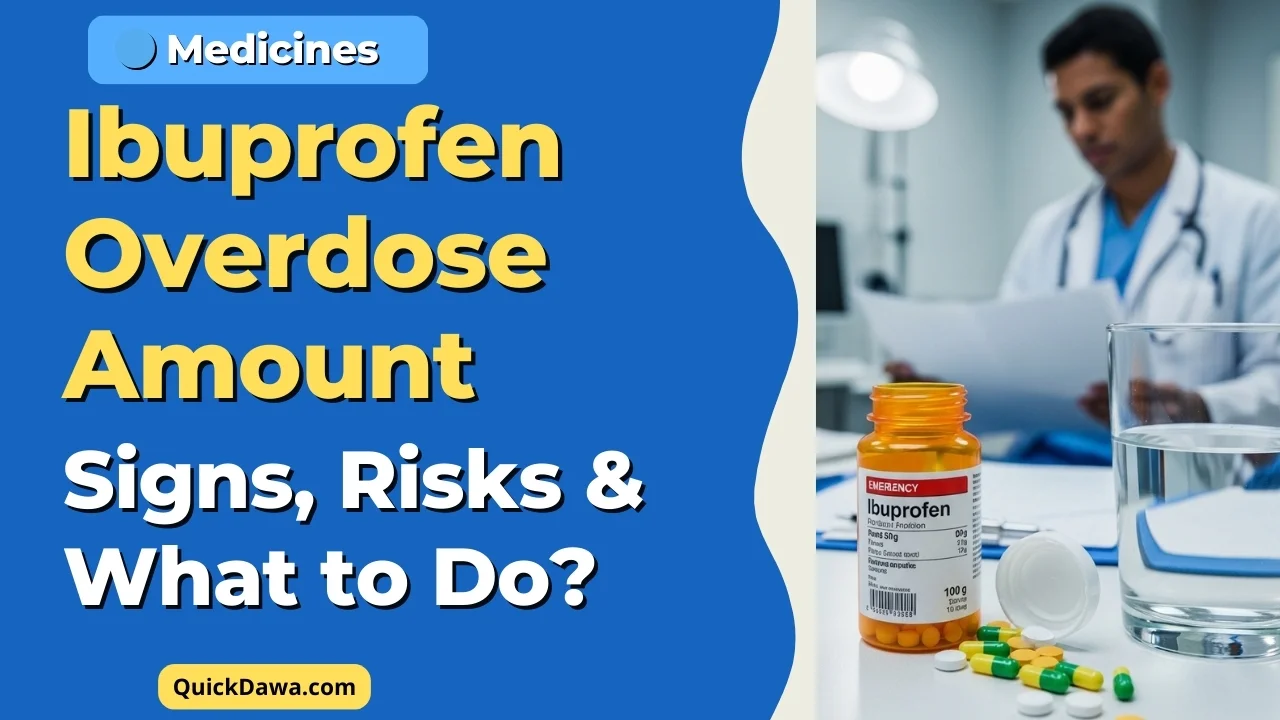
Ibuprofen Overdose Amount – How Much is Too Much? Signs, Risks & What to Do | QuickDawa
Let me paint a picture for you.
You’ve got a pounding headache that just won’t quit.
You took two ibuprofen tablets an hour ago — but the pain is still there.
So you think, “Maybe I’ll just take a couple more.”
And then a couple more after dinner.
Before you know it, you’ve lost count of how many you’ve taken today.
Sound familiar?
You’re not alone.
Millions of people around the world reach for ibuprofen every single day.
It’s sitting in almost every medicine cabinet.
It’s so common that we sometimes forget it’s still a real medication — with real risks.
And here’s the thing most people don’t realize: taking too much ibuprofen can actually be dangerous.
We’re talking stomach bleeding, kidney damage, and in extreme cases, life-threatening complications.
That’s exactly why understanding the ibuprofen overdose amount matters — not to scare you, but to keep you and your family safe.
At QuickDawa, we’re all about making medicine easy to understand — so let’s break down everything you need to know about ibuprofen overdose in simple, clear language.
No medical jargon.
No confusing charts.
Just honest, helpful information you can actually use.
💊 What Is Ibuprofen?

Ibuprofen is a nonsteroidal anti-inflammatory drug (NSAID).
It’s one of the most widely used over-the-counter pain relievers in the world.
You probably know it by brand names like Advil, Motrin, or Nurofen.
It works by reducing hormones in your body that cause pain, swelling, and fever.
People use it for headaches, toothaches, muscle pain, menstrual cramps, arthritis, and minor injuries.
It’s effective, affordable, and available without a prescription — which is exactly why people sometimes take more than they should.
🚫 The Ceiling Effect — Why More Isn’t Better
Here’s something most people don’t know.
With ibuprofen, there’s a point where taking more doesn’t give you more relief.
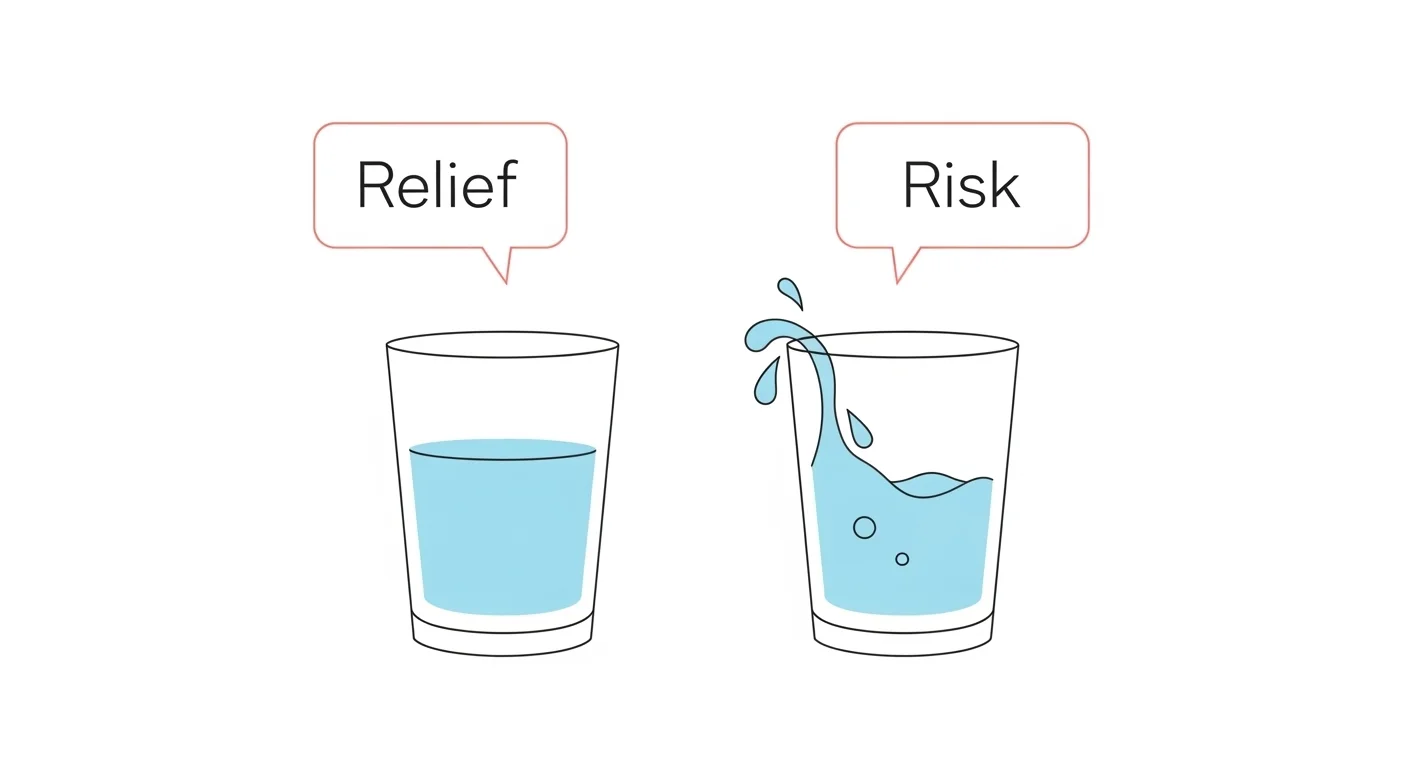
Doctors call this the “ceiling effect.”
Let me explain it simply.
Think of it like filling a glass of water.
Once the glass is full, pouring more water doesn’t give you a bigger glass — it just spills over and makes a mess.
Ibuprofen works the same way in your body.
After a certain dose, the pain-relieving benefits max out.
But the side effects?
Those keep climbing.
So What’s the Safe Amount?
For most healthy adults, the guidelines look like this:
- Single dose: 200mg to 400mg
- Maximum daily dose (OTC): 1,200mg per day (that’s three 400mg tablets)
- Maximum daily dose (prescription-strength, doctor-supervised): up to 3,200mg per day
- Never exceed the recommended dose without talking to your doctor
For children, the dose is based on weight, not age.
Always use the measuring tool that comes with children’s ibuprofen.
The key takeaway?
More ibuprofen does not equal more pain relief.
It just equals more risk.
⚠️ Ibuprofen Overdose Amount — How Much Is Too Much?
Now let’s answer the big question.
How much ibuprofen is considered an overdose?
Here’s what the medical community generally says:
- Mild toxicity can occur at doses above 200mg per kilogram of body weight.
- Serious toxicity usually happens at doses above 400mg per kilogram of body weight.
- The lethal dose of ibuprofen is estimated at around 600mg per kilogram or more — but this can vary widely.
Let me put that in real-world terms.
For a 70kg (154-pound) adult, mild toxicity could start around 14,000mg — that’s about 70 standard 200mg tablets.
But here’s the important part: you don’t need to reach those extreme numbers to get hurt.
Even taking just a little more than the recommended daily dose, especially over several days, can cause serious damage to your stomach, kidneys, and heart.
Chronic overuse is just as dangerous as a single massive dose.
So how much ibuprofen is too much?
Anything above the recommended daily limit of 1,200mg (OTC) without a doctor’s guidance is too much.
Period.
🤒 Signs and Symptoms of Ibuprofen Overdose

If someone has taken too much ibuprofen, the body will start sending warning signals.
Here are the most common signs of ibuprofen toxicity to watch for:
Mild to Moderate Symptoms:
- Nausea and vomiting
- Stomach pain or cramping
- Diarrhea
- Tinnitus (ringing in the ears)
- Headache (ironically)
- Dizziness or blurred vision
- Drowsiness
Severe Symptoms (Medical Emergency):
- Vomiting blood or material that looks like coffee grounds
- Black, tarry stools (sign of internal bleeding)
- Difficulty breathing
- Seizures
- Loss of consciousness
- Little or no urine output (kidney failure sign)
- Rapid or irregular heartbeat
- Severe drop in blood pressure
Tinnitus is one of the earliest red flags.
If you or someone you know starts hearing a ringing sound in the ears after taking ibuprofen, that’s the body saying, “Hey, that’s too much.”
Don’t ignore it.
🆘 Immediate Actions — What to Do If You Suspect an Ibuprofen Overdose
If you think someone has taken too much ibuprofen, time matters.
Here’s exactly what you should do:
Step 1: Stay Calm
Panicking won’t help anyone.
Take a breath and act quickly but calmly.
Step 2: Call Poison Control Immediately

In the United States, the number is:
📞 Poison Control: 1-800-222-1222
This hotline is free, confidential, and available 24 hours a day, 7 days a week.
They will tell you exactly what to do based on the situation.
Step 3: Call 911 (or Your Local Emergency Number)
If the person is:
- Unconscious
- Having seizures
- Not breathing properly
- Vomiting blood
Call emergency services immediately.
Don’t wait.
Step 4: Gather Information
While waiting for help, try to figure out:
- How many tablets were taken?
- What strength were the tablets (200mg, 400mg, 600mg)?
- When were they taken?
- Was anything else taken along with ibuprofen (alcohol, other medications)?
This information will be incredibly helpful for the medical team.
Step 5: Do NOT Do These Things
- ❌ Do not try to make the person vomit unless Poison Control tells you to.
- ❌ Do not give them food or water unless instructed.
- ❌ Do not wait to “see if they feel better.”
When it comes to a potential overdose, it is always better to be safe than sorry.
🏥 Treatment Protocols in the ER — What Happens at the Hospital
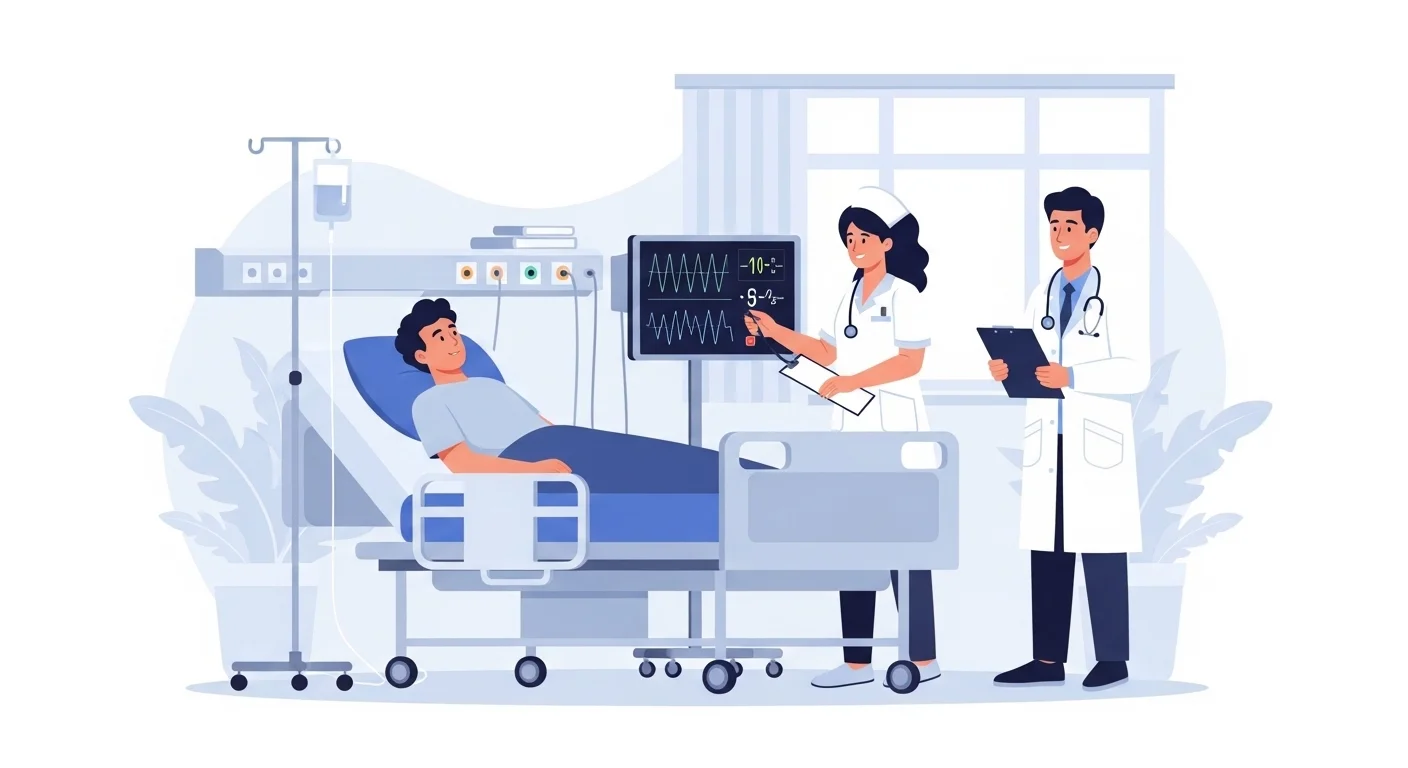
If someone arrives at the emergency room after an ibuprofen overdose, here’s what typically happens:
1. Assessment and Stabilization
The medical team will check vital signs — heart rate, blood pressure, oxygen levels, and temperature.
They’ll assess how alert and responsive the person is.
2. Activated Charcoal
If the overdose happened within the last 1–2 hours, doctors may give activated charcoal.
This works like a sponge in the stomach.
It absorbs the ibuprofen before the body can.
It’s most effective when given early.
3. Blood Tests
Doctors will run blood work to check:
- Kidney function
- Liver function
- Electrolyte levels
- Blood clotting ability
These tests help determine how much damage, if any, has occurred.
4. IV Fluids
Intravenous fluids are given to help:
- Protect the kidneys
- Prevent dehydration from vomiting
- Stabilize blood pressure
5. Monitoring
The patient will be monitored for several hours — sometimes overnight.
Doctors watch for delayed symptoms like internal bleeding or kidney problems.
6. Symptomatic Treatment
There’s no specific antidote for ibuprofen overdose.
Treatment is focused on managing symptoms and supporting the body while it processes the drug.
In severe cases, additional interventions may be needed for seizures, bleeding, or organ support.
The good news?
Most ibuprofen overdoses, when treated early, have a good outcome.
The key is acting fast and getting medical help right away.
🩺 When to Call a Doctor
You don’t need to wait for a full-blown emergency to reach out to a doctor.
Call your doctor or seek medical attention if:
- You accidentally took more than the recommended dose of ibuprofen
- You’ve been taking ibuprofen every day for more than 10 days without a doctor’s approval
- You notice stomach pain, dark stools, or blood in your vomit
- You experience swelling in your ankles or feet (possible kidney issue)
- You feel unusually tired or confused after taking ibuprofen
- You hear ringing in your ears
- You have pre-existing kidney, liver, or heart conditions and took ibuprofen
At QuickDawa, we always say this: when in doubt, call your doctor.
No question is too small when it comes to your health.
A quick phone call could save you from a serious problem down the road.
🙋 Frequently Asked Questions (FAQ)
Q: Can you take ibuprofen with acetaminophen (Tylenol) safely?
A: Yes, most adults can take ibuprofen and acetaminophen together — they work differently and don’t interact dangerously.
However, always follow the recommended doses for each, and check with your doctor first.
Q: How long does ibuprofen stay in your system?
A: Ibuprofen typically stays active in your body for about 4 to 6 hours.
It’s usually fully cleared from your system within 24 hours.
Q: Is ibuprofen safe for children under 12?
A: Ibuprofen can be given to children 6 months and older, but only in the correct dose based on their weight.
Never give adult-strength tablets to a child — always use the pediatric formulation.
Q: Ibuprofen vs. naproxen — which is safer for long-term use?
A: Naproxen (Aleve) lasts longer and may be slightly easier on the heart for long-term use.
But both carry similar risks for stomach and kidney problems — talk to your doctor about what’s best for you.
Q: Can you take ibuprofen for a toothache?
A: Absolutely — ibuprofen is one of the best OTC options for toothache pain because it reduces both pain and swelling.
A common recommendation is to alternate it with acetaminophen for stronger relief, but see a dentist for the underlying cause.
🌐 Sources & External References
Here are trusted sources where you can learn more about ibuprofen safety and overdose:
- FDA Drug Label — Ibuprofen — Official FDA information
- MedlinePlus — Ibuprofen — U.S. National Library of Medicine
- Drugs.com — Ibuprofen Full Information — Comprehensive drug details
- WebMD — Ibuprofen Oral — Uses, side effects, and interactions
- Mayo Clinic — Ibuprofen (Oral Route) — Dosing and precautions
- RxList — Ibuprofen — Professional drug information
🏁 Conclusion — Stay Informed, Stay Safe
Let’s wrap this up with the most important points.
Ibuprofen is a fantastic pain reliever — when used correctly.
But taking more than the recommended dose doesn’t make it work better.
It just increases the risk of serious side effects like stomach bleeding, kidney damage, and worse.
Know the ibuprofen overdose amount warning signs.
Stick to the safe daily limits.
And if you ever suspect an overdose — in yourself or someone else — call Poison Control at 1-800-222-1222 or go to the emergency room immediately.
Your health is not something to gamble with.
At QuickDawa, we believe that understanding your medicine is just as important as taking it. Knowledge is the first step toward better health. If you found this guide helpful, share it with someone who needs it — and explore more medicine guides on QuickDawa.com for trusted, easy-to-understand health information.
💬 Got a question about ibuprofen or any other medicine?
Drop it in the comments below or reach out to us through our QuickDawa Contact Page. We love hearing from you!
⚠️ Medical Disclaimer
The information provided in this article is intended for educational and informational purposes only. It is not a substitute for professional medical advice, diagnosis, or treatment. Always seek the guidance of your qualified doctor, pharmacist, or healthcare provider with any questions you may have regarding a medical condition, medication, or treatment plan.
Never disregard professional medical advice or delay seeking it because of something you read on QuickDawa.com or any other website. If you think you may have a medical emergency, call your doctor, go to the nearest emergency room, or call emergency services immediately.
Drug information, dosages, and interactions described in this post are provided for general awareness only and may not apply to your individual health situation. Medications affect people differently based on age, weight, health conditions, and other factors.
QuickDawa.com and its authors do not assume any liability for any consequences arising from the use or misuse of information presented on this website.