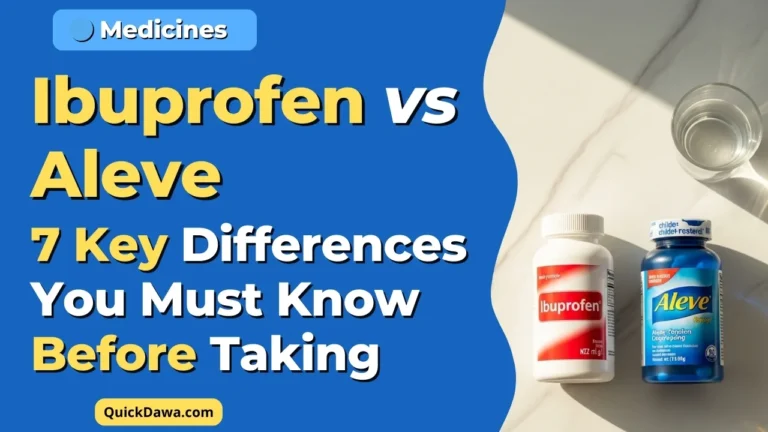
Naproxen vs Ibuprofen – Key Differences, Side Effects & Which One Is Better for You
You’re standing in the pain relief aisle at the pharmacy.
Your back is killing you. Or maybe it’s a nasty headache. Or your knee is swollen after a weekend run.
You look at the shelves. There’s Aleve on one side. Advil on the other. Both say they relieve pain. Both say they reduce inflammation.
So… which one do you grab?
This is one of the most common questions people have. And honestly? Most people just pick whichever one they recognize first without knowing the actual difference.
But here’s the thing — naproxen and ibuprofen are NOT the same medicine. They’re similar, yes. They belong to the same drug family. But they work differently in your body. They last different amounts of time. And they come with different risks.
Choosing the right one can mean better pain relief with fewer side effects.
At QuickDawa, we’re all about making medicine easy to understand — so let’s break down the naproxen vs ibuprofen debate in simple, clear language. No medical degree needed.
💊 What Are Naproxen and Ibuprofen?
Let’s start with the basics.
Both naproxen and ibuprofen belong to a drug class called NSAIDs — which stands for Nonsteroidal Anti-Inflammatory Drugs.
That’s a fancy way of saying they fight three things: pain, inflammation, and fever — without using steroids.
🔹 Naproxen (Brand Name: Aleve)
- Drug class: NSAID
- Most popular brand: Aleve (OTC), Naprosyn (prescription)
- Manufacturer: Bayer (for Aleve)
- Available: Over-the-counter and prescription strengths
- Been around since: 1976
🔹 Ibuprofen (Brand Name: Advil, Motrin)
- Drug class: NSAID
- Most popular brands: Advil, Motrin
- Manufacturer: Pfizer/Haleon (for Advil), Johnson & Johnson (for Motrin)
- Available: Over-the-counter and prescription strengths
- Been around since: 1969
Both drugs have been used by millions of people for decades. They’re trusted, effective, and widely available.
But the differences between them matter more than you think.
🤝 How Are They Similar?
Before we dive into the differences, let’s cover what these two have in common. Because they share a LOT.
Both naproxen and ibuprofen:
- ✅ Are NSAIDs — same drug family
- ✅ Relieve mild to moderate pain
- ✅ Reduce inflammation and swelling
- ✅ Bring down fevers
- ✅ Work by blocking COX enzymes (the enzymes that produce prostaglandins — the chemicals that cause pain, swelling, and fever)
- ✅ Are available over the counter without a prescription
- ✅ Also come in prescription-strength versions
- ✅ Carry the same FDA Black Box Warning about cardiovascular and gastrointestinal risks
- ✅ Can irritate the stomach lining
- ✅ Should be taken with food or milk to reduce stomach issues
So if they’re so similar, why does it matter which one you pick?
Great question. Let’s get into the real differences.
🔍 Key Differences — Naproxen vs Ibuprofen
This is the section everyone’s here for. Let’s lay it out clearly.
Here’s a head-to-head comparison table:
| Feature | Naproxen (Aleve) | Ibuprofen (Advil/Motrin) |
|---|---|---|
| How long it lasts | 8–12 hours | 4–6 hours |
| How fast it works | 30–60 minutes | 20–30 minutes |
| How often you take it | Every 8–12 hours | Every 4–6 hours |
| Daily pill count | Fewer pills per day | More pills per day |
| OTC max daily dose | 660 mg (3 pills) | 1,200 mg (6 pills of 200 mg) |
| Strength per OTC pill | 220 mg | 200 mg |
| Stomach irritation | Slightly higher risk | Slightly lower risk |
| Cardiovascular risk | Possibly slightly lower | Possibly slightly higher with long-term high doses |
| Best for | Long-lasting pain, arthritis, menstrual cramps | Quick relief, headaches, fevers, dental pain |
| Safe for kids? | Not under 12 (OTC) | Yes, from age 6 months+ (infant formulations) |
| Available as liquid for kids? | Prescription only | Yes — widely available OTC |
Let me break down the most important differences in plain English.
🔹 Duration — This Is the Biggest Difference
Naproxen lasts longer. A single dose can keep you comfortable for up to 12 hours. That means you might only need to take it twice a day.
Ibuprofen wears off faster. It typically lasts about 4–6 hours. So you’ll need to take it more often — usually 3–4 times a day.
If your pain is constant — like arthritis or chronic back pain — naproxen’s longer duration means fewer doses and less hassle.
If your pain is occasional — like a one-time headache — ibuprofen’s quick kick-in time might be all you need.
🔹 Speed — Ibuprofen Is Faster
Need relief NOW?
Ibuprofen starts working in about 20–30 minutes. Naproxen takes closer to 30–60 minutes.
It’s not a huge gap. But when your head is pounding, those extra minutes feel like forever.
🔹 Stomach Friendliness
Neither one is exactly gentle on the stomach. Both can cause heartburn, nausea, and stomach irritation.
But research suggests that naproxen may be slightly harder on the stomach than ibuprofen — possibly because it stays in your system longer, giving it more time to irritate the stomach lining.
That said, both carry the same FDA warning about stomach ulcers and bleeding. Taking either one with food helps a lot.
🔹 Heart Safety
This is where it gets interesting.
All NSAIDs carry a cardiovascular risk. But some studies suggest that naproxen may be slightly safer for the heart compared to other NSAIDs, including ibuprofen — especially at higher, long-term doses.
The American Heart Association has noted that naproxen may carry the lowest cardiovascular risk among NSAIDs. But “may” is the keyword here. The research is still evolving.
If you have heart disease or are at high risk, talk to your doctor before taking either one.
🔹 Kid-Friendliness
This one’s pretty clear-cut.
Ibuprofen wins for kids. It’s available in infant drops and children’s liquid suspensions. It’s approved for babies as young as 6 months old (with a doctor’s guidance).
Naproxen (Aleve) is NOT recommended for children under 12 in OTC form. Prescription versions exist for kids with conditions like juvenile arthritis, but dosing must be supervised by a doctor.
If you’re a parent looking for a fever or pain reliever for your little one, ibuprofen is the go-to NSAID.
✅ Uses Compared — Which One Is Better for What?
Both drugs treat similar conditions. But certain situations favor one over the other.
Let’s go condition by condition.
🔹 Headaches & Migraines
Winner: Ibuprofen (for most people)
Ibuprofen kicks in faster, which makes it a better choice when you want quick headache relief. For migraines, both can help, but ibuprofen is more commonly recommended as a first-line OTC option.
That said, if your headaches tend to last all day, naproxen’s longer duration might serve you better.
🔹 Back Pain
Winner: Naproxen
Back pain — especially chronic lower back pain — tends to stick around. Naproxen’s 12-hour relief means you don’t have to keep popping pills throughout the day. Many doctors prefer naproxen for ongoing musculoskeletal pain.
🔹 Arthritis (Osteoarthritis & Rheumatoid Arthritis)
Winner: Naproxen (slight edge)
For arthritis, you need consistent, long-lasting pain and inflammation control. Naproxen’s extended duration makes it more convenient. Many rheumatologists lean toward naproxen for daily arthritis management.
Ibuprofen works too — you’ll just need to take it more frequently.
🔹 Menstrual Cramps (Period Pain)
Winner: Naproxen
Here’s why: menstrual cramps can last hours. Naproxen’s longer action means one or two doses can cover you through the worst of it. It’s also specifically effective at blocking the prostaglandins that cause uterine contractions.
Many gynecologists recommend naproxen as a top choice for period pain.
🔹 Toothache / Dental Pain
Winner: Ibuprofen
Dental pain often needs fast relief — especially after a procedure or when you’re waiting to see a dentist. Ibuprofen’s quicker onset makes it the better choice. Many dentists specifically recommend ibuprofen for post-procedure pain.
🔹 Fever
Winner: Ibuprofen (especially for children)
Both reduce fever effectively. But ibuprofen works faster and is available in kid-friendly liquid formulations. It’s also approved for much younger children than naproxen.
For adults, either one works fine.
🔹 Sports Injuries / Sprains / Strains
Winner: Tie — depends on the situation
For immediate pain relief right after an injury, ibuprofen’s speed is helpful. For ongoing pain from a healing sprain or strain, naproxen’s duration is more convenient.
Some athletic trainers recommend starting with ibuprofen and switching to naproxen after the first day or two.
🔹 Gout
Winner: Naproxen
Naproxen is commonly prescribed for acute gout attacks. It’s effective at reducing the intense inflammation and pain that gout causes. Prescription-strength naproxen is often the go-to choice for gout flare-ups.
⚠️ Side Effects Compared
Since both drugs are NSAIDs, they share many of the same side effects. But there are some nuances.
🟢 Common Side Effects (Both Drugs)
These are mild and usually manageable:
- Stomach pain or upset — the #1 complaint with any NSAID
- Nausea — that queasy feeling, especially on an empty stomach
- Heartburn / acid reflux — that burning feeling in your chest
- Headache — yes, a pain reliever can cause one. Life is ironic.
- Dizziness — mild lightheadedness
- Bloating or gas
Naproxen may cause slightly more stomach irritation because it stays in your body longer.
Ibuprofen may cause slightly more kidney-related issues with frequent or high-dose use, though this applies to both.
🟡 Less Common Side Effects
- Ringing in the ears (tinnitus) — more common with higher doses
- Constipation or diarrhea
- Rash or itching
- Swelling in hands, feet, or ankles (fluid retention)
- Elevated blood pressure — both NSAIDs can nudge blood pressure up
- Difficulty sleeping — more reported with naproxen
🔴 Rare but Serious Side Effects (Both Drugs — Seek Help Immediately)
These are uncommon but can be life-threatening. They apply to both naproxen and ibuprofen:
- Stomach ulcers or GI bleeding — black/tarry stools, vomiting blood, severe stomach pain. This is the most serious GI risk with all NSAIDs. Elderly patients are at higher risk.
- Heart attack or stroke — chest pain, sudden weakness on one side, slurred speech, sudden severe headache. Risk increases with long-term or high-dose use.
- Severe allergic reaction (anaphylaxis) — trouble breathing, facial swelling, severe hives. Call 911 immediately.
- Kidney damage — decreased urination, swelling, extreme fatigue. Both NSAIDs reduce blood flow to kidneys.
- Liver problems — jaundice (yellowing of skin/eyes), dark urine, severe exhaustion
- Severe skin reactions (Stevens-Johnson Syndrome) — blistering, peeling skin. Extremely rare but a medical emergency.
💡 Reassuring note: Side effects don’t happen to everyone. Millions of people use both naproxen and ibuprofen every day without any problems at all. But it’s important to be aware — because knowing the warning signs can genuinely save your life. Short-term use at the lowest effective dose is always the smartest approach.
🚨 Warnings & Precautions for Both NSAIDs
Both naproxen and ibuprofen carry the same FDA Black Box Warning. This is the strongest safety warning the FDA can issue.
Let’s go through the critical warnings.
⚫ FDA BLACK BOX WARNING (Applies to Both)
Cardiovascular Risk: NSAIDs may increase the risk of serious cardiovascular events, including heart attack and stroke. This risk may be greater with longer use and higher doses. People with existing heart disease or risk factors are at the greatest risk.
Gastrointestinal Risk: NSAIDs increase the risk of serious GI events, including bleeding, ulcers, and perforation of the stomach or intestines. These can occur without warning and can be fatal. Elderly patients are at higher risk.
⚠️ Do NOT take either drug right before or after coronary artery bypass graft (CABG) surgery.
🔹 Who Should NOT Take Either Drug?
- People with a known allergy to naproxen, ibuprofen, aspirin, or any other NSAID
- People who’ve had asthma attacks, hives, or facial swelling triggered by aspirin or NSAIDs
- People with active stomach ulcers or GI bleeding
- People in the third trimester of pregnancy (after 30 weeks)
- People scheduled for or recovering from CABG heart surgery
🔹 Pregnancy & Breastfeeding
- Both drugs should be avoided in the third trimester. They can cause serious heart problems in the unborn baby and complications during delivery.
- During the first and second trimesters, use only if your doctor specifically says it’s okay.
- Both pass into breast milk in small amounts. Ibuprofen is generally considered the safer NSAID for breastfeeding mothers because less of it gets into the milk and it’s been studied more extensively in this context.
🔹 Kidney & Liver Considerations
- Both drugs are processed by the kidneys and liver.
- If you have chronic kidney disease, both can make it worse.
- If you have liver disease, your body may not clear the drug properly, increasing side effects.
- Never take both drugs at the same time. Doubling up on NSAIDs doubles your risk without doubling your benefit.
🔹 Elderly Patients (65+)
Older adults are more vulnerable to:
- Stomach bleeding
- Kidney problems
- Cardiovascular events
- Falls caused by dizziness
The rule for seniors: lowest dose, shortest time. Regular check-ups with a doctor are essential.
🔹 Alcohol Warning
Avoid alcohol with both drugs.
Alcohol irritates the stomach lining. NSAIDs irritate the stomach lining. Combine them, and you’re asking for trouble — specifically stomach bleeding and ulcers.
If you drink 3 or more alcoholic beverages a day, the risk is significantly higher.
🔹 Driving & Machinery
Both drugs can cause dizziness or drowsiness in some people. If either one affects you this way, don’t drive or operate heavy machinery until you know how your body handles it.
🔄 Drug Interactions
Both NSAIDs interact with many of the same drugs. Here’s what to watch out for:
| Drug / Substance | Type of Interaction | What Happens |
|---|---|---|
| Aspirin (low-dose, for heart) | Major | Both naproxen and ibuprofen can interfere with aspirin’s heart-protective effects. Naproxen interferes less than ibuprofen if timed properly (take naproxen 2 hours after aspirin). |
| Warfarin / Blood Thinners | Major | Both increase the risk of dangerous bleeding. |
| ACE Inhibitors / ARBs (blood pressure meds) | Major | Both can reduce the effectiveness of blood pressure medications and harm kidneys. |
| Lithium | Major | Both can raise lithium levels to potentially toxic amounts. |
| Methotrexate | Major | Both can increase methotrexate to dangerous levels. |
| SSRIs (antidepressants) | Moderate | Combining SSRIs with either NSAID increases GI bleeding risk. |
| Diuretics (water pills) | Moderate | Both reduce the effectiveness of diuretics and strain kidneys. |
| Other NSAIDs | Major | NEVER take two NSAIDs together. No extra benefit — only extra risk. |
| Alcohol | Major | Dramatically increases stomach bleeding risk with both drugs. |
| Ginkgo Biloba / Fish Oil | Moderate | Both supplements thin the blood. Adding an NSAID increases bleeding risk. |
| Corticosteroids (Prednisone) | Moderate | Combining increases the risk of GI ulcers and bleeding. |
📌 Always tell your doctor or pharmacist about every medicine, supplement, or herbal product you’re currently taking before starting naproxen or ibuprofen. This includes vitamins, fish oil, turmeric, garlic supplements — everything.
Here at QuickDawa, we always stress this point. Drug interactions are sneaky. What feels harmless can sometimes be dangerous when combined.
💉 Overdose & Missed Dose
Let’s cover both drugs together here. The advice is similar for both.
🔸 Overdose — What Happens If You Take Too Much?
Taking too much of either naproxen or ibuprofen can be dangerous. It often happens when people:
- Take multiple products that both contain NSAIDs without realizing it
- Take doses too close together
- Exceed the maximum daily limit
Signs and symptoms of NSAID overdose:
- Severe nausea and vomiting
- Stomach pain (may be intense)
- Drowsiness or extreme fatigue
- Ringing in the ears
- Headache
- Blurred vision
- Blood in vomit or stool
- Seizures (in severe cases)
- Slow, shallow breathing
What to do if you suspect an overdose:
- Call Poison Control immediately: 1-800-222-1222 (U.S.)
- Go to the nearest emergency room. Don’t wait to see if symptoms improve.
- Bring the medicine bottle with you.
Do NOT try to make yourself vomit unless a medical professional tells you to.
Do NOT take a double dose to make up for a missed one. Ever.
🔸 Missed Dose
If you’re taking either drug on a regular schedule and you miss a dose:
- Take it as soon as you remember — unless it’s almost time for the next dose.
- If your next dose is coming up soon, skip the missed one.
- Never double up. Taking two doses at once dramatically increases your risk of side effects.
If you’re using these drugs “as needed” for occasional pain, missing a dose isn’t really an issue. Just take it when the pain returns.
📊 Dosage Comparison
Here’s a side-by-side dosage overview for both drugs.
| Dosage Detail | Naproxen (Aleve) | Ibuprofen (Advil/Motrin) |
|---|---|---|
| OTC pill strength | 220 mg per tablet | 200 mg per tablet |
| Adult starting dose | 220 mg every 8–12 hours | 200–400 mg every 4–6 hours |
| Max OTC daily dose | 660 mg (3 tablets) | 1,200 mg (6 tablets of 200 mg) |
| Max prescription daily dose | Up to 1,000–1,500 mg | Up to 3,200 mg |
| Children’s OTC dose | Not for under 12 | Available for 6 months+ (dose by weight) |
| Elderly dose | Lowest effective dose | Lowest effective dose |
| Available forms | Tablets, liquid gels, delayed-release, oral suspension (Rx) | Tablets, caplets, liquid gels, chewables, infant drops, oral suspension |
Key takeaway: Naproxen = fewer pills, less often. Ibuprofen = more flexibility in dosing, especially for children.
⚠️ “This dosage information is for general awareness only. Always follow your doctor’s prescription or the instructions on your medicine packaging.”
🙋 Frequently Asked Questions — FAQ
Q: Is naproxen stronger than ibuprofen?
A: Dose for dose, naproxen is more potent. A single 220 mg naproxen tablet provides roughly the same pain relief as a 400 mg ibuprofen dose. Plus, naproxen lasts much longer — up to 12 hours compared to ibuprofen’s 4–6 hours. So you could say naproxen “goes the distance,” even though both are effective pain relievers.
Q: Can I take naproxen and ibuprofen together?
A: No. You should never take two NSAIDs at the same time. They work through the same mechanism, so combining them doesn’t give you double the benefit — it gives you double the risk. Double the stomach irritation. Double the kidney strain. Double the bleeding risk. Pick one. Stick with it.
Q: Which is better for back pain — naproxen or ibuprofen?
A: For chronic or long-lasting back pain, naproxen is usually the better choice because its effects last up to 12 hours. For a sudden, short-lived backache, ibuprofen’s faster onset might be more helpful. Many doctors lean toward naproxen for ongoing musculoskeletal pain.
Q: Which is safer for the stomach?
A: Neither one is truly “stomach-friendly” — both can cause irritation, heartburn, and even ulcers. But ibuprofen may be slightly gentler on the stomach for most people because it clears from the body faster. That said, the difference is small. Taking either one with food significantly reduces stomach risk.
Q: Which is safer for the heart?
A: Some studies suggest that naproxen may carry a slightly lower cardiovascular risk compared to ibuprofen and other NSAIDs. The American Heart Association has noted this. But the difference isn’t huge, and the research is still evolving. If you have heart disease, talk to your doctor before taking any NSAID.
Q: Can I switch between naproxen and ibuprofen?
A: Yes, you can switch — but don’t take them at the same time or overlap doses. If you want to switch from ibuprofen to naproxen (or vice versa), wait until your last dose has worn off before taking the other. And always check with your pharmacist if you’re unsure about timing.
Q: Can I take either one with acetaminophen (Tylenol)?
A: Yes! This is actually a common strategy doctors recommend. Acetaminophen works differently than NSAIDs — it targets pain and fever in the brain, while NSAIDs work on inflammation throughout the body. Taking them together (or alternating them) can provide better pain relief than either one alone. Just be careful not to exceed the maximum dose for each. Check out our acetaminophen guide on QuickDawa for more details.
🏁 Conclusion — So, Which One Should You Choose?
Alright, let’s wrap this up with a simple bottom line.
There’s no single “winner” in the naproxen vs ibuprofen debate. The best choice depends on YOUR specific situation.
Here’s the cheat sheet:
Choose Naproxen (Aleve) if:
- ✅ Your pain is long-lasting (arthritis, chronic back pain)
- ✅ You want fewer pills per day
- ✅ You have menstrual cramps
- ✅ You’re dealing with a gout flare-up
- ✅ You’re concerned about heart health (it may carry slightly lower cardiovascular risk)
Choose Ibuprofen (Advil/Motrin) if:
- ✅ You need fast relief NOW (headaches, toothaches)
- ✅ You’re treating a child’s fever or pain
- ✅ Your pain is short-lived and occasional
- ✅ You want slightly less stomach irritation
- ✅ You’re breastfeeding (it’s generally preferred over naproxen)
Golden rule for both: Use the lowest dose that works, for the shortest time necessary. Take with food. Don’t combine two NSAIDs. And if you have any chronic health condition — heart disease, kidney issues, liver problems, or stomach ulcers — talk to your doctor first.
At QuickDawa, we believe that understanding your medicine is just as important as taking it. Knowledge is the first step toward better health. If you found this guide helpful, share it with someone who needs it — and explore more medicine guides on QuickDawa.com for trusted, easy-to-understand health information.
💬 Still have a question about naproxen, ibuprofen, or which one is right for you? Drop it in the comments below or reach out through our contact page. We love hearing from our readers!
⚠️ Medical Disclaimer
The information provided in this article is intended for educational and informational purposes only. It is not a substitute for professional medical advice, diagnosis, or treatment. Always seek the guidance of your qualified doctor, pharmacist, or healthcare provider with any questions you may have regarding a medical condition, medication, or treatment plan.
Never disregard professional medical advice or delay seeking it because of something you read on QuickDawa.com or any other website. If you think you may have a medical emergency, call your doctor, go to the nearest emergency room, or call emergency services immediately.
Drug information, dosages, and interactions described in this post are provided for general awareness only and may not apply to your individual health situation. Medications affect people differently based on age, weight, health conditions, and other factors.
QuickDawa.com and its authors do not assume any liability for any consequences arising from the use or misuse of information presented on this website.
🌐 Sources & External References
Here are trusted, authoritative sources for more information on both drugs:
- FDA — NSAID Medication Guide — Official FDA information on all NSAIDs
- MedlinePlus — Naproxen — U.S. National Library of Medicine
- MedlinePlus — Ibuprofen — U.S. National Library of Medicine
- Drugs.com — Naproxen vs Ibuprofen Comparison — Detailed head-to-head comparison
- Mayo Clinic — Naproxen — Trusted medical institution
- Mayo Clinic — Ibuprofen — Trusted medical institution
- WebMD — Naproxen vs Ibuprofen — Consumer-friendly comparison