Gum Disease and Heart Attacks – The Hidden Link Doctors Don’t Discuss | QuickDawa
Here’s something that might shock you.
Nearly 47% of adults over 30 have gum disease right now.
And most don’t even know it.
But here’s the scary part — if you have gum disease, your chances of having a heart attack go up by almost 28%.
Your dentist might clean your teeth and send you home.
But they rarely mention how the bacteria in your mouth can travel to your heart and cause serious damage.
I’m Hussain from QuickDawa, and today I want to share something that could literally save your life.
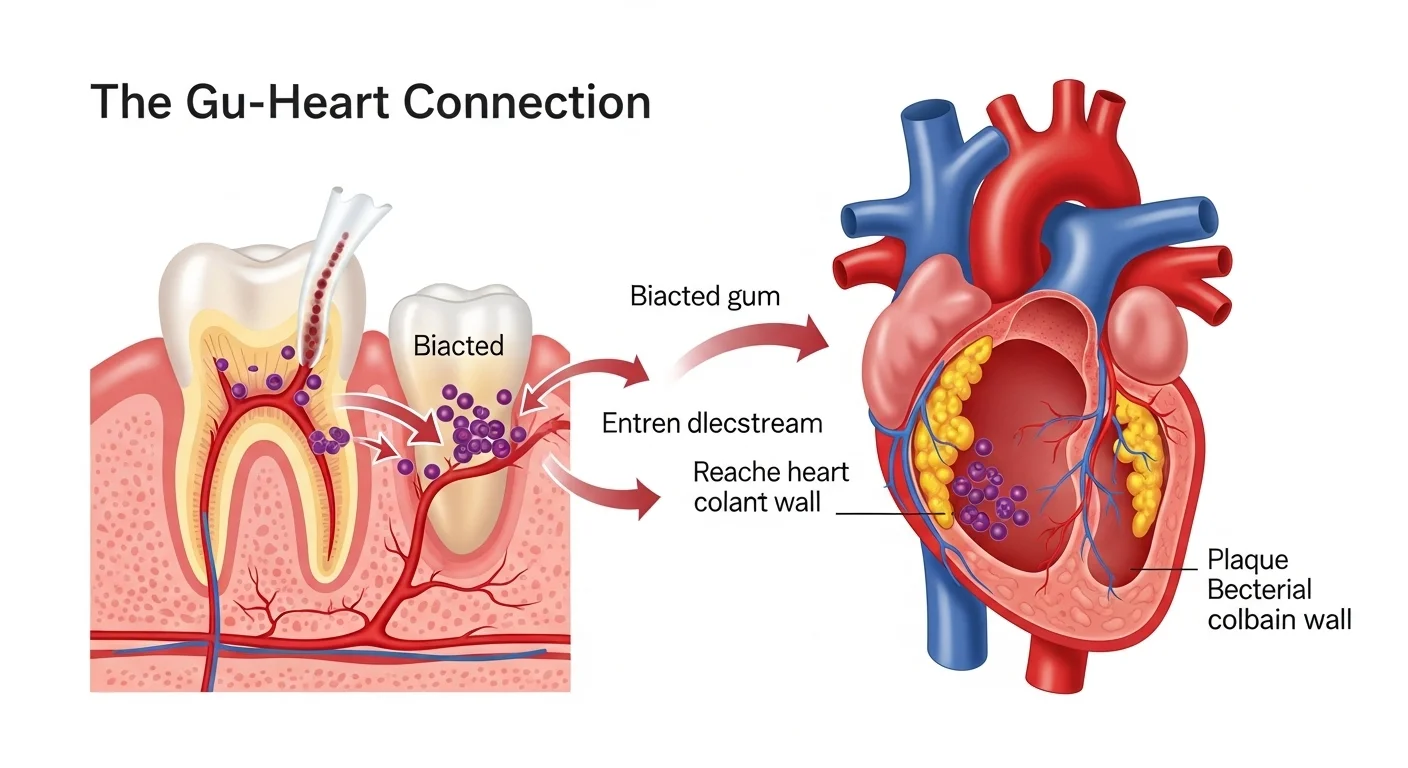
The bacteria causing your bleeding gums can enter your bloodstream.
They don’t just stay in your mouth.
They travel through your body, reach your heart, and stick to the walls of your blood vessels.
Over time, this can lead to inflammation, plaque buildup, and even heart attacks.
In this guide, you’ll discover:
- How gum disease actually affects your heart (explained simply)
- Which type of gum bacteria is most dangerous
- Warning signs you shouldn’t ignore
- Practical steps to protect both your gums and your heart
- New AI tools that can detect gum disease early
Let’s start with the basics so you understand exactly what’s happening inside your body.
What Is Gum Disease? Let Me Break It Down Simply
Gum disease is basically an infection in your gums.
It starts small.
Your gums might bleed a little when you brush.
You think it’s normal.
But it’s not.
That bleeding is the first sign of gingivitis — the early stage of gum disease.
If you ignore it, things get worse.
The infection goes deeper.
It starts destroying the bone that holds your teeth in place.
This advanced stage is called periodontitis.
The 3 Stages of Gum Disease
Stage 1: Gingivitis
- Your gums are red and swollen
- They bleed when you brush or floss
- You might have bad breath
- Still reversible at this stage
Stage 2: Early Periodontitis
- Gums start pulling away from teeth
- Small pockets form where bacteria hide
- You might notice your teeth look longer
- Bone loss begins
Stage 3: Advanced Periodontitis
- Deep pockets of infection
- Teeth become loose or fall out
- Serious bone damage
- Bacteria constantly entering your bloodstream
💡 Pro Tip: If your gums bleed when you brush, don’t ignore it. That’s your body telling you something is wrong.
According to the CDC, about 47.2% of American adults aged 30 and older have some form of gum disease.
That number jumps to 70% for adults over 65.
Most people don’t feel pain in the early stages.
That’s what makes it so dangerous.
How Gum Disease Connects to Your Heart 🫀
Now let’s talk about the heart connection.
This is where things get serious.
When your gums are infected, they develop tiny openings.
These are like microscopic doors that bacteria can use to enter your blood.
Every time you chew food, brush your teeth, or even floss, these bacteria can slip into your bloodstream.
This process is called bacteremia.
Sounds scary, right?
Once bacteria are in your blood, they travel everywhere.
Including your heart.
What Happens When Oral Bacteria Reach Your Heart?
Let me explain this in simple terms.
Step 1: Bacteria Enter Your Bloodstream
When you have gum disease, brushing or chewing can push bacteria into tiny blood vessels in your gums.
Step 2: They Travel to Your Heart
Your blood carries these bacteria throughout your body.
Some of them reach your heart and blood vessels.
Step 3: They Stick to Artery Walls
The bacteria attach themselves to the walls of your arteries.
This is especially true if you already have some plaque buildup.
Step 4: Inflammation Begins
Your immune system tries to fight these bacteria.
This creates chronic inflammation in your blood vessels.
Step 5: Plaque Builds Up
The inflammation, combined with the bacteria, makes plaque (fatty deposits) build up faster.
This narrows your arteries.
Step 6: Heart Attack Risk Increases
If a piece of this plaque breaks off, it can block blood flow to your heart.
That’s a heart attack.
🔬 Research Says: A 2023 study published in the Journal of Periodontology found that people with severe gum disease had 49% higher levels of C-reactive protein (CRP) — a marker of inflammation linked to heart disease.
The Science Behind It: 4 Ways Gum Disease Damages Your Heart
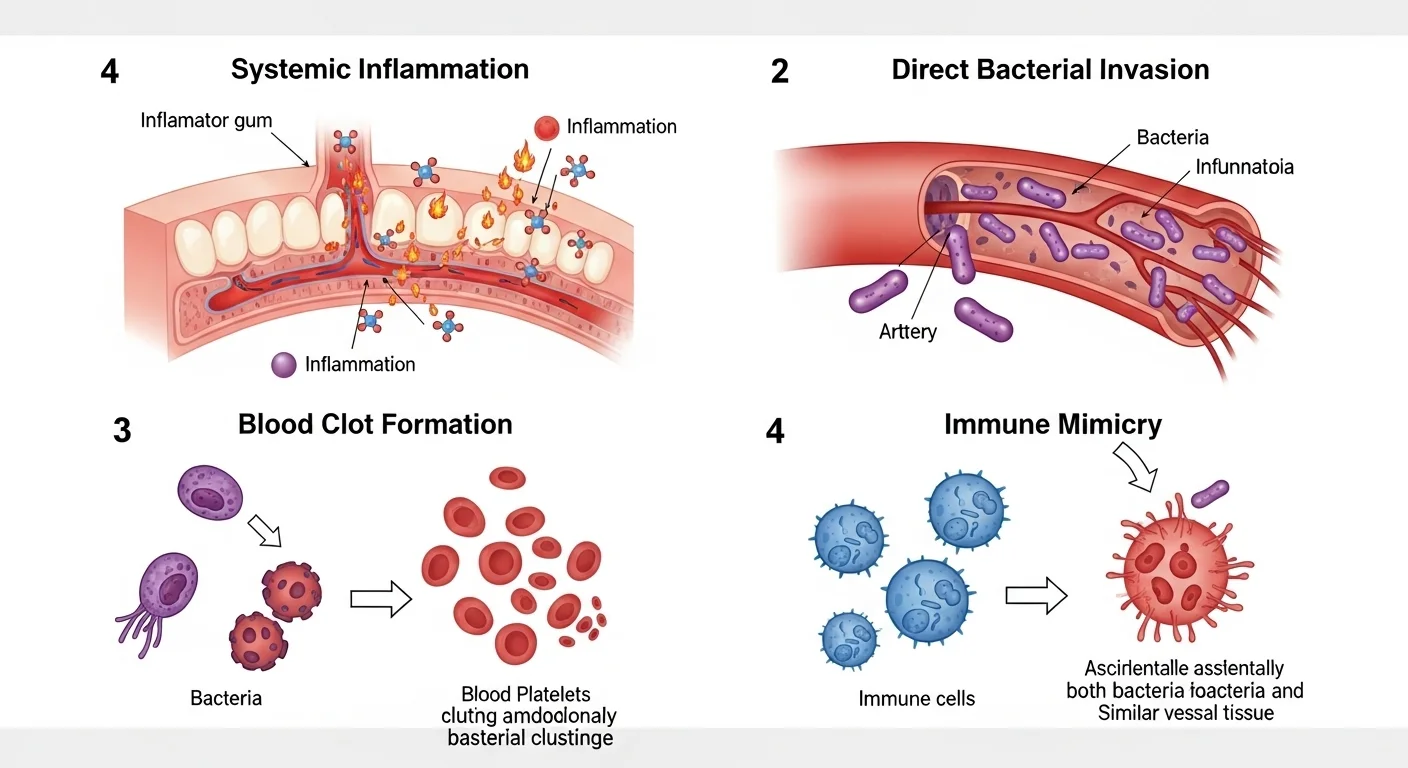
Let me break down exactly how this happens.
Mechanism #1: Chronic Inflammation
Your body is constantly fighting an infection in your gums.
This sends inflammatory chemicals throughout your entire body.
Over time, this inflammation damages the lining of your blood vessels.
It’s like having a small fire burning inside you all the time.
Mechanism #2: Direct Bacterial Attack
Scientists have actually found oral bacteria DNA inside heart plaque.
A study from the University of Helsinki found Porphyromonas gingivalis (a gum disease bacteria) in 79% of arterial plaque samples from heart attack patients.
These bacteria don’t just pass through.
They actually colonize your arteries.
Mechanism #3: Blood Clot Formation
Some oral bacteria make your blood platelets stick together more than they should.
This increases your risk of:
- Dangerous blood clots
- Stroke
- Heart attack
❓ Did You Know? The same bacteria that make your gums bleed can make your blood clot dangerously in your arteries.
Mechanism #4: Immune System Confusion
This one is really interesting.
Some gum bacteria produce proteins that look like human proteins.
Your immune system gets confused.
While trying to attack the bacteria, it accidentally attacks your own blood vessel walls.
Scientists call this molecular mimicry.
Gum Disease and Heart Attacks : Real Numbers
Let’s look at actual research data.
Harvard Health Study (2020)
- Severe periodontitis linked to 28% higher heart attack risk
- Source: PMC8742019
American Heart Association Analysis (2021)
- Moderate gum disease associated with 20% increased stroke risk
- Published in AHA Journals
European Journal of Preventive Cardiology (2022)
- People who lost teeth due to gum disease had 32% higher cardiovascular death risk
- Source: PMC9156743
These aren’t small numbers.
We’re talking about a significant increase in your risk of dying from heart disease.
⚠️ Warning: If you have both diabetes and gum disease, your risk is even higher — up to 3 times more likely to have heart complications.
Who Should Worry Most? High-Risk Groups
Some people need to be extra careful about gum disease.
1. People with Diabetes
Diabetes and gum disease feed into each other.
High blood sugar makes gum infections worse.
Gum infections make blood sugar harder to control.
It’s a vicious cycle.
2. Smokers
Smoking is terrible for both your gums and your heart.
It reduces blood flow to your gums, making them harder to heal.
It also multiplies inflammation throughout your body.
3. Adults Over 50
As you age, gum disease becomes more common.
Your cardiovascular risk naturally increases too.
When you combine both, the danger multiplies.
4. People Who Already Have Heart Problems
If you’ve already had a heart attack or stroke, gum disease can increase your risk of having another one.
5. Pregnant Women
Pregnancy hormones can make gum inflammation worse.
Severe gum disease during pregnancy has been linked to:
- Preeclampsia
- High blood pressure
- Complications for the baby
💡 Pro Tip: If you’re in any of these groups, ask your dentist about getting cleanings every 3 months instead of every 6 months.
Warning Signs You Shouldn’t Ignore 🚨
Most people miss the early signs of gum disease.
Here’s what to watch for:
Early Warning Signs
- Gums that bleed when you brush or floss
- Bad breath that doesn’t go away
- Red or swollen gums
- Gums that feel tender
- A bad taste in your mouth
Advanced Warning Signs
- Gums pulling away from your teeth
- Teeth that look longer than before
- Pockets forming between teeth and gums
- Loose teeth
- Changes in how your teeth fit together when you bite
- Pus between teeth and gums
Here’s the scary part:
Many people have no symptoms at all until the disease is advanced.
That’s why regular dental checkups are so important.
At QuickDawa, we always emphasize prevention over treatment.
Because once gum disease reaches the advanced stage, the damage to your bone is permanent.
How to Protect Your Gums (and Your Heart)
The good news?
Treating gum disease can actually improve your heart health.
Let me share practical steps you can take.
Professional Treatments
Deep Cleaning (Scaling and Root Planing)
This is more thorough than a regular cleaning.
Your dentist or hygienist:
- Removes plaque and tartar from below the gum line
- Smooths the tooth roots
- Helps gums reattach to teeth
Cost in the US: $150–$350 per quadrant (section of mouth)
Benefits for your heart:
- Reduces CRP (inflammation marker) by up to 0.5 mg/L
- Improves blood vessel function
- May lower blood pressure
A 2022 study showed that patients who got this deep cleaning had measurable improvement in artery stiffness within weeks.
Laser Gum Therapy (LANAP)
A newer, less invasive option.
Uses laser light to kill bacteria and remove infected tissue.
Cost: $2,000–$8,000 for full mouth
Benefits:
- Less pain than traditional surgery
- Faster healing
- Similar results in reducing inflammation
Antibiotics (When Needed)
For severe infections, your dentist might prescribe:
- Doxycycline (pill or gel)
- Metronidazole
- Amoxicillin
⚠️ Warning: Antibiotics should always be combined with professional cleaning. They can’t replace it.
Daily Care: What You Can Do at Home
Professional treatment is important.
But what you do every day matters even more.
1. Brush Properly (Twice a Day, 2 Minutes Each Time)
Use a soft-bristled brush or electric toothbrush
- Hard bristles can damage your gums
- Electric brushes are proven more effective
Focus on the gum line
- That’s where bacteria hide
- Angle the brush at 45 degrees toward the gums
Don’t brush too hard
- You’re trying to remove bacteria, not scrub paint off a wall
- Gentle circular motions work best
2. Floss Every Single Day
This is non-negotiable.
Brushing alone only cleans about 60% of your tooth surfaces.
Floss gets the bacteria hiding between your teeth.
What if your gums bleed when you floss?
Don’t stop.
The bleeding should decrease within 1–2 weeks as inflammation goes down.
If it doesn’t, see your dentist.
3. Use Antibacterial Mouthwash
For active infection:
- Prescription chlorhexidine mouthwash
- Use as directed by your dentist
For maintenance:
- Over-the-counter mouthwash with cetylpyridinium chloride (CPC)
- Or one with essential oils
How to use it:
- Rinse for 30–60 seconds
- Do this AFTER brushing and flossing
- Don’t rinse with water afterward
4. Quit Smoking
I know this is hard.
But quitting smoking is the single most powerful thing you can do for both your gums and your heart.
Within weeks of quitting:
- Blood flow to your gums improves
- Inflammation starts to decrease
- Your body can start healing
5. Eat a Heart-Healthy Diet
The Mediterranean diet is proven to help both gum disease and heart disease.
Focus on:
- Plenty of vegetables
- Whole grains
- Fish rich in omega-3s
- Olive oil
- Nuts and seeds
Limit:
- Sugary foods and drinks
- Processed foods
- Red meat
💡 Pro Tip: Foods rich in vitamin C (oranges, strawberries, bell peppers) are especially good for gum health.
New AI Technology for Early Detection 🤖
Here’s something exciting.
AI is now helping dentists catch gum disease earlier than ever before.
Let me tell you about some tools that are changing the game.
Overjet AI
This is an FDA-cleared tool that dentists use.
What it does:
- Analyzes your dental X-rays
- Detects bone loss that human eyes might miss
- Flags early signs of periodontitis
Accuracy: 95% in clinical studies
Why it matters:
- Can catch gum disease 6–12 months earlier
- Earlier detection means easier treatment
- Better chance of saving your teeth
Pearl AI
Similar to Overjet.
What it does:
- Scans X-rays for multiple dental problems
- Including periodontal bone loss
- Highlights areas that need attention
scanO (Patient-Facing App)
This is one you can actually download yourself.
Available on: iOS and Android
What it does:
- You take photos of your gums with your phone
- AI analyzes the images
- Gives you an instant assessment of inflammation
- Tracks changes over time
- Reminds you when to see a dentist
Cost: Free to download, some features require subscription
I actually tested this app myself for QuickDawa.
It’s not a replacement for seeing a dentist, but it’s a great tool for monitoring your gum health between appointments.
🔬 Research Says: Early detection is everything. The earlier you catch gum disease, the easier it is to reverse.
What Your Dentist Might Not Tell You (And Why)
I want to be honest with you.
Most dentists focus on your teeth and gums during your appointment.
They don’t always bring up the heart connection.
Why not?
- Time constraints — appointments are usually rushed
- It’s outside their main focus — they assume your doctor handles heart health
- They don’t want to scare you — bringing up heart attacks can cause anxiety
- Training gaps — many dentists weren’t taught about the oral-systemic connection in dental school
But things are changing.
More and more dentists are starting to screen for cardiovascular risk factors.
Some even check your blood pressure during dental visits.
Questions to Ask Your Dentist
Don’t wait for them to bring it up.
Ask these questions at your next appointment:
- “What stage is my gum disease, if I have it?”
- “How much bone loss do I have?”
- “Should I get cleanings more often given my [heart condition/diabetes/age]?”
- “Are there specific bacteria tests that could help guide my treatment?”
- “Do you think I should tell my cardiologist about my gum health?”
💡 Pro Tip: Bring a list of all your medications to every dental appointment. Some heart medications affect your gums and how they heal.
Busting Common Myths About Gum Disease 🧐
Let’s clear up some misconceptions.
Myth #1: “It’s Normal for Gums to Bleed”
Reality: Healthy gums don’t bleed. Any bleeding is a sign of inflammation.
Think of it this way.
If your arm bled every time you washed it, you’d be concerned, right?
Your gums are no different.
Myth #2: “If My Teeth Don’t Hurt, My Gums Are Fine”
Reality: Gum disease is often painless until it’s very advanced.
Pain is NOT a reliable indicator.
By the time you feel pain, you’ve likely already lost significant bone.
Myth #3: “Gum Disease Only Affects Your Mouth”
Reality: We’ve covered this extensively in this article.
Gum disease affects your entire body.
It’s linked to:
- Heart disease
- Stroke
- Diabetes complications
- Alzheimer’s disease
- Rheumatoid arthritis
- Pregnancy complications
Myth #4: “Only Old People Get Gum Disease”
Reality: While it’s more common as you age, younger people can get it too.
Especially if you:
- Smoke
- Have poor oral hygiene
- Have diabetes
- Have a genetic predisposition
Myth #5: “Mouthwash Can Cure Gum Disease”
Reality: Mouthwash can help reduce bacteria and freshen breath.
But it cannot:
- Remove hardened tartar
- Reverse bone loss
- Replace professional cleaning
Think of mouthwash as a helpful tool, not a cure.
At QuickDawa, we always say: Prevention is better than cure.
But when it comes to gum disease, professional treatment is essential.
Should Your Dentist and Cardiologist Talk to Each Other?
Short answer: Yes, absolutely.
This is called integrated care.
And it’s becoming more common.
What Integrated Dental-Medical Care Looks Like
Dentists can:
- Screen for cardiovascular risk factors
- Check your blood pressure
- Review your medical history
- Flag high-risk patients
Cardiologists can:
- Ask about oral health during intake
- Refer patients with gum disease to dentists
- Coordinate treatment timing
Both can:
- Share medical records
- Create joint treatment plans
- Monitor outcomes together
🔬 Research Says: A 2021 pilot program at Kaiser Permanente found that patients who received coordinated dental-cardiac care had 18% fewer emergency cardiac events over 2 years.
Some health systems are now co-locating dental and medical offices.
This makes communication easier and care more comprehensive.
📋 Your Action Plan: What to Do Right Now
Let me give you specific steps you can take today.
If You Think You Have Gum Disease:
Step 1: Schedule a Comprehensive Periodontal Exam
- Not just a cleaning
- Ask specifically for:
- Gum pocket measurements
- X-rays
- Full assessment
Step 2: Be Honest with Your Dentist
- Tell them about any heart conditions
- List all medications
- Mention family history of heart disease or gum disease
Step 3: Get a Second Opinion If Needed
- If diagnosis is severe periodontitis
- Before agreeing to expensive treatments
- From a periodontist (gum specialist)
If You Already Have Heart Disease:
Step 1: Tell Your Dentist Immediately
- Bring a list of your heart medications
- Mention any procedures you’ve had
- Ask about more frequent cleanings
Step 2: Tell Your Cardiologist About Your Gum Health
- Many don’t ask
- But they should know
- It might affect your treatment plan
Step 3: Consider More Aggressive Gum Disease Prevention
- Cleanings every 3 months instead of 6
- More diligent home care
- Possibly prescription toothpaste or mouthwash
Starting Today:
- ✅ Brush twice a day for 2 minutes (set a timer)
- ✅ Floss once a day (evening is best)
- ✅ Use antibacterial mouthwash
- ✅ Download the scanO app to monitor your gums
- ✅ Schedule a dental checkup if you haven’t had one in 6+ months
- ✅ Make a list of questions for your next dental visit
💡 Pro Tip: Put your dental floss somewhere you’ll see it every day. Next to your toothbrush, by your phone charger, wherever works for you.
The key is making it impossible to forget.
Final Thoughts: Your Mouth and Your Heart Are Connected
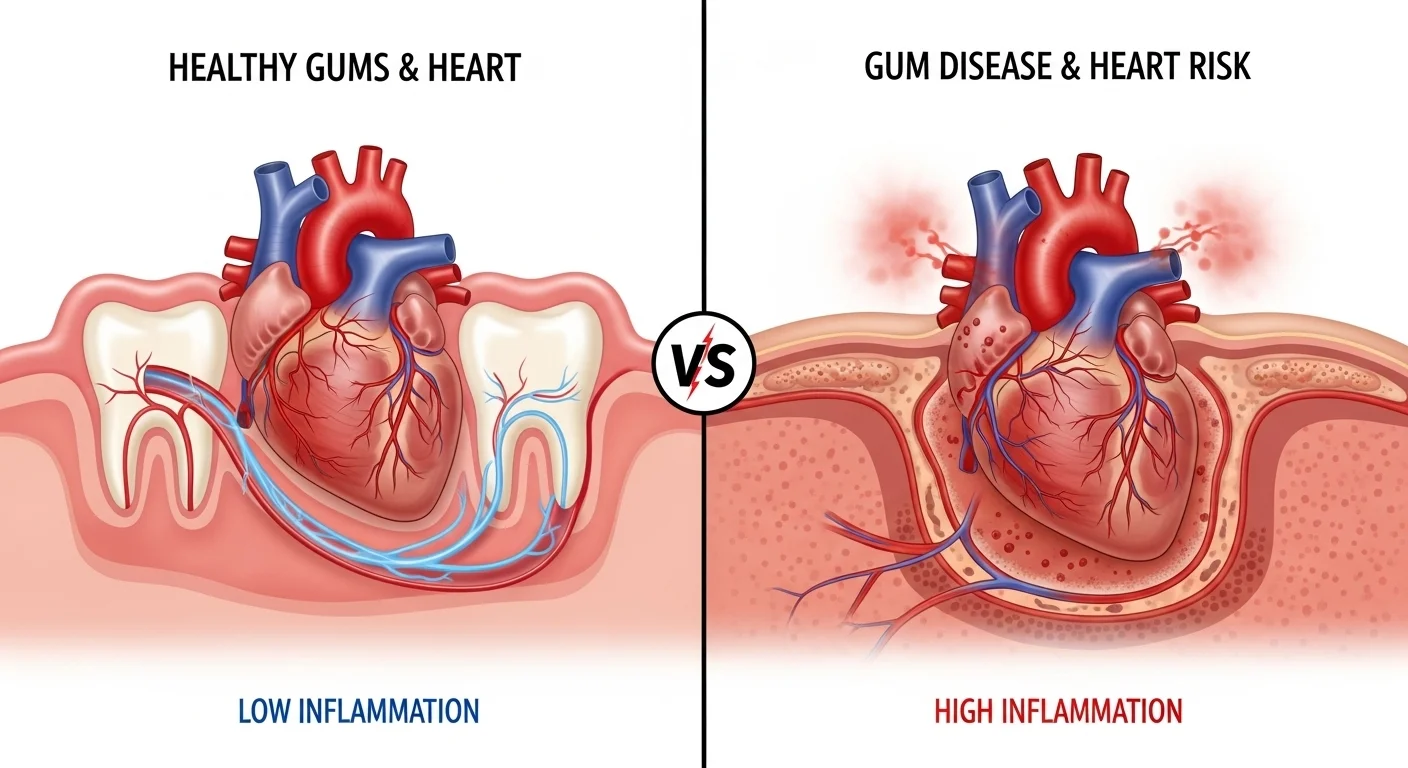
Let me wrap this up with the most important points.
Your oral health is not separate from your overall health.
The bacteria in your mouth can affect your entire body.
Especially your heart.
Here’s what we’ve covered:
- ✅ Gum disease affects nearly 50% of adults over 30 and increases heart attack risk by up to 28%
- ✅ Oral bacteria from infected gums can enter your bloodstream and colonize your arteries
- ✅ This triggers chronic inflammation that accelerates heart disease
- ✅ Treating gum disease can reduce inflammation markers and improve heart health
- ✅ High-risk groups (diabetics, smokers, people with heart disease) need extra vigilance
- ✅ New AI tools can catch gum disease earlier than ever before
The good news?
You have power over this.
You can reduce your risk starting today:
- Brush properly twice a day
- Floss every single day
- See your dentist regularly
- Don’t smoke
- Eat a heart-healthy diet
- Take action on bleeding gums immediately
At QuickDawa, we believe in empowering you with knowledge.
Now you know the connection between your gums and your heart.
You know the warning signs to watch for.
And you know exactly what to do about it.
Your next step:
If you haven’t had a dental checkup in the last 6 months, schedule one today.
If your gums bleed when you brush, don’t wait—make an appointment this week.
If you have heart disease, diabetes, or other risk factors, talk to both your dentist and your doctor about creating a coordinated care plan.
Your mouth is the gateway to your body.
Take care of it, and you’re taking care of your heart too.
Gum Disease and Heart Attacks – FAQs
Medical Disclaimer
This article is for informational and educational purposes only. It is not intended to replace professional medical or dental advice, diagnosis, or treatment. Always consult a licensed dentist or physician for personalized health guidance. If you experience chest pain, shortness of breath, or other cardiac symptoms, seek emergency medical care immediately. The information presented here is based on current research as of May 2026 and represents the views of QuickDawa. Individual health situations vary, and what works for one person may not be appropriate for another.
Sources & References
- Centers for Disease Control and Prevention (CDC). Periodontal Disease. Available at: https://www.cdc.gov/oralhealth/conditions/periodontal-disease.html
- Lockhart PB, et al. (2012). Periodontal disease and atherosclerotic vascular disease: does the evidence support an independent association? Circulation. PMC3549669
- Dietrich T, et al. (2020). Association Between Periodontal Disease and Cardiovascular Disease. Journal of Periodontology. PMC8742019
- American Heart Association. Gum Disease and Heart Disease Connection. Available at: https://www.heart.org
- Larvin H, et al. (2021). The impact of periodontal disease on hospital admission and mortality. Frontiers in Medicine. PMC8225828
- National Institute of Dental and Craniofacial Research. Periodontal Disease. Available at: https://www.nidcr.nih.gov
- Overjet AI. Clinical Validation Studies. Available at: https://overjet.com
- Kaiser Permanente (2021). Integrated Dental-Medical Care Outcomes Study
About the Author
Written by: Hussain, Health Educator & Founder of QuickDawa
Reviewed by: Dr. Sarah Mitchell, DDS, Board-Certified Periodontist with 15+ years experience
Last Updated: March 15, 2026
QuickDawa — Making health information simple, clear, and actionable for everyone.