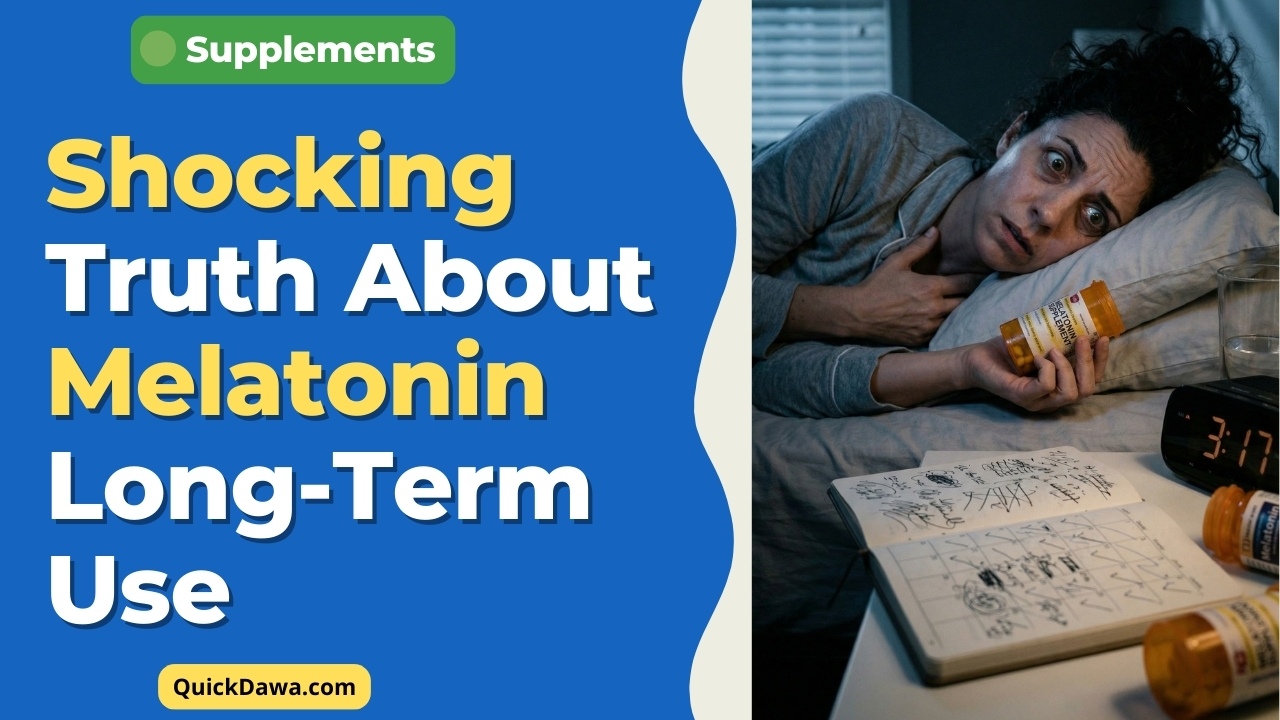
😴 The Shocking Truth About Melatonin Long-Term Use – Why It’s Quietly Ruining Your Sleep?
Do you pop a melatonin pill every single night just to fall asleep?
You’re not alone , but melatonin long-term use may be doing far more harm than good.
Millions of people reach for melatonin like it’s a harmless vitamin.
But new research from 2025 is raising serious red flags about taking it night after night for months or years.
Here’s the truth: melatonin was designed as a short-term sleep tool.
It was never meant to be your nightly routine.
In this post, we’re breaking down exactly why melatonin long-term use is a problem , the science, the risks, and what you should be doing instead to finally sleep better naturally.
🔹 WHAT IS MELATONIN AND HOW DOES IT WORK? 🌙
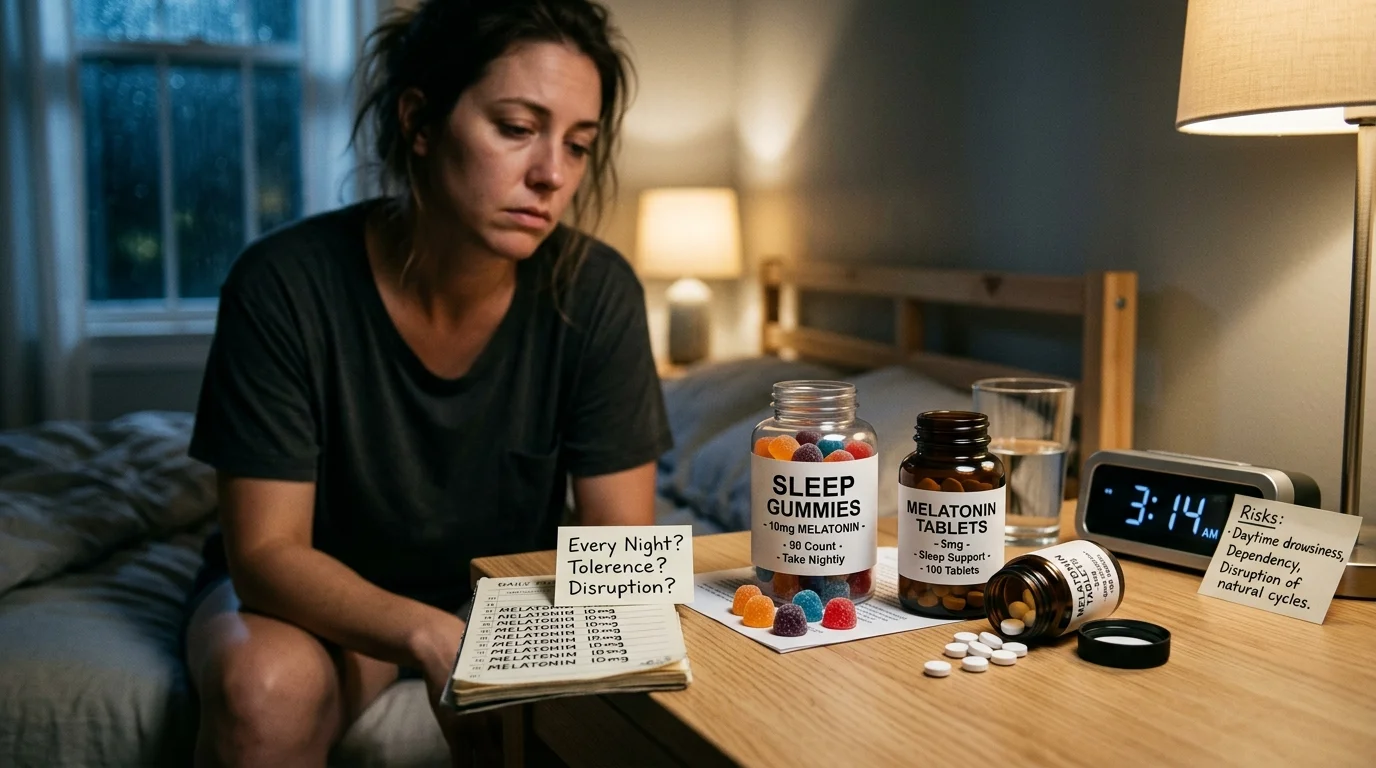
Your brain makes melatonin naturally. Think of it like your body’s built-in “darkness alarm clock.”
When the sun goes down, your brain signals, “It’s dark — time to sleep!” It releases melatonin. This makes you feel drowsy.
When the sun comes up, melatonin production stops. You feel awake.
Melatonin supplements are a man-made copy of this natural hormone. Taking a pill adds extra melatonin to what your brain already makes.
🌙 Simple analogy: Imagine your brain is a DJ at a party. When it’s time to sleep, the DJ naturally turns the music down slowly. Melatonin supplements are like someone jumping on stage and smashing the volume knob down all at once — every single night. Eventually, the DJ stops doing its own job properly.
That’s the problem with taking it long-term. Your brain may start relying on the supplement instead of doing the job itself.
Cleveland Clinic – How Does Melatonin Work?
🔹 HOW COMMON IS MELATONIN USE AND SLEEP TROUBLE? 📊
The numbers here are genuinely alarming.
- 🔵 The global melatonin supplements market was worth $2.84 billion in 2024 — and is projected to hit $13.1 billion by 2035, according to market research firm Future Market Insights.
- 🔵 U.S. melatonin sales rose by 150% between 2016 and 2020 alone — meaning more people are using it than ever before.
- 🔵 An estimated 852 million adults worldwide experience insomnia — a global prevalence rate of 16.2%, according to a PMC meta-analysis.
- 🔵 About 10% of adults have a diagnosed insomnia disorder, and another 20% experience occasional insomnia symptoms.
So people are struggling with sleep — and turning to melatonin in record numbers. But more use doesn’t mean safer use.
🔹 9 REASONS MELATONIN LONG-TERM USE IS BAD FOR SLEEP ⚡
Here’s the honest breakdown of why nightly melatonin is a problem.
🔸 Reason 1: Your Brain May Stop Making Its Own Melatonin
Your brain is incredibly adaptable. When you flood it with melatonin supplements night after night, it may start making less on its own.
Over time, you could end up needing the supplement just to reach the melatonin levels your brain used to produce naturally. This creates a cycle that’s hard to break.
Like your legs getting weaker when you always use an elevator — your brain’s melatonin system can become “lazy” with constant external help.
🔸 Reason 2: A Shocking New Heart Failure Risk
This is the most alarming finding of 2025.
A major study presented at the American Heart Association’s Scientific Sessions in 2025 found that long-term melatonin use for insomnia was linked to a 90% higher risk of developing heart failure. Melatonin users were also 3.5 times more likely to be hospitalized for heart failure.
They were also twice as likely to die from any cause during the five-year follow-up period. While researchers note more studies are needed, this data cannot be ignored.
American College of Cardiology – Melatonin and Heart Failure
🔸 Reason 3: You’re Taking Way Too Much
Your brain naturally produces only 0.1 to 0.3 milligrams (mg) of melatonin per night. Now look at your supplement bottle.
Most store-bought melatonin pills contain 5 mg, 10 mg, or even 20 mg. That’s 30 to 100 times more than your body naturally makes. Flooding your system with that much melatonin nightly is not natural or healthy.
Imagine filling a small cup of water by opening a fire hose. That’s what high-dose melatonin supplements do to your hormonal system.
🔸 Reason 4: It Masks the Real Problem
Here’s the big issue most doctors want you to know. Insomnia is usually a symptom — not the root disease.
Anxiety, depression, sleep apnea, thyroid problems, chronic pain — these all cause poor sleep. Melatonin may help you fall asleep, but it does nothing to treat the underlying condition.
So while you sleep a little better, the real problem quietly gets worse. You’re just covering it up with a supplement.
🔸 Reason 5: Melatonin Loses Effectiveness Over Time
The Sleep Foundation clearly states: “Long-term use of melatonin may lead to decreased effectiveness.”
In other words, the more you use it, the less it works. So you take a higher dose. Which works less. So you take more. You can see where this goes.
This isn’t physical addiction — but it is a frustrating cycle that leaves you sleeping worse than before you started.
🔸 Reason 6: It Disrupts Your Natural Sleep Architecture
Healthy sleep has specific stages — light sleep, deep sleep, and REM (dream sleep). Each stage is critical for brain and body repair.
External melatonin can shift and disrupt these natural sleep stages when taken at the wrong time or in too-high doses. Over months, this may leave you waking up groggy, unrested, and mentally foggy — even after a full 8 hours.
🔸 Reason 7: Psychological Dependence Is Real
Melatonin won’t cause physical withdrawal like sleep medications can. But psychological reliance is a genuine issue.
Many long-term users simply cannot imagine falling asleep without their melatonin pill. That belief itself disrupts their brain’s natural sleep signals. The ritual becomes a mental crutch — and the confidence to sleep naturally disappears entirely.
🔸 Reason 8: Particularly Risky for Children and Teenagers
Research published in the Kosin Medical Journal found that long-term melatonin use in children and adolescents causes fatigue, excessive sleepiness, and mood swings. More critically, researchers noted there is no evidence of long-term safety for children.
Despite this, children’s gummy melatonin products are among the best-selling supplements in many countries. This is deeply concerning. Kids’ brains are still developing — and hormonal interference is a serious risk.
🔸 Reason 9: It Creates a False Sense of Security About Sleep Health
Taking melatonin feels like “doing something” about your sleep problem. So you don’t pursue real solutions.
You don’t fix your sleep schedule. You don’t treat anxiety. You don’t improve your sleep environment. You just take a pill and hope.
Meanwhile, years pass — and your sleep quality may actually decline. The pill became a substitute for real sleep health habits that would have genuinely fixed the problem.
🔹 WARNING SIGNS YOU’RE OVER-RELYING ON MELATONIN 🚨
Watch for these signals. They may mean melatonin long-term use has become a problem for you:
✅ You can’t fall asleep without melatonin anymore — a sign of psychological sleep dependency.
✅ You feel groggy and tired every morning — melatonin disrupting your natural sleep stages.
✅ You’re taking higher doses than when you started — a sign of reduced effectiveness over time.
✅ You experience vivid nightmares or strange dreams — a common side effect of excess melatonin.
✅ You feel anxious or depressed — Mayo Clinic lists these as known melatonin side effects.
✅ You have frequent headaches or dizziness — signs your hormone levels may be disrupted.
✅ You feel unusually sleepy during the day — excess melatonin can blur your sleep-wake boundary.
✅ You’ve been taking it for longer than 3 months — UC Davis Health advises stopping after 1–2 months.
⚠️ See a doctor if you notice these signs. Especially if you have heart concerns, are pregnant, or are giving melatonin to a child — please seek professional guidance immediately.
🔹 HOW TO STOP RELYING ON MELATONIN AND SLEEP NATURALLY 💪
The good news: your brain can relearn to sleep on its own. Here’s how.
🌿 Tip 1: Taper Down Your Melatonin Dose Slowly
Don’t stop cold turkey overnight. Cut your dose in half for one week. Then halve it again. Then stop.
This gives your brain time to ramp its own melatonin production back up. Gradual is much better than sudden here.
🌿 Tip 2: Fix Your Sleep Schedule First 🕙
Your body loves routine. Go to bed and wake up at the same time every day — even weekends.
This trains your brain to release melatonin naturally at the right time. Within 2–3 weeks, your body’s internal clock will start working properly again.
🌿 Tip 3: Dim Your Lights 2 Hours Before Bed 💡
Bright light — especially from phones and screens — blocks your brain from making melatonin naturally. This is one of the biggest sleep disruptors today.
Dim your lights after 8pm. Use night mode on screens. Or better still, put the phone down an hour before bed.
🌿 Tip 4: Try Magnesium Glycinate Instead 💊
Magnesium glycinate is one of the best natural sleep supplements. It calms the nervous system and promotes deep sleep. It doesn’t interfere with your natural melatonin production.
Take 200–400 mg of magnesium glycinate about an hour before bed. Most people notice improved sleep within a week.
Henry Ford Health – Natural Alternatives to Melatonin
🌿 Tip 5: Eat a Sleep-Supporting Diet 🥝
Certain foods naturally boost your melatonin and serotonin levels. Add these to your evening meals:
- Tart cherry juice — one of the richest natural sources of melatonin
- Kiwi fruit — shown to improve sleep onset and quality in research
- Walnuts and almonds — contain melatonin and magnesium
- Warm milk or chamomile tea — classic, research-backed relaxation aids
🌿 Tip 6: Try Valerian Root or L-Theanine 🌱
Valerian root has been used as a natural sleep aid for over 2,000 years. It supports relaxation without sedating your brain like a drug. L-theanine (found in green tea) reduces anxiety and calms your mind without drowsiness.
Both are gentler alternatives to melatonin and won’t suppress your brain’s natural sleep systems.
🌿 Tip 7: Practice a Calming Bedtime Ritual 🧘
Mental stress is the #1 cause of insomnia. Your mind needs a “wind-down signal” just like your body does.
Try 10 minutes of deep breathing, gentle stretching, or journaling before bed. These activate your parasympathetic nervous system — your “rest and digest” mode. Over time, these rituals become powerful sleep triggers.
🌿 Tip 8: Keep Your Bedroom Cold, Dark, and Quiet 🛏️
Your brain produces melatonin best in total darkness. Even a small amount of light — from a phone charger, a streetlight, or a TV — can block natural melatonin release.
Keep your room at around 65–68°F (18–20°C). Use blackout curtains. Consider a white noise machine. Make your bedroom a true sleep sanctuary.
🔹 WHEN TO SEE A DOCTOR 🩺
Sleep problems are serious. Please see a doctor if:
- ☑️ You’ve taken melatonin nightly for more than 2–3 months
- ☑️ Your sleep hasn’t improved despite consistent supplementation
- ☑️ You experience chest pain, shortness of breath, or heart palpitations
- ☑️ You suffer from chronic anxiety or depression affecting sleep
- ☑️ You suspect you might have sleep apnea (snoring, gasping in sleep)
- ☑️ You’re giving melatonin to a child under 18
- ☑️ You need higher and higher doses to get the same effect
There is genuinely no shame in asking for help. A sleep specialist can identify why you can’t sleep — and fix it properly. You deserve real, deep, restorative sleep — not just a pill that papers over the problem.
🔹 FREQUENTLY ASKED QUESTIONS ❓
Q1: Is it safe to take melatonin every night long term?
Most major health institutions — including Mayo Clinic, Johns Hopkins, and UC Davis — agree that melatonin long-term use is not recommended. Short-term use of 1–2 months is generally considered safe for most adults. Beyond that, safety data is limited — and a concerning 2025 study linked long-term use to a 90% higher risk of heart failure.
Q2: Does melatonin stop your body from making its own?
Research suggests that while melatonin supplements can shift the timing of your natural melatonin production, they may not permanently suppress it. However, over-reliance on supplements can reduce your brain’s natural drive to produce melatonin at the right time. This is why gradually weaning off is better than stopping suddenly.
Q3: What is a safer alternative to long-term melatonin use?
Several natural alternatives work without the risks of melatonin long-term use. Magnesium glycinate, L-theanine, and valerian root support sleep naturally. Good sleep hygiene — consistent bedtime, darkness, and screen-free evenings — is the most powerful long-term sleep solution of all.
Q4: What are the side effects of taking melatonin every night?
Common side effects include daytime grogginess, headaches, dizziness, nausea, vivid dreams or nightmares, irritability, and stomach cramps. For children, long-term studies report fatigue, excessive sleepiness, and mood swings. The 2025 AHA study also raised serious concerns about heart failure risk with prolonged use.
Q5: How do I wean off melatonin after taking it for months?
Wean off melatonin gradually — cut your dose in half each week until you reach zero. Simultaneously build better sleep habits: consistent sleep schedule, evening light reduction, stress management, and natural sleep-supporting foods. Most people find their natural sleep improves significantly within 2–4 weeks of stopping, especially when combined with good sleep hygiene.
🔹 CONCLUSION 🌙
Melatonin is not the villain — but melatonin long-term use certainly has a dark side.
It may suppress your brain’s natural sleep drive, mask serious underlying conditions, deliver doses far beyond what your body naturally makes, and — as alarming 2025 research suggests — may even raise your risk of heart failure with prolonged use.
The better path? Build sleep that doesn’t require a pill every night. Use magnesium, fix your schedule, dim your lights, manage your stress, and let your brain do what it was born to do.
Your brain already knows how to put you to sleep — it just needs the right conditions to do it. Give it those conditions, and deep, natural sleep will follow. 🌙
Share this post with someone who takes melatonin every night — you might just change their sleep, and protect their heart. ❤️
Remember: the real danger of melatonin long-term use isn’t the first night — it’s the next hundred nights that quietly compound the problem.
⚕️ MEDICAL DISCLAIMER
Disclaimer: This blog post is written strictly for informational and educational purposes only. It is not intended to serve as medical advice, diagnosis, or treatment recommendation of any kind.
The information presented in this article — including references to the 2025 American Heart Association study — reflects publicly available research findings that are still evolving. Correlation does not equal causation, and individual health circumstances vary significantly. The AHA study’s authors themselves noted that factors such as pre-existing heart conditions and other medications may have influenced results.
Do not stop taking any supplement or medication without consulting your healthcare provider. If you are currently taking melatonin nightly, please speak with a qualified physician or sleep specialist before making any changes to your routine.
Melatonin may be entirely appropriate for certain individuals under medical supervision — including those with circadian rhythm disorders or specific neurological conditions. This post is not intended to replace that professional guidance.
The author and publisher of this content accept no liability for any health outcomes resulting from the use or misuse of information contained in this article. Always consult a licensed healthcare professional for advice tailored to your personal health situation.