ADHD in Women Symptoms-10 Shocking Signs You’ve Been Misdiagnosed Your Whole Life
Have you spent your whole life feeling like something was just — off?
ADHD in women symptoms are completely different from what most people think ADHD looks like.
You were never the hyperactive kid bouncing off the walls.
You were the daydreamer. The overthinker. The girl who tried harder than everyone — and still felt behind.
You were told you were anxious. Sensitive. Disorganized. Lazy. Too emotional.
But nobody ever said — “You might have ADHD.”
Here’s the shocking truth. 75% of women with ADHD go undiagnosed their entire lives.
Because the medical world built its understanding of ADHD around boys.
And women — quietly — got left behind.
Today — that changes. Let’s talk about what ADHD in women really looks like. 💙👇
🔹 What Is ADHD in Women? 🤔
ADHD stands for Attention Deficit Hyperactivity Disorder.
It is a brain condition. Not a character flaw. Not a parenting failure.
The ADHD brain is wired differently from a neurotypical brain.
It struggles with focus, organization, and controlling impulses.
But here’s what most people don’t know.
There are three types of ADHD:
- 🔵 Hyperactive type — can’t sit still, talks too much, acts impulsively
- 🔵 Inattentive type — daydreams, forgets, loses focus constantly
- 🔵 Combined type — a mix of both
Most boys show the hyperactive type. That’s why they get diagnosed early.
Most women show the inattentive type. That’s why they get missed completely.
Here’s a simple analogy:
Imagine ADHD is a fire alarm going off inside your brain — all day long.
For boys — the alarm is loud and obvious. Everyone notices.
For women — the alarm is muffled. Hidden under layers of coping, masking, and people-pleasing.
The alarm is just as real. Just as exhausting. But nobody hears it from the outside.
That’s ADHD in women symptoms — invisible to everyone except the woman living inside it.
🔹 How Common Is Undiagnosed ADHD in Women? 📊
The numbers reveal a quiet crisis.
- 🔵 According to the CDC, boys are diagnosed with ADHD almost 3 times more often than girls — not because it’s rarer in girls, but because it presents differently and gets missed.
- 🔵 Research from the Journal of Child Psychology found that the average age of ADHD diagnosis for women is 36–38 years — compared to early childhood for boys. That is a gap of 25–30 years of living without answers.
- 🔵 A study published in JAMA Psychiatry found that women with undiagnosed ADHD are significantly more likely to be misdiagnosed with anxiety, depression, or bipolar disorder before anyone considers ADHD.
- 🔵 Up to 75% of women with ADHD remain undiagnosed, according to ADHD awareness organizations — meaning millions of women right now are struggling without knowing why.
So if you have spent years feeling broken — without knowing why — you are not alone. And you are not broken.
🔹 10 Reasons ADHD in Women Gets Missed for Decades 💡
1. 🎭 Women Are Masters of Masking
Masking means hiding your symptoms to appear “normal.”
From a young age — girls learn to people-please, follow rules, and work harder to compensate.
So a girl with ADHD learns to mask her struggles so well that nobody — including herself — sees them.
She exhausts herself keeping it together. But from the outside? She looks fine.
Example: Sophie always appeared organized at work. She arrived early, wrote endless lists, and stayed late. But behind the scenes — she was running on anxiety fuel, working twice as hard just to appear half as capable.
2. 🧠 Inattentive ADHD Has No “Obvious” Symptoms
The stereotypical ADHD image — a boy unable to sit still — doesn’t apply to most women.
Inattentive ADHD looks like daydreaming, forgetting, losing things, and drifting mid-conversation.
These are easy to dismiss as personality quirks — not medical symptoms.
Doctors trained to spot hyperactivity simply don’t recognize the inattentive pattern as ADHD.
3. 😰 It Gets Misdiagnosed as Anxiety Every Single Time
ADHD in women symptoms create enormous anxiety.
Missing deadlines. Forgetting important things. Always feeling behind. Always falling short.
Of course that creates anxiety. But the anxiety is a symptom of the ADHD — not the root cause.
Doctors treat the anxiety. The ADHD goes completely untouched.
Example: Nina was diagnosed with generalized anxiety disorder at 19. She took medication for 15 years. At 34 — a new doctor finally identified ADHD as the actual root cause of her anxiety.
4. 😢 It Gets Misdiagnosed as Depression
ADHD causes chronic underperformance despite enormous effort.
Years of struggling — while appearing fine to others — leads to deep exhaustion and low self-worth.
That looks exactly like depression. And it often gets treated as depression alone.
But antidepressants don’t fix ADHD. The underlying struggle continues.
5. 📚 Girls Are Socialized to Sit Still and Be Quiet
Society trains girls differently from boys.
Girls who can’t focus are told to try harder. Boys who can’t sit still get referred for assessment.
This social conditioning means girls with ADHD learn to suppress and internalize — while boys with ADHD get noticed and helped.
The bias isn’t just medical. It’s cultural.
6. 🌙 Hormones Make ADHD Symptoms Dramatically Worse
Estrogen plays a powerful role in dopamine regulation.
Dopamine is the brain chemical that ADHD brains are deficient in.
When estrogen drops — during periods, perimenopause, or postpartum — ADHD in women symptoms spike dramatically.
Many women are first diagnosed during perimenopause — when plummeting estrogen unmasks a lifetime of hidden ADHD.
Example: Diane sailed through her 30s managing her symptoms. At 43 — as perimenopause began — her focus, memory, and emotional regulation completely fell apart. She was finally diagnosed with ADHD at 44.
7. 🔄 She Hyperfocuses — So People Don’t Believe She Has ADHD
Hyperfocus is an ADHD superpower — and a major reason women go undiagnosed.
Women with ADHD can laser-focus on things they find interesting — for hours.
So people say: “You can’t have ADHD — you focused on that book for 4 hours!”
But ADHD isn’t about never focusing. It’s about having no control over when and what you focus on.
8. 💬 She’s Told She’s “Too Smart” to Have ADHD
Many women with ADHD are highly intelligent.
Their intelligence compensates for their ADHD — at least for a while.
They develop workarounds, systems, and coping mechanisms that mask the struggle.
Doctors see a bright, articulate woman and simply don’t consider ADHD.
But intelligence doesn’t cure ADHD. It just makes it harder to see.
9. 🏠 Adult Responsibilities Reveal Hidden ADHD
Many women only realize something is wrong when adult life demands increase.
New job. Marriage. Children. Running a household.
Suddenly — the coping strategies stop working. Everything falls apart.
That’s when ADHD finally surfaces — not because it’s new, but because life got more demanding than the mask could handle.
10. 📋 Medical Research Has Historically Excluded Women
ADHD research was built almost entirely on studies of white boys aged 6–12.
The diagnostic criteria were written to describe their symptoms.
Women’s patterns — inattention, emotional dysregulation, internalized chaos — were never included in the original framework.
So the system was never designed to find ADHD in women. And so it didn’t.
🔹 Warning Signs of ADHD in Women You Should Never Dismiss 🚨
These are the real ADHD in women symptoms — not the hyperactive stereotype:
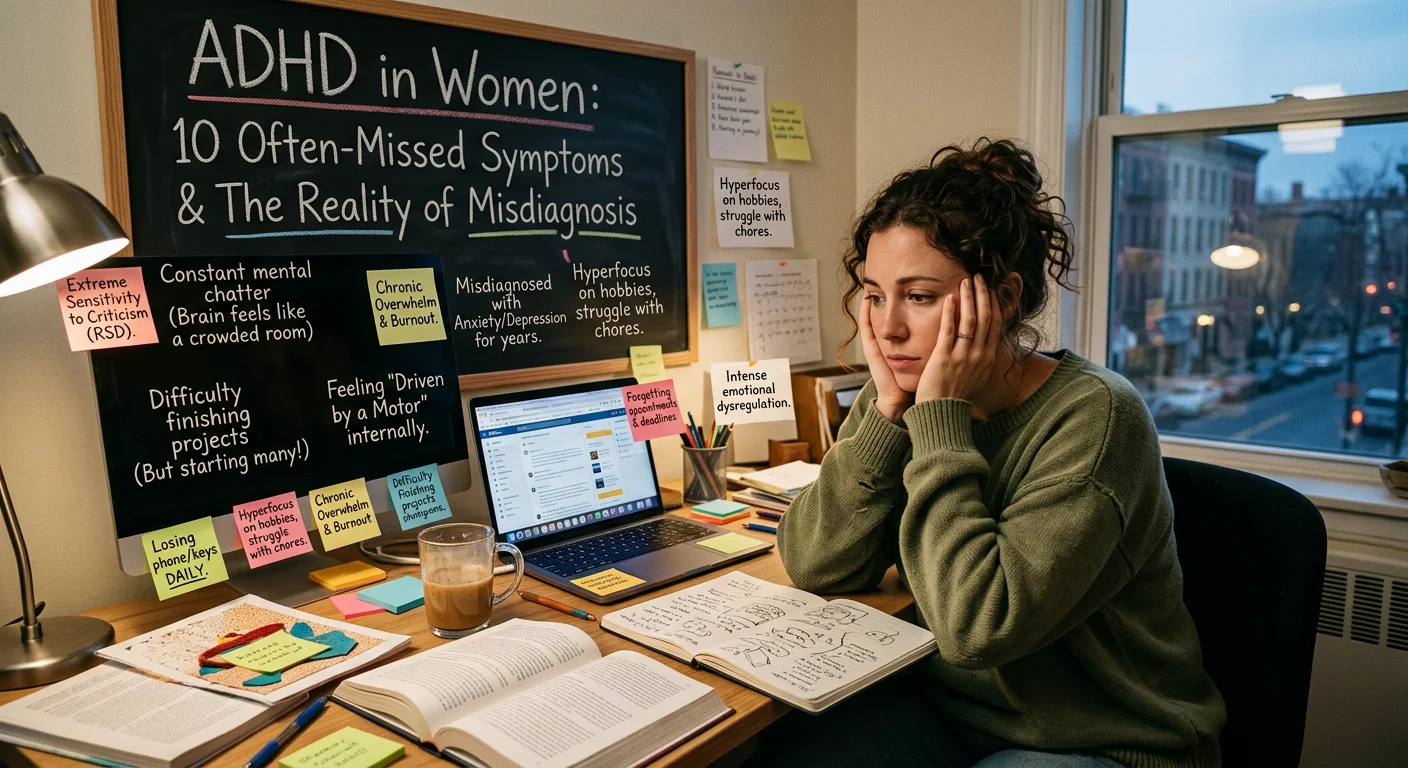
✅ Chronic disorganization — despite trying every planner, system, and app available.
✅ Emotional dysregulation — feelings hit like a freight train — disproportionately intense and hard to manage.
✅ Rejection Sensitive Dysphoria (RSD) — extreme emotional pain from perceived criticism or rejection.
✅ Time blindness — being perpetually late or losing track of hours without noticing.
✅ Chronic overwhelm — even simple tasks feel mountainous and paralyzing.
✅ Racing thoughts at night — brain refuses to switch off at bedtime despite physical exhaustion.
✅ Hyperfocus episodes — completely losing track of time on interesting tasks.
✅ Constant mental exhaustion — feeling drained from the effort of appearing functional every single day.
⚠️ See a doctor or psychologist if you recognize these patterns — especially if they’ve been present since childhood. Early identification of ADHD in women symptoms changes lives. You deserve answers.
🔹 How to Manage and Thrive With ADHD as a Woman 🛡️
A diagnosis is a door — not a ceiling. Here’s how to move forward powerfully.
1. 🩺 Seek a Specialist Who Understands Female ADHD
Not all doctors understand how differently ADHD presents in women.
Seek a psychologist or psychiatrist who specifically has experience with adult female ADHD.
Ask directly: “Are you familiar with how ADHD presents differently in women?” before booking.
2. 🧠 Learn About Your Specific ADHD Type (Lifestyle Tip)
ADHD is not one-size-fits-all. Your specific pattern shapes which strategies work best.
Read books written specifically for women with ADHD — like “Women with Attention Deficit Disorder” by Sari Solden.
Understanding your brain is the first step to working with it — not against it.
3. 🍳 Eat to Support Dopamine Production (Diet Tip)
The ADHD brain needs dopamine. Nutrition directly affects dopamine production.
Eat high-protein meals — eggs, fish, lean meat, and legumes provide the amino acids that build dopamine.
Cut ultra-processed foods and sugar — they cause blood sugar crashes that worsen ADHD focus and mood dramatically.
4. 🏃 Exercise Daily — It’s the Most Powerful Natural ADHD Tool
Exercise increases dopamine and norepinephrine — the exact brain chemicals ADHD brains lack.
Even a 20–30 minute brisk walk daily produces measurable improvement in ADHD focus and emotional regulation.
Consistency matters more than intensity. Start small — start today.
5. ⏰ Use External Structure — Your Brain Needs It
The ADHD brain struggles to create structure internally.
Use timers, alarms, visual schedules, and body doubling (working alongside someone else) to create external structure.
Don’t rely on memory — externalize everything into systems, apps, and physical reminders.
6. 🧘 Treat the Anxiety Alongside the ADHD (Mental Health Tip)
ADHD and anxiety exist together in most women with this condition.
Mindfulness, therapy — especially CBT (Cognitive Behavioural Therapy) — and nervous system regulation practices all help significantly.
Treating anxiety alone never works. Treating both together creates real transformation.
7. 😴 Protect Your Sleep — ADHD Makes It Harder
ADHD brains are notoriously hard to switch off at night.
Create a strict wind-down routine — no screens 1 hour before bed, consistent sleep time, and a dark cool room.
Poor sleep makes every ADHD symptom dramatically worse the next day.
8. 🔬 Explore Medication Options With Your Doctor
ADHD medication — including stimulants like methylphenidate and non-stimulants — can be genuinely life-changing for many women.
Medication is not a weakness. It is a tool that helps the brain access its own chemistry properly.
Work closely with a prescribing doctor to find the right medication and dose for your unique profile.
🔹 When Should You See a Doctor? 🩺
Please seek assessment if:
- ✔️ You have struggled with focus, organization, or emotional regulation since childhood
- ✔️ You have been treated for anxiety or depression — but something still feels off
- ✔️ You feel chronically exhausted from the effort of appearing “normal”
- ✔️ You consistently lose things, miss deadlines, or forget important tasks
- ✔️ Your symptoms worsen significantly around your period or during perimenopause
- ✔️ You recognize yourself in every single point of this article
Please know this: Getting assessed for ADHD in women symptoms is not about labelling yourself.
It is about finally understanding yourself. And getting the right support. You deserve that. 💙
🔹 Frequently Asked Questions (FAQ) ❓
Q1. What are the main ADHD in women symptoms that get overlooked?
The most overlooked ADHD in women symptoms include chronic disorganization, emotional dysregulation, time blindness, rejection sensitivity, racing thoughts at night, and deep mental exhaustion from masking. These are rarely recognized as ADHD — and are more commonly misdiagnosed as anxiety or depression.
Q2. Why is ADHD in women so commonly misdiagnosed as anxiety?
Because ADHD in women symptoms naturally create anxiety. Missing deadlines, forgetting things, and constantly falling short creates real anxious feelings. Doctors treat the anxiety — but the root ADHD goes untouched. That’s why many women cycle through anxiety medications for years with limited relief.
Q3. Can ADHD in women develop later in life?
ADHD doesn’t develop later — but it often gets noticed later. Hormonal changes during perimenopause cause estrogen to drop. Since estrogen supports dopamine function, this drop unmasks previously hidden ADHD symptoms. Many women are diagnosed for the first time in their 40s and 50s for this exact reason.
Q4. What does ADHD emotional dysregulation feel like in women?
It feels like emotions arrive without warning — and at full volume. A small criticism feels like devastating rejection. A minor frustration triggers a disproportionate meltdown. This is called Rejection Sensitive Dysphoria (RSD) and is one of the most painful and least discussed ADHD in women symptoms.
Q5. What is the best first step if I think I have undiagnosed ADHD?
Start by documenting your symptoms — especially ones that go back to childhood. Then book an appointment with a psychologist or psychiatrist experienced in adult and female ADHD assessment. Bring your symptom notes. Be specific. And don’t let anyone dismiss you. You know your own brain.
🔹 Conclusion ✅
If you read every word of this post and felt seen — pay attention to that feeling.
ADHD in women symptoms have been dismissed, misdiagnosed, and minimized for generations.
But the world is finally catching up. And more women are getting the answers they deserved decades ago.
You are not lazy. You are not broken. You are not “too emotional” or “too sensitive.”
You may simply have a brain that works differently — and has never been properly understood.
💙 Share this post with every woman in your life who has ever been told she just needs to try harder — because she may have been living with undiagnosed ADHD her whole life.
Getting the right diagnosis starts with knowing the real ADHD in women symptoms — and today, you do. 🌟
Medical Disclaimer: This article is for informational purposes only and relies on current medical research as of 2026. It is not a substitute for professional medical advice, diagnosis, or treatment. Never change the timing or dosage of your medication without explicitly consulting your physician or pharmacist. Some formulations (like extended-release vs. immediate-release) have specific requirements that may differ from general rules.