Autoimmune Ovarian Failure – Why Your Own Body is Attacking Your Ovaries – And How to Stop It!
Did you know your own immune system could be quietly destroying your fertility?
Autoimmune ovarian failure is a condition where your body’s defense system turns against your own ovaries.
It happens silently. No loud warning signs. No obvious symptoms at first.
Many women don’t find out until they struggle to get pregnant.
By that point — significant damage may have already been done.
The scariest part? Most doctors don’t screen for it. Most women have never even heard of it.
But it affects far more women than anyone talks about.
So today — we are going to change that.
Let’s break it all down in simple, clear words. 👇
🔹 What Is Autoimmune Ovarian Failure? 🤔
Your immune system is like your body’s army.
Its job is to fight germs, bacteria, and viruses.
It protects you every single day. Without it — you couldn’t survive.
But sometimes — that army makes a terrible mistake.
It confuses your own healthy body parts for the enemy.
And it starts attacking them instead.
That’s what autoimmune disease means.
Auto means “self.” So autoimmune = your immune system attacking itself.
Now here’s the specific problem.
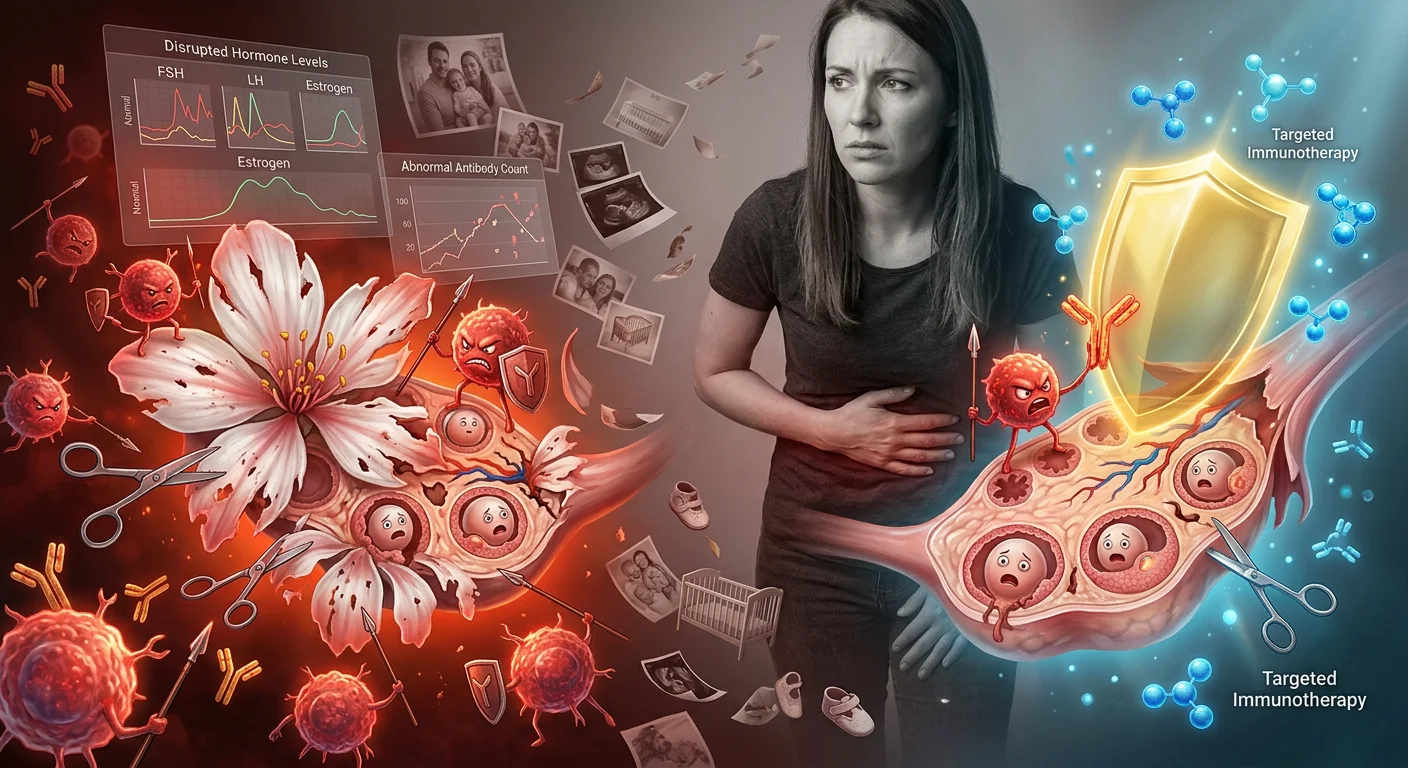
In autoimmune ovarian failure — your immune system targets your ovaries directly.
It sends attack signals to the ovarian tissue.
Over time — it damages the cells that produce eggs and hormones.
Here’s a simple analogy:
Imagine your body is a country. Your immune system is the army.
Now imagine the army suddenly thinks the power station (your ovaries) is the enemy.
It starts bombing the power station.
Slowly — the lights go out. The power stops working.
That’s exactly what happens during autoimmune ovarian failure.
The ovaries lose their ability to produce eggs and hormones — often permanently — if left undetected.
🔹 How Common Is Autoimmune Ovarian Failure? 📊
This condition is more common than most people realize.
- 🔵 Premature Ovarian Insufficiency (POI) — the medical term for early ovarian failure — affects 1 in 100 women under the age of 40, according to the National Institutes of Health (NIH).
- 🔵 Studies suggest that up to 30% of all POI cases are caused by autoimmune factors — making it one of the leading causes of early ovarian failure in young women.
- 🔵 Women with other autoimmune conditions — like Hashimoto’s thyroiditis, lupus, or rheumatoid arthritis — are 3–5 times more likely to develop autoimmune ovarian failure.
- 🔵 According to research published in the Journal of Clinical Endocrinology, the majority of women with autoimmune POI go undiagnosed for 5–10 years after symptoms begin.
So yes — autoimmune ovarian failure is a real, widespread, and seriously underdiagnosed condition.
🔹 Why Does the Immune System Attack the Ovaries? 10 Key Causes 💡
1. 🧬 You Already Have Another Autoimmune Disease
If your immune system already attacks one part of your body — it can spread.
Women with Hashimoto’s thyroiditis (autoimmune thyroid disease) have significantly higher rates of autoimmune ovarian failure.
In fact — up to 40% of women with Hashimoto’s show signs of ovarian immune activity.
Example: Sarah had Hashimoto’s thyroid disease for 5 years. When she struggled to conceive at 29 — tests revealed her immune system had been attacking her ovaries too.
2. 🧪 Genetic Predisposition (It Runs in Families)
Some women are born with genes that make their immune system overreactive.
These genes increase the risk of the immune system misidentifying healthy tissue as a threat.
If your mother or sister has an autoimmune disease — your risk is higher.
3. 🦠 A Viral Infection That Triggered the Immune System
Sometimes — a virus can confuse the immune system permanently.
The virus looks similar to ovarian tissue at a molecular level.
So after fighting the virus — the immune system keeps attacking similar-looking cells. Including in your ovaries.
This is called molecular mimicry — and it is a well-documented cause of autoimmune disease.
4. 💉 Certain Vaccine Reactions (In Rare Cases)
In very rare cases — certain immune-stimulating vaccines have been linked to triggering autoimmune responses.
This is extremely uncommon. And vaccines remain critically important.
But for women with existing autoimmune conditions — it is worth discussing with a doctor before any new vaccination.
5. 😰 Chronic Stress and Cortisol Dysregulation
Long-term stress throws your immune system completely out of balance.
Chronic stress raises cortisol levels — which initially suppresses immunity.
But when cortisol stays elevated for months — the immune system can swing into overdrive and become hyperactive.
A hyperactive immune system is more likely to attack healthy tissue — including ovarian cells.
Example: Priya worked 14-hour days for 3 years. She dismissed her irregular periods as stress. At 32 — she was diagnosed with autoimmune ovarian failure.
6. 🌿 Environmental Toxins and Endocrine Disruptors
We are surrounded by chemicals that interfere with hormones and immune function.
BPA (found in plastics), pesticides, phthalates (in cosmetics), and heavy metals can all trigger immune dysregulation.
These chemicals are called endocrine disruptors — they mimic hormones and confuse the immune system.
Long-term exposure increases the risk of autoimmune conditions — including autoimmune ovarian failure.
7. 🍽️ Leaky Gut Syndrome
Your gut plays a massive role in immune regulation.
When the gut lining becomes damaged — it becomes “leaky.” Undigested particles enter the bloodstream.
The immune system responds by going on high alert.
Over time — this chronic immune activation can lead to the immune system attacking healthy tissues — including the ovaries.
8. 🧴 Hormone-Disrupting Personal Care Products
Many everyday products — shampoos, lotions, and deodorants — contain parabens and synthetic estrogens.
These chemicals can confuse the immune system by mimicking natural hormones.
Regular exposure over years may contribute to immune dysregulation in sensitive women.
9. 😴 Chronic Sleep Deprivation
Poor sleep doesn’t just make you tired. It damages your immune regulation.
During sleep — your immune system resets and repairs itself.
Without enough sleep — immune cells become confused. They can start targeting healthy tissue.
Studies link chronic sleep deprivation directly to increased autoimmune activity in women.
10. 🧬 Previous Ovarian Surgery or Damage
Any surgery near or on the ovaries can trigger an immune response.
The immune system detects the tissue disruption as a “threat.”
In women already prone to autoimmune reactions — this can trigger a lasting immune attack on ovarian tissue.
Example: Lisa had an ovarian cyst removed at 24. Within 2 years — her periods became irregular. At 28 — she was diagnosed with autoimmune ovarian failure triggered by post-surgical immune response.
🔹 Warning Signs of Autoimmune Ovarian Failure 🚨
These signs are easy to miss or dismiss. Don’t ignore them.
✅ Irregular or missed periods — your cycle becomes unpredictable without obvious reason.
✅ Hot flashes in your 20s or 30s — feeling suddenly overheated is a hormonal red flag.
✅ Night sweats — waking up drenched in sweat regularly without being ill.
✅ Difficulty getting pregnant despite trying for 6–12 months.
✅ Extreme fatigue that doesn’t improve even with full rest.
✅ Brain fog — difficulty concentrating or remembering things clearly.
✅ Low libido (sex drive) — a sudden or gradual loss of sexual interest.
✅ Vaginal dryness — a symptom of dropping estrogen levels caused by ovarian decline.
⚠️ See a doctor immediately if you notice any of these signs — especially if you are under 40. Early detection of autoimmune ovarian failure is the single most important factor in protecting your fertility.
🔹 How to Protect Your Ovaries: Prevention Tips 🛡️
You have more power than you think. Here’s how to actively protect your ovarian health.
1. 🩺 Test Your Thyroid Every Year
Thyroid autoimmune disease is the biggest risk factor for autoimmune ovarian failure.
Ask your doctor for a full thyroid panel — including TPO antibodies — every year.
Catching thyroid autoimmunity early may help prevent it from spreading to your ovaries.
2. 🥦 Eat an Anti-Inflammatory Diet (Diet Tip)
Inflammation feeds autoimmune activity. Fighting it through food is powerful.
Fill your plate with colourful vegetables, omega-3 rich fish, turmeric, ginger, and berries.
Cut out processed foods, refined sugar, and seed oils — they fuel immune dysregulation.
3. 🧘 Manage Stress Daily (Mental Health Tip)
Chronic stress is one of the biggest autoimmune triggers in women.
Build a daily stress-relief practice — even 10 minutes of breathing exercises or meditation counts.
A calmer nervous system means a more balanced immune system — and safer ovaries.
4. 🧴 Switch to Clean Personal Care Products (Lifestyle Tip)
Swap chemical-heavy beauty products for clean, paraben-free alternatives.
Check labels for parabens, phthalates, and synthetic fragrances — and avoid them.
Small daily swaps dramatically reduce your toxic hormone-disrupting load over time.
5. 🌿 Heal Your Gut Health
A healthy gut = a balanced immune system.
Eat fermented foods like yogurt, kimchi, and kefir daily to feed good gut bacteria.
Consider working with a doctor on a gut-healing protocol if you have digestive symptoms.
6. 💧 Filter Your Water and Reduce Plastic Use
Tap water often contains traces of pesticides and hormone-disrupting chemicals.
Use a quality water filter — and switch from plastic bottles to glass or stainless steel.
These simple changes reduce your daily endocrine disruptor exposure significantly.
7. 😴 Prioritize Sleep Like a Medicine
Aim for 7–9 hours of deep sleep every night — without compromise.
Sleep is when your immune system resets, repairs, and recalibrates.
Poor sleep over months is a direct contributor to immune dysregulation and ovarian damage.
8. 🔬 Ask for Ovarian Reserve Testing Early
If you have any autoimmune condition — ask your doctor for ovarian reserve testing.
A simple blood test measuring AMH (Anti-Müllerian Hormone) tells you how many eggs you have left.
Early knowledge = early action. Don’t wait until you are trying to conceive.
🔹 When Should You See a Doctor? 🩺
Please see a doctor right away if you:
- ✔️ Are under 40 and your periods have become irregular or stopped
- ✔️ Already have a diagnosed autoimmune condition
- ✔️ Have been trying to conceive for more than 6 months without success
- ✔️ Experience hot flashes or night sweats under age 40
- ✔️ Have a family history of premature menopause or autoimmune disease
- ✔️ Feel extreme fatigue, brain fog, or low mood alongside period changes
Please don’t feel embarrassed or wait. Doctors see this every day.
The earlier autoimmune ovarian failure is detected — the more options you have. Hope is very real when you act early. 💙
🔹 Frequently Asked Questions (FAQ) ❓
Q1. Can autoimmune ovarian failure be reversed?
In some early-stage cases — yes. When caught early, treating the underlying autoimmune condition and reducing inflammation can slow or partially reverse ovarian damage. Full reversal is rare — but slowing progression is absolutely possible with proper medical care and lifestyle changes.
Q2. Is autoimmune ovarian failure the same as early menopause?
They overlap — but they are not the same. Early menopause means ovarian function has permanently stopped. Autoimmune ovarian failure (also called Premature Ovarian Insufficiency) means the ovaries are failing — but may still function intermittently. Some women with POI still ovulate occasionally and can conceive naturally.
Q3. Can I still get pregnant with autoimmune ovarian failure?
Yes — in some cases. Around 5–10% of women with POI conceive naturally. Others successfully use egg donation IVF. The key is early diagnosis and working closely with a reproductive endocrinologist who understands autoimmune infertility.
Q4. What tests diagnose autoimmune ovarian failure?
Key tests include: FSH and LH hormone levels, AMH (egg reserve test), estradiol levels, antiovarian antibody tests, and a full autoimmune panel including thyroid antibodies. Ask your doctor specifically for these — they are not part of a standard fertility workup.
Q5. Which autoimmune diseases most commonly cause autoimmune ovarian failure?
The most commonly linked conditions are Hashimoto’s thyroiditis, Addison’s disease (adrenal autoimmune disease), Type 1 diabetes, lupus, and rheumatoid arthritis. If you have any of these — regular ovarian reserve monitoring is strongly recommended.
🔹 Conclusion ✅
Autoimmune ovarian failure is real. It is silent. And it is far more common than anyone admits.
But knowledge is power — and now you have it.
If your body shows any of the warning signs — please don’t wait. Don’t dismiss it as stress or age.
Get tested. Get answers. Protect your ovaries before damage is done.
You deserve to make informed decisions about your fertility and your health.
💙 Share this post with every woman you care about — because most of them have never heard of autoimmune ovarian failure. And they need to.
Early detection of autoimmune ovarian failure could be the most important thing you do for your future. 🌟
Medical Disclaimer: This article is for informational purposes only and relies on current medical research as of 2026. It is not a substitute for professional medical advice, diagnosis, or treatment. Never change the timing or dosage of your medication without explicitly consulting your physician or pharmacist. Some formulations (like extended-release vs. immediate-release) have specific requirements that may differ from general rules.