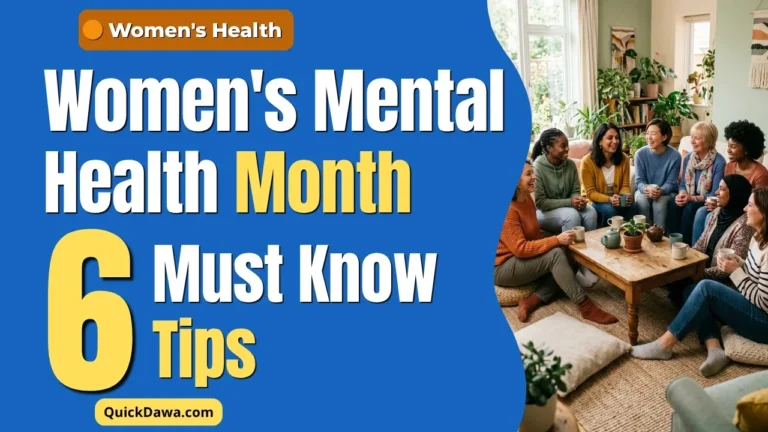
Women’s Mental Health-7 Self Care Tips Every Woman Needs | QuickDawa
You know that feeling when you’re taking care of everyone else but yourself?
The kids need help with homework.
Your partner needs dinner ready.
Your boss needs that report by tomorrow.
Your parents need you to call them back.
And somewhere in all of this, you forgot when you last did something just for YOU.
If this sounds familiar, you’re not alone.
Women’s mental health often takes a backseat because we’re taught to put others first.
But here’s the truth: you can’t pour from an empty cup.
Your mental health matters just as much as your physical health.
Maybe you’ve been feeling more anxious lately.
Or you’re exhausted even after a full night’s sleep.
Perhaps you snap at small things that normally wouldn’t bother you.
These are signs your mental health needs attention.
And that’s exactly what we’re going to talk about today.
At QuickDawa, we’re all about making health easy to understand, so let’s break down everything you need to know about women’s mental health and self-care in simple, clear language.
Because taking care of your mind isn’t selfish.
It’s necessary.
💊 What Is Women’s Mental Health Self Care?
Women’s mental health self-care is about intentionally taking steps to protect and improve your emotional and psychological wellbeing.
It’s not just bubble baths and face masks (though those can help!).
It’s about creating habits and boundaries that support your mental wellness every single day.
Think of it as preventive medicine for your mind.
🌸 Why Women’s Mental Health Needs Special Attention
Women face unique mental health challenges that men don’t always experience.
Hormonal changes during periods, pregnancy, postpartum, and menopause can trigger mood swings, anxiety, and depression.
Society also puts extra pressure on women to be perfect mothers, wives, daughters, and employees all at once.
This constant juggling act takes a toll.
Research shows that women are nearly twice as likely as men to experience depression and anxiety disorders.
That’s not because women are weaker.
It’s because the mental load women carry is genuinely heavier.
Understanding this is the first step toward better self-care.
🧠 Common Mental Health Issues Women Face
Let’s talk about what you might be experiencing.
Depression
Feeling sad, empty, or hopeless for weeks at a time.
Losing interest in things you used to enjoy.
Changes in sleep and appetite.
Anxiety
Constant worry that won’t turn off.
Racing thoughts and heart palpitations.
Feeling like something bad is always about to happen.
Postpartum Depression
Intense sadness after giving birth.
Feeling disconnected from your baby.
Overwhelming thoughts of worthlessness.
Stress and Burnout
Feeling exhausted no matter how much you rest.
Irritability and emotional numbness.
Physical symptoms like headaches and muscle tension.
PMDD (Premenstrual Dysphoric Disorder)
Severe mood swings before your period.
Intense irritability and anxiety.
Physical and emotional symptoms that disrupt daily life.
If any of these sound like you, please know there’s nothing wrong with you.
You’re experiencing something real and valid.
And help is available.
🌟 7 Self Care Tips for Women’s Mental Health
Now let’s get practical.
Here are seven self-care strategies that actually work.
1. Set Boundaries Without Guilt
You don’t have to say yes to everything.
It’s okay to say “I can’t do that right now” without explaining yourself.
Boundaries protect your energy and mental space.
Start small: say no to one thing this week that drains you.
2. Move Your Body Regularly
Exercise isn’t just for weight loss.
It releases endorphins, the natural mood boosters your brain loves.
You don’t need a gym membership.
A 20-minute walk around your neighborhood works wonders.
Dance in your living room.
Stretch before bed.
Just move in whatever way feels good.
3. Talk to Someone You Trust
Bottling up emotions makes them heavier.
Talk to a friend, family member, or therapist.
If talking feels hard, try journaling.
Write down what’s bothering you without filtering.
Sometimes just getting it out of your head helps.
4. Prioritize Sleep
Poor sleep makes everything worse.
Anxiety feels bigger.
Sadness feels deeper.
Patience runs thinner.
Aim for 7-8 hours of quality sleep.
Create a bedtime routine: dim lights, no screens 30 minutes before bed, and maybe some calming tea.
Your brain repairs itself during sleep, so don’t skip it.
5. Practice Mindfulness or Meditation
You don’t need to be a yoga expert for this.
Mindfulness is simply being present in the moment.
Try this right now: take three slow, deep breaths.
Notice how your chest rises and falls.
That’s it. You just practiced mindfulness.
Apps like Headspace or Calm can guide you if you want more structure.
6. Limit Social Media
Scrolling through Instagram makes you compare your messy reality to everyone else’s highlight reel.
It’s toxic for mental health.
Set limits on social media use.
Maybe no phones during meals or after 9 PM.
Notice how much lighter you feel when you’re not constantly scrolling.
7. Ask for Professional Help When Needed
This is the most important one.
If self-care isn’t enough, please see a mental health professional.
Therapy isn’t a sign of weakness.
It’s a sign of strength and self-awareness.
Medication can also be helpful when recommended by a doctor.
There’s zero shame in getting the help you need.
🩺 When to Call a Doctor
Self-care is powerful, but it’s not a replacement for professional help.
Call your doctor or a mental health professional if you:
- Feel hopeless or think about harming yourself
- Can’t get out of bed for days
- Experience panic attacks that disrupt your life
- Notice your mental health affecting your relationships or work
- Have thoughts of suicide (call emergency services immediately)
- Feel like you can’t cope anymore despite trying self-care strategies
Your mental health is just as important as a broken bone.
You wouldn’t ignore a fracture, so don’t ignore your emotional pain.
At QuickDawa, we always encourage you to reach out when things feel too heavy.
🙋 FAQs
Q: Can stress affect women’s physical health too?
A: Yes, absolutely.
Chronic stress can lead to headaches, digestive issues, high blood pressure, and weakened immune system.
Your mind and body are deeply connected, so taking care of your mental health protects your physical health too.
According to the American Psychological Association, stress is a major contributor to many health problems.
Q: How long does it take for self-care to improve mental health?
A: It varies from person to person.
Some people feel better after a few days of consistent self-care, while others need weeks or months.
The key is consistency, not perfection.
Small daily habits add up over time.
Mayo Clinic recommends making self-care a regular part of your routine for lasting benefits.
Q: Is therapy safe for women dealing with trauma?
A: Yes, therapy is one of the safest and most effective ways to process trauma.
Look for therapists who specialize in trauma-informed care.
Techniques like EMDR and CBT have strong evidence for treating trauma.
National Institute of Mental Health provides comprehensive information about different therapy approaches.
Q: Self-care vs therapy: which is better for anxiety?
A: They work best together.
Self-care helps manage day-to-day anxiety, while therapy addresses root causes and teaches coping skills.
Think of self-care as the foundation and therapy as the expert guidance.
You don’t have to choose one over the other.
Anxiety and Depression Association of America explains how combining both approaches leads to better outcomes.
Q: Can meditation help with depression?
A: Meditation can be a helpful tool for managing depression symptoms, but it shouldn’t replace professional treatment for moderate to severe depression.
Mindfulness meditation has shown promise in reducing negative thought patterns.
However, if you’re experiencing clinical depression, please see a healthcare provider.
Research from Harvard Health suggests meditation works best as part of a comprehensive treatment plan.
🏁 Summary
Let’s wrap this up with what really matters.
Your mental health isn’t a luxury, it’s a necessity.
Women’s mental health self-care isn’t about being perfect or doing everything right.
It’s about showing up for yourself, even in small ways.
Set boundaries when you need them.
Move your body when you can.
Talk to someone when things feel heavy.
Sleep enough to let your brain rest.
Practice mindfulness to stay present.
Limit things that drain your energy.
And most importantly, ask for help when you need it.
You deserve to feel good mentally and emotionally.
Not just functional, but genuinely well.
At QuickDawa, we believe that understanding your health is just as important as taking care of it.
Knowledge is the first step toward better health.
If you found this guide helpful, share it with another woman who might need it, and explore more health guides on QuickDawa.com for trusted, easy-to-understand health information.
Remember: taking care of your mental health isn’t selfish.
It’s how you become the best version of yourself for you and the people you love.
Have questions about women’s mental health or self-care?
Drop them in the comments or reach out through our QuickDawa contact page.
We’re here to help make health simple.
⚠️ Medical Disclaimer
The information provided in this article is intended for educational and informational purposes only. It is not a substitute for professional medical advice, diagnosis, or treatment. Always seek the guidance of your qualified doctor, pharmacist, or healthcare provider with any questions you may have regarding a medical condition, medication, or treatment plan.
Never disregard professional medical advice or delay seeking it because of something you read on QuickDawa or any other website. If you think you may have a medical emergency, call your doctor, go to the nearest emergency room, or call emergency services immediately.
Mental health conditions affect people differently based on age, life circumstances, health history, and other factors. What works for one person may not work for another.
QuickDawa and its authors do not assume any liability for any consequences arising from the use or misuse of information presented on this website.
🌐 Sources & External References
- National Institute of Mental Health – Women and Mental Health
- Mayo Clinic – Stress Management
- American Psychological Association – Stress Effects on the Body
- MedlinePlus – Women’s Mental Health
- Anxiety and Depression Association of America – Self Help
- Harvard Health – Mental Health and Meditation